

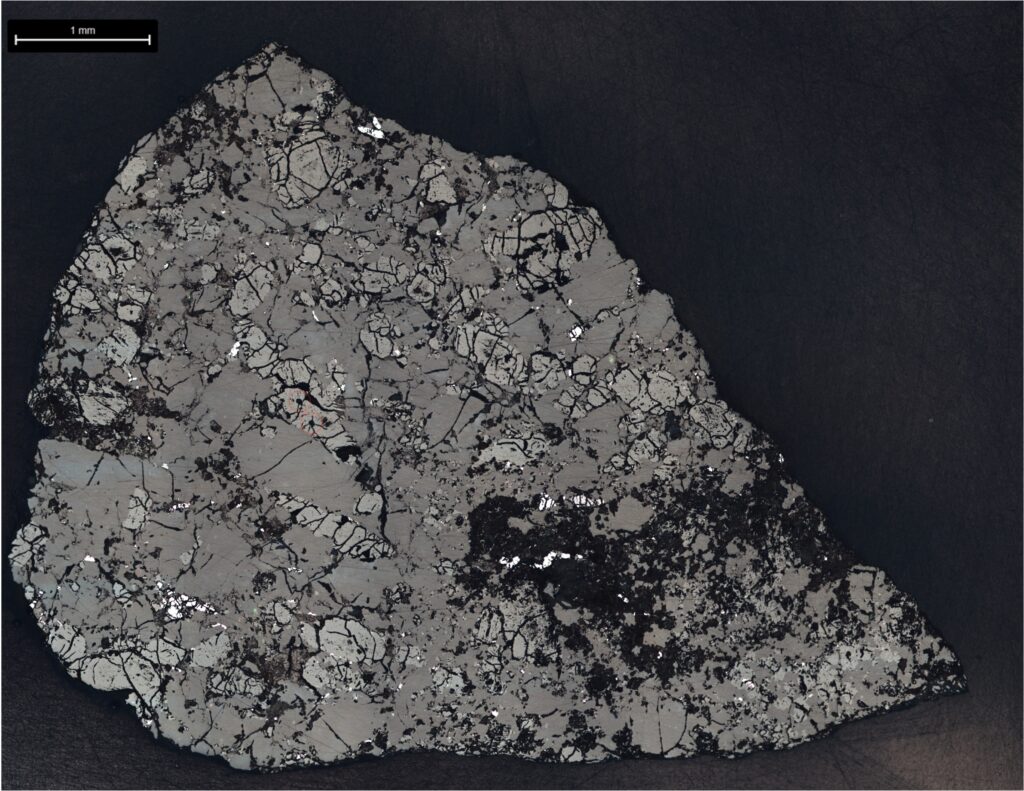
Every rock a rover examines on Mars stays on Mars. The instruments are clever, but they are not a full laboratory, and the planet’s oldest terrain has never been sampled directly. So geologists rely on accidents: chunks of crust blasted off Mars by impacts that eventually fall to Earth. A new study of one such Martian meteorite, a pinkish stone called Teghaza 001, shows it carries a piece of the planet that was already being reworked by water more than 4.1 billion years ago.
The rock, nearly 800 grams in total, was found in the Sahara in 2022 and takes its name from a salt plain in Mali. Researchers at the University of New Mexico confirmed it as Martian from its oxygen isotopes, the mix of lighter and heavier oxygen atoms that works as a planetary fingerprint. A team led by Yang Liu of NASA’s Jet Propulsion Laboratory (JPL) has now published an initial characterisation in Science on 29 October 2026, with colleagues at Caltech, UCLA, the University of Maine and New Mexico.
Dating a rock this rare is a problem in itself. Standard methods dissolve a sample completely. Instead, the team used an in-situ rubidium-strontium technique from Francois Tissot’s group at Caltech, which reads the slow decay of radioactive rubidium into strontium inside single mineral grains on a slice smaller than a fingernail. Nothing is consumed. According to JPL’s account of the work, the clocks show that water altered Teghaza 001 around 4.1 billion years ago, so the rock itself crystallised earlier still. It also contains zircon, a tough mineral that geologists prize for holding age information.
That puts its origin in the Pre-Noachian, the opening chapter of Martian history between roughly 4.5 and 4.1 billion years ago, when the planet may have been warmer and wetter. Few Martian meteorites reach that far back. Of the roughly 435 known pieces, most are only about 200 million years old. Teghaza 001 is one of the three oldest, alongside ALH84001, which is similar in age but made almost entirely of one mineral, and the volcanic jumble nicknamed Black Beauty. Teghaza 001 is different again: a mix of igneous minerals that records crust cooling from magma, later altered by water.
Working out where it came from is detective work. The team compared its mineralogy and chemistry with orbital observations and with surface data gathered from the Viking landers to the Curiosity and Perseverance rovers. They found 13 candidate source regions, several of them in the heavily cratered southern highlands, terrain old enough to fit. Lee Saper, who did the work as a postdoctoral scholar at JPL and is now at NASA Ames, describes it as the first sample from a part of Mars never sampled before. One of the paper’s reviewers, Liu recalls, called it “a Rosetta Stone for Mars”.
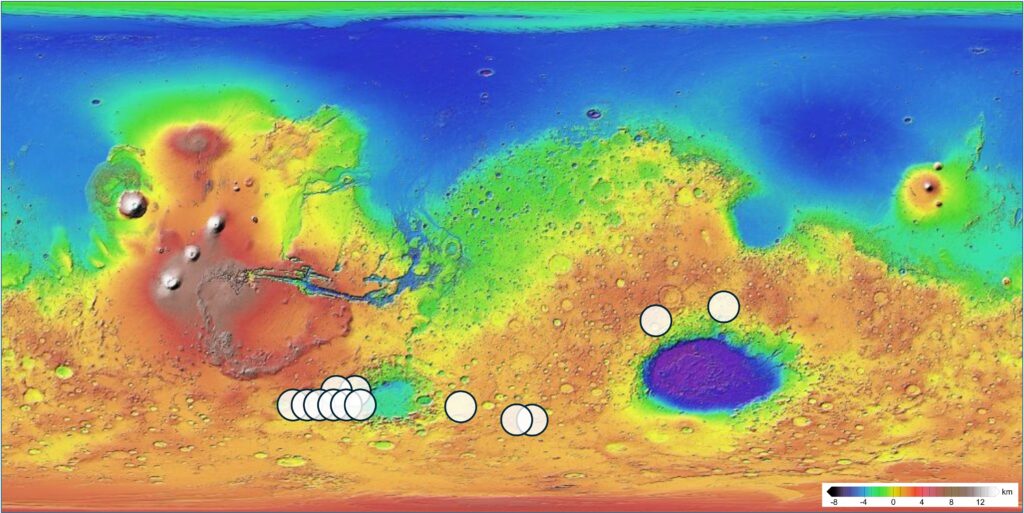
Water is where the rock becomes most useful. Its oxygen isotopes, texture and chemistry point to an active, changing water cycle on the young planet, and Saper suggests it may even hold an imprint of the atmosphere as Mars was losing its water. A separate paper in Science Advances in June examined its water content in detail. The New Mexico team also found patches rich in manganese oxide, a compound that rovers hunt for as a marker of environments that could have supported life.
The caveats are real. The team states them plainly. No one will ever know exactly where Teghaza 001 left Mars; 13 candidates is a shortlist, not an address. The 4.1 billion year figure dates the water alteration, so the formation age is a lower limit rather than a precise number. Manganese oxide speaks to past conditions, not to life. And this is a single rock, presented as a first description, with fuller studies still to come.
Beyond this one rock, the dating method may matter more. A technique that ages individual grains without using them up is exactly what samples returned from Mars, the Moon or asteroids will need, when every milligram has cost a mission. Tissot’s group is one of very few able to do it today.
For now, the oldest piece of Martian crust that geologists can hold did not arrive by rocket. It was thrown off by an impact, crossed the inner Solar System on its own, and lay in a desert until someone noticed it was pink.
