

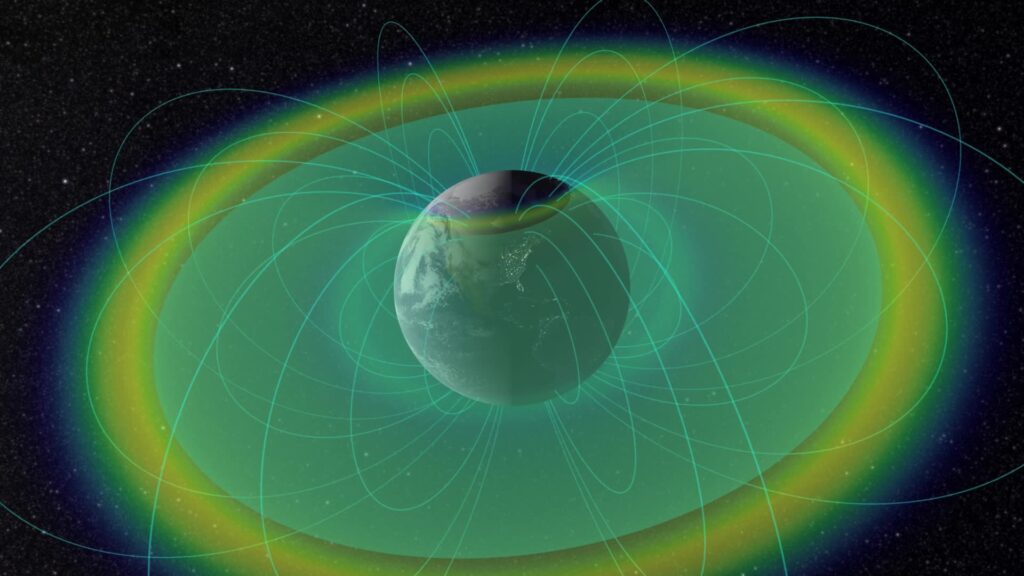
Earth’s radiation belts have an inner wall. Since 2014, space physicists have known that the most energetic electrons in the outer Van Allen belt stop abruptly about three Earth radii from the planet’s centre, as if they had run into glass. Inside that line, near-Earth space has been relatively sheltered. During the great solar storm of May 2024 the shelter failed, and a new study argues the cause was not an invasion from outside but electrons being pumped up on the spot, inside the impenetrable barrier itself.
The work, led by Yoshizumi Miyoshi of Nagoya University’s Institute for Space-Earth Environmental Research, was published in Geophysical Research Letters on 26 October 2026. It rests on data from Arase, a JAXA satellite whose orbit carries it through the belts close to the magnetic equator, and which kept recording through the storm of 10 to 11 May 2024. That storm pushed aurorae to mid-latitudes as far apart as Mexico, southern Europe and Japan. Arase found a large flux of ultra-relativistic electrons, moving close to the speed of light, in a region where there should have been almost none.
Why the barrier exists at all is still debated. NASA’s Van Allen Probes reported it in Nature, and one leading explanation is plasmaspheric hiss, a natural low-frequency radio emission in the magnetosphere. Human transmitters may help too: the very-low-frequency signals used to reach submarines can knock belt electrons down into the atmosphere. Either way, the boundary has held under ordinary conditions, which made the 2024 readings a puzzle with two possible answers.
Either the electrons had been shoved inwards from the outer belt, or they had been accelerated where Arase found them. To tell the two apart, the team tracked phase space density, a measure of how many electrons share a given energy and pattern of motion at each distance from Earth. Inward drift should produce a slope running downhill towards the planet. Instead, over successive orbits, a peak grew near three Earth radii, right at the old boundary. A local maximum that strengthens with time is the fingerprint of particles gaining energy in place. Some exceeded three megaelectronvolts, enough to pass through the shielding on some satellites.
The likely energy source is chorus, a natural electromagnetic wave that sweeps upward in frequency. “When converted into audio, it sounds like a bird song,” Miyoshi said. Chorus can hand energy to an electron when its oscillation keeps time with the electron’s spiral around a magnetic field line. Ordinarily the plasmasphere, a dense cloud of cool charged gas around Earth, fills this region, and the hot electrons that generate chorus stay farther out. In May 2024 the storm stripped it back hard: an earlier Arase study found its outer edge collapsed from about 44,000 km to 9,600 km above the surface within nine hours.
That emptiness also lingered. Plasma density near the barrier took about 4.3 to 4.7 days to climb back above half its pre-storm level, against a typical recovery of around two days. A negative ionospheric storm, in which the upper atmosphere’s supply of charged particles drops sharply, starved the plasmasphere of the material it needed to refill. That gave chorus several extra days to work on electrons normally out of its reach.
Satellite designers and space weather forecasters treat the zone inside the barrier as the calmer part of the belts, which is why the result matters. This study shows that, under extreme conditions, it can fill with electrons energetic enough to damage hardware, and that the threat can be manufactured locally rather than arriving as a visible surge from farther out. Miyoshi frames it as a reason to revisit radiation risk assessments for spacecraft and to sharpen space weather forecasts.
There are limits. The evidence comes from one storm, seen largely through one spacecraft. The authors describe the chorus link as consistent with local acceleration: waves and electrons appeared together, which is strong circumstantial evidence, not a measured transfer of energy. Storms as strong as May 2024 are rare, so the conditions that opened the region, a collapsed plasmasphere that stayed collapsed, may not recur often enough to test the idea quickly. Predicting when the barrier will give way also means forecasting both the erosion and its slow recovery, which Miyoshi says the field now needs to learn.
So the barrier looks less like a wall than a set of conditions. Keep the plasma thick and the hardest electrons stay outside. Strip it away for a few days and the radiation no longer needs to break in. It can be made on the premises.
