

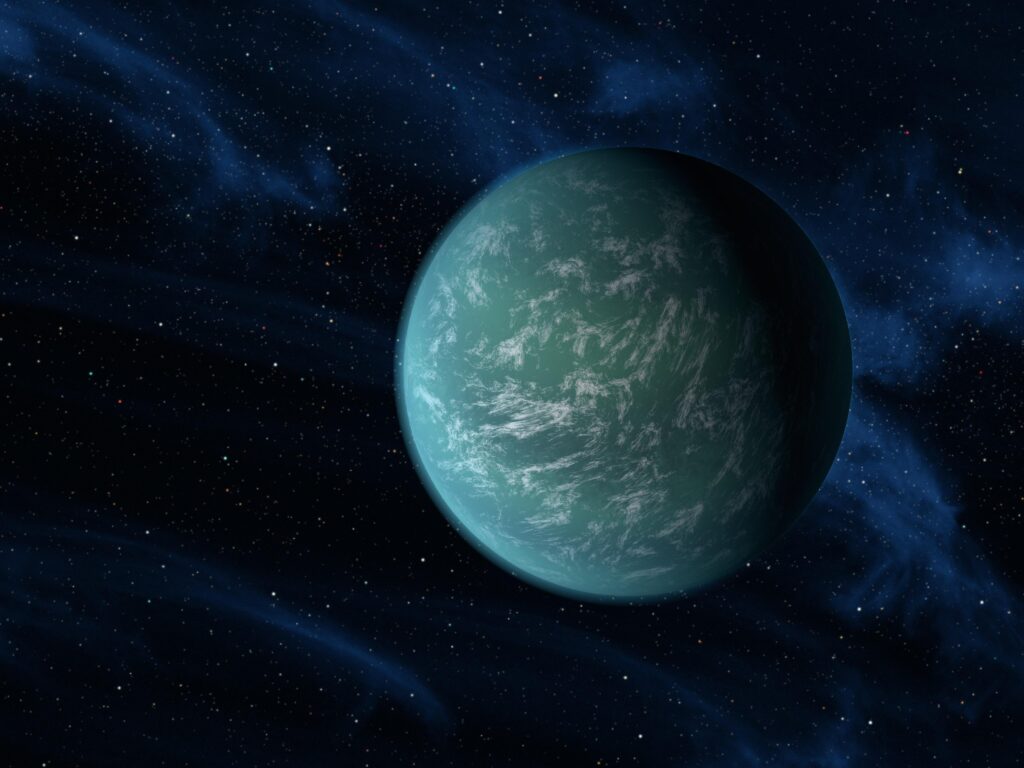
A young planet struck by another growing world might be expected to come away bruised and bare. The textbook picture holds that the heat of such giant impacts boils off the thin hydrogen envelope the planet gathered at birth. A new study argues that the opposite is often true: a late collision can help a planet keep its atmosphere, and that could explain why astronomers keep finding two distinct kinds of small planet around other stars.
The work, by Darius Modirrousta-Galian of Shanghai Jiao Tong University and Jun Korenaga of Yale University, was published in Nature Astronomy on 26 October 2026. It models the largest collision a rocky planet suffers after its protoplanetary disc, the ring of gas and dust around a newborn star, has cleared away. Korenaga describes such impacts as “a key part of how rocky planets grow”.
Bookkeeping settles it. A collision adds heat, but it also adds mass, and extra mass tightens the planet’s gravitational grip on its gas. The pair found that much of the impact energy never reaches the mantle as heat. Melting rock soaks some of it up as latent heat, while the impactor’s metal core sinks deep and stays hot, passing little energy to the rock above. Binding energy rises faster than mantle temperature. The atmosphere stays put.
That splits small planets onto two paths. According to the accepted manuscript, worlds that take a late giant impact hold their hydrogen and grow into sub-Neptunes roughly 1.75 to 3.5 times Earth’s radius. Smaller worlds that avoid such a collision are slowly stripped by their star’s light and end up as bare super-Earths of about one to 1.75 Earth radii. Surveys find both types in abundance, and why nature makes so many of each has long been an open question.
This is a model, not an observation. Nobody can watch an exoplanet’s collision history, and the study follows only the single largest impact after the disc disperses rather than every blow a planet takes. It does, however, make a testable prediction, set out in Yale’s announcement and the paper: on average, sub-Neptunes should have more massive rocky interiors than super-Earths. Careful mass measurements of many small planets will show whether that holds.
If it does, the thick hydrogen skies of sub-Neptunes are less a sign of a sheltered upbringing than the scar of a violent one.
