

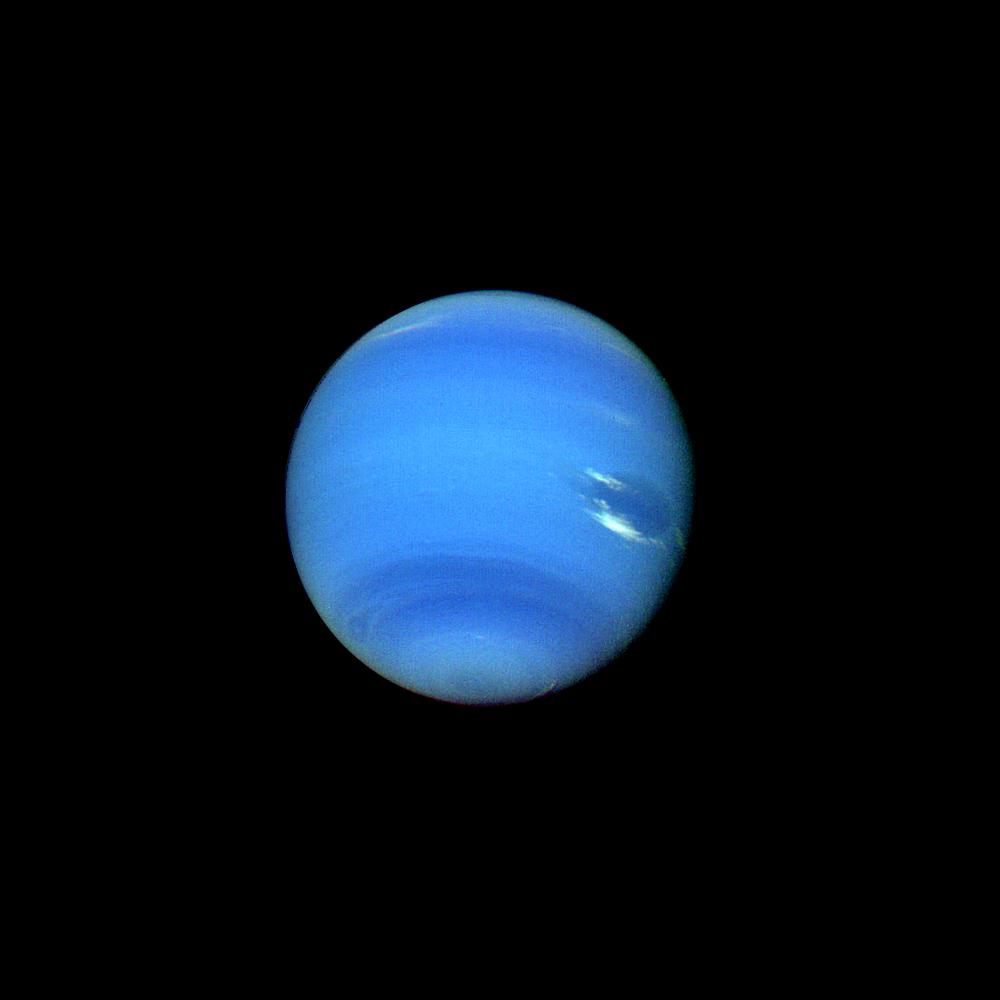
Neptune does not travel alone. Two clouds of icy bodies share its orbit, one running 60 degrees ahead of the planet and one 60 degrees behind, held in place by the combined pull of Neptune and the Sun. Astronomers know of about 32 of these Neptune Trojans, yet almost all of them sit in the leading cloud. Early data from the Vera C. Rubin Observatory has now doubled the known long-lived members of the trailing one.
The team, led by Megan Schwamb of Queen’s University Belfast, reports two confirmed trailing Trojans and a third candidate in a paper accepted by The Astrophysical Journal Letters. Queen’s announced the result on 28 October 2026, and Schwamb presented it at the Division for Planetary Sciences meeting of the American Astronomical Society the same week. The objects turned up in Rubin’s test observations from 2025, before its 10-year Legacy Survey of Space and Time (LSST) began earlier this year.
Why has the trailing cloud been so hard to find? For about 15 years it has sat, as seen from Earth, in front of the crowded plane of the Milky Way. Spotting a faint, slow-moving speck against a dense field of background stars is a test of patience. To confirm the new objects truly belong, the team simulated each best-fit orbit alongside slightly altered copies, known as clones, and checked that they stay locked in place over long periods.
What astronomers want is a fairer census. Jupiter has about 16,000 known Trojans, and researchers suspect Neptune’s could outnumber them by four to 10 times. Their numbers, orbits and surfaces preserve a record of how the giant planets migrated early in the Solar System’s history, so astronomers want to know whether the two clouds are mirror images. Colour measurements through Rubin’s filters suggest the trailing objects have surfaces much like those in the leading cloud: a first hint of symmetry.
Caution is still in order. The sample is tiny. Four objects cannot settle whether the clouds match in size or population, and the candidate needs further observations before it counts. Colours measured for a handful of faint, distant bodies also carry real uncertainty.
That should change quickly. Over the course of the LSST, Rubin is expected to find tens to hundreds of new Neptune Trojans across both clouds. After 15 years lost in the Milky Way’s glare, Neptune’s quieter companions are about to get a proper headcount.
