

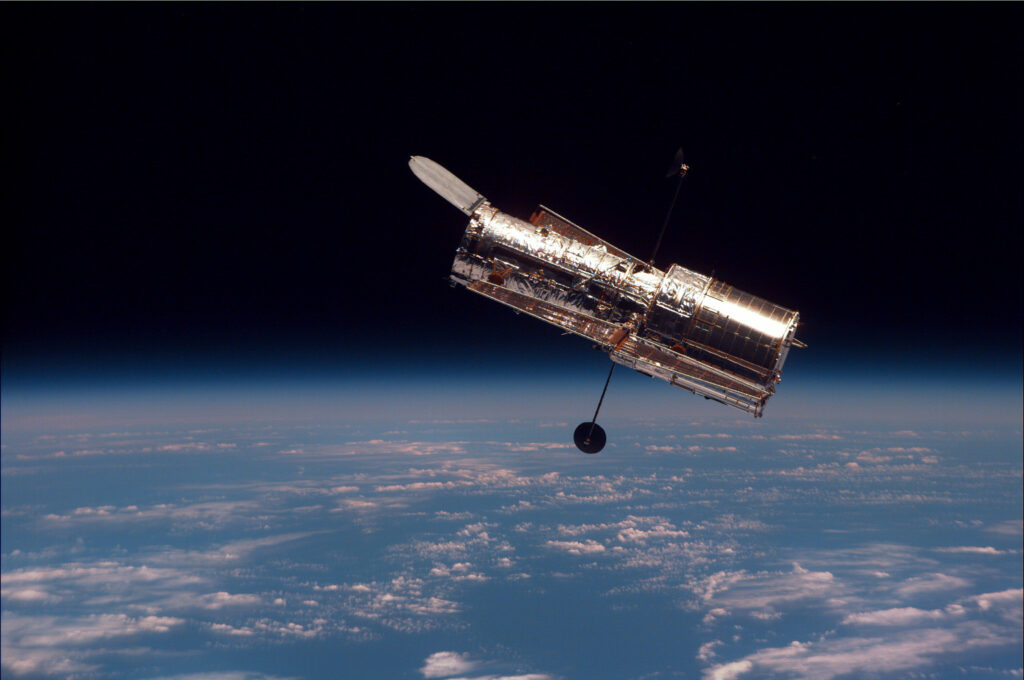
A telescope with no engine has a lifespan set by the air around it. Even hundreds of kilometres up, faint traces of atmosphere drag on the Hubble Space Telescope, and NASA now expects it to fall back to Earth in 2033 or 2034. On 29 October 2026 the agency asked industry whether that date can be moved, with a formal request for ideas on commercial Hubble servicing.
The request, announced by NASA on 30 October, covers three possible jobs: lifting Hubble into a higher orbit, servicing it to improve its capabilities, or guiding it to a controlled re-entry when its work is done. Companies have until 30 November to respond. NASA estimates that any rescue would need to fly by 2032, which leaves only a few years for design, testing and launch. “Hubble still has important science ahead of it,” said NASA Administrator Jared Isaacman.
Some of the groundwork was laid long ago. Astronauts visited Hubble five times by Space Shuttle, and the last crew, in May 2009, fitted a Soft Capture Mechanism to its rear so that a future robotic craft could latch on. Private interest is not new either. In 2022 NASA signed an unfunded agreement with SpaceX and the Polaris Program, the private spaceflight effort Isaacman led before he ran the agency, for a study of up to six months into using a Dragon capsule to raise the orbit. No mission followed.
The timing is pointed. Six days before the request, NASA ended the science mission of the Swift Observatory, another telescope without propulsion, after it sank to 275 kilometres and could no longer point steadily. A commercial craft called LINK had been sent to lift it, but an attitude control problem meant it could not capture or boost Swift. Hubble, observing for more than 35 years, is a far bigger prize.
It is also a far harder target. A request for information is a survey, not a contract, and it carries no promise of money. Any servicer would have to approach a working observatory with delicate optics, attach without setting it tumbling and then push it gently upwards. The Swift attempt shows how quickly such plans can unravel.
The 2009 crew left a handle on the back of the telescope for exactly this moment. Whether anyone grabs it before 2032 is now a question of engineering, money and how hard the Sun pushes up the atmosphere in the meantime.
