

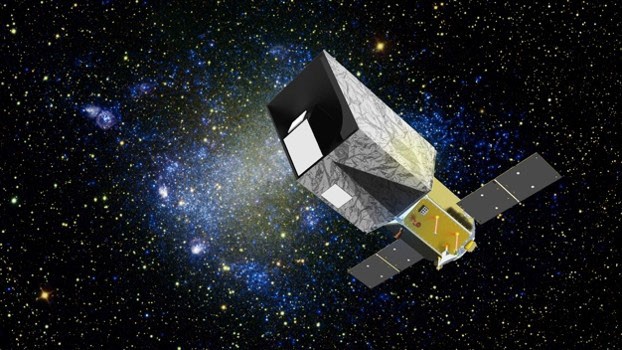
For more than a decade, astronomers have had no dedicated wide-field eye on the ultraviolet sky. Earth’s atmosphere blocks this light, so it can only be surveyed from orbit, and NASA’s last telescope built for the job, the Galaxy Evolution Explorer (GALEX), was switched off on 28 June 2013. That gap now has an end date. On 27 October, NASA confirmed the UVEX space telescope (UltraViolet EXplorer) and committed to launching it by January 2031.
Confirmation followed Key Decision Point C, the combined technical and programmatic review that clears a mission to move from design into building flight hardware. NASA’s announcement puts the total lifecycle cost at $590 million. Fiona Harrison of Caltech leads the mission, with the University of California, Berkeley, NASA’s Jet Propulsion Laboratory, Northrop Grumman and the Space Dynamics Laboratory as partners.
The design is simple to describe. Two co-aligned wide-field imagers, one for far-ultraviolet and one for near-ultraviolet light, sit alongside a broadband spectrometer. Over a two-year baseline mission, UVEX will sweep the whole sky repeatedly, reaching 50 to 100 times deeper than GALEX, according to the team’s mission paper. Its targets include small, metal-poor galaxies nearby that resemble the earliest galaxies, and the hot young stars of the Magellanic Clouds.
Speed may matter most. When two neutron stars merge, the expelled debris glows briefly in ultraviolet light before cooling. After the gravitational wave event GW170817 in 2017, Swift’s ultraviolet telescope caught that glow and watched it dim by more than 2.5 magnitudes, roughly a factor of ten, in under a day. Swift made its final observation on 20 October 2026. UVEX is built to swing towards such sources fast, covering part of what Swift leaves behind, though not its gamma-ray burst hunting.
Schedules are the catch. When NASA picked the proposal for further study in 2022, the target launch was 2028; the 2024 selection moved that to 2030, and the commitment now reads January 2031. Cost comparisons are murkier. The 2024 selection cited about $300 million excluding launch, while the new $590 million covers the full lifecycle, so the two figures are not like for like.
For now, the ultraviolet sky remains largely as GALEX left it: a map more than a decade old. By the early 2030s it should become something closer to a film, refreshed again and again, and ready for the next neutron star collision while its light is still blue.
