

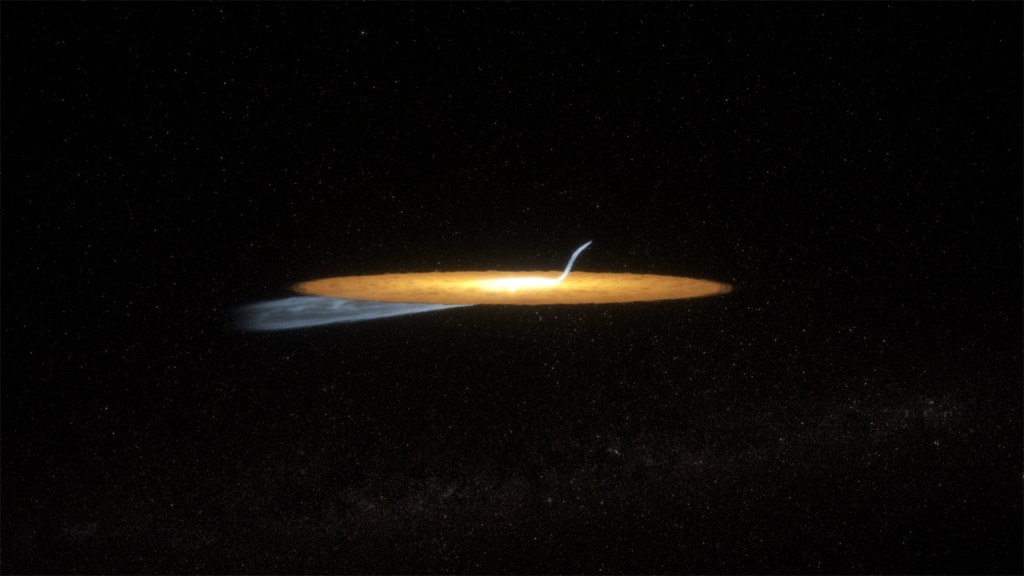
Planets are assembled by collision, and the smashing does not stop once the planets are built. Around the young star Beta Pictoris, 63 light-years away, a curl of dust nicknamed the Cat’s Tail looks like the wreckage of exactly such a crash. New Hubble Space Telescope images have now caught that dust in visible light for the first time, and its near-black colour points to a collision between two bodies at least as large as Pluto’s moon Charon.
The work, led by Arin Avsar, a doctoral student at the University of Arizona, appears in The Astrophysical Journal Letters. The feature itself turned up in 2024, when the James Webb Space Telescope (JWST) picked out a thin branch of warm dust peeling away from the system’s debris disc, the belt of rubble left over from planet building. According to the University of Arizona, the structure stretches roughly 1,000 astronomical units, where one astronomical unit is the distance from Earth to the Sun. Until now only Webb had ever seen it, which was odd for something so large.
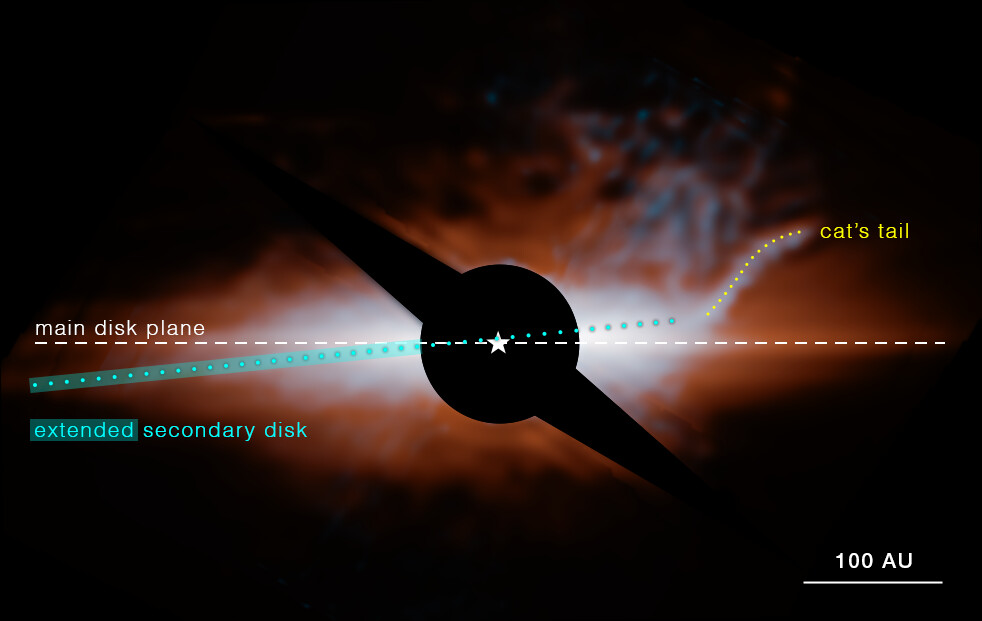
To find it, the team combined six sets of observations from Hubble’s STIS instrument, a spectrograph fitted with a coronagraph that blocks the star’s glare, taken between 2012 and 2025. Stacked together, the data trace the disc out to about 500 astronomical units and show the tail as a faint smear. In visible light it is between 200 and 1,000 times dimmer than in Webb’s mid-infrared images. That imbalance is the clue. Dust that glows warmly in the infrared while reflecting almost nothing must be swallowing most of the starlight that reaches it.
Modelling the grains suggests they are around a micron across, extremely porous and made almost entirely of organic refractory material, tough carbon-rich compounds that survive heating. The best fits put organics at about 96 per cent of the solids, with silicate rock a minor ingredient. Avsar’s own summary is blunt: “These long chains of carbon atoms absorb visible light, so they’re quite black.” Co-author Kevin Wagner has suggested that the impact vaporised carbon, which then recondensed into fluffy grains as it cooled, though the team says the exact process remains unclear.
Working out the size of the culprits is a matter of bookkeeping. The 2024 Webb study estimated that the tail holds about 2 × 10¹⁹ kilograms of organic debris. If the colliding bodies were between 14 and 38 per cent organic by mass, a range drawn from the dwarf planet Haumea, comet 67P and interstellar dust, each must have weighed at least 1 to 3 × 10²¹ kilograms. That implies a radius of roughly 600 to 800 kilometres, comparable to Charon or the dwarf planet Makemake. The authors treat these figures as lower limits.
Hubble also found that the outer halo of fine dust is warped, bulging above the disc on one side and below it on the other. The authors link that twist to the gravitational tug of Beta Pictoris b, a giant planet about 10 times the mass of Jupiter. What emerges is a young system in which large bodies still collide and giant planets still sculpt the leftovers. Our own Solar System probably went through a similar phase: the Kuiper Belt beyond Neptune was once far more crowded, and the outer giant planets are thought to have cleared much of it.
None of this is settled yet. The tail stands only between five and 10 times above the background noise, and its ragged tip means the Hubble outline does not perfectly match Webb’s. Its geometry is uncertain too, since the modelling cannot say for sure whether the streak lies across the plane of the sky or swings behind the star. Nobody has found where the rockier share of the debris went; one proposal is that starlight pressure sorted the grains by type. Linking the warp to Beta Pictoris b will also need dedicated simulations before it counts as more than suggestive.
Even with those caveats, the timing is what lingers. The Webb team’s preferred model puts the collision only a century or two in the past. On astronomical timescales that is barely yesterday afternoon, and astronomers are looking at the smoke still drifting from the wreck.
