

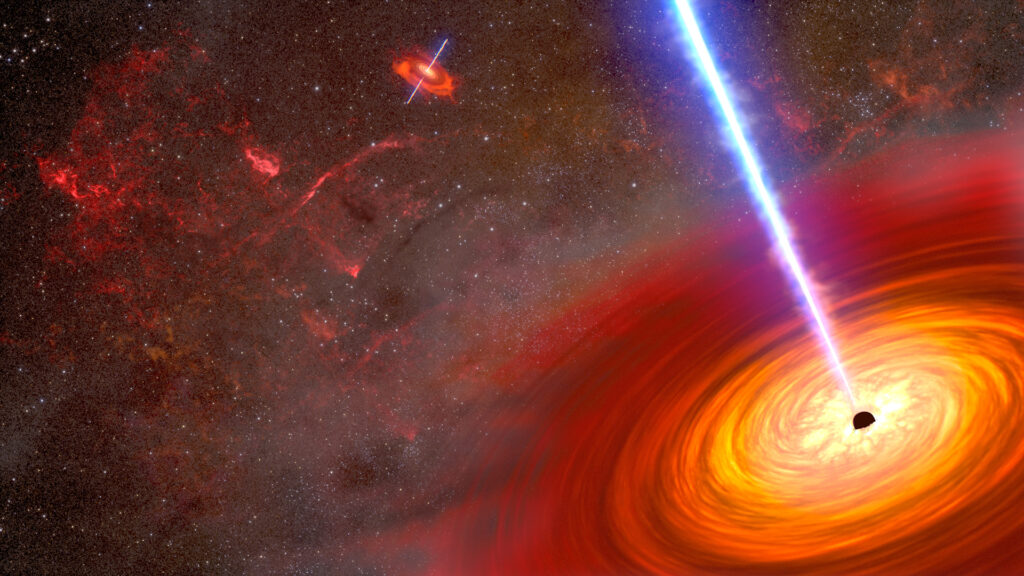
When galaxies collide, their central black holes should eventually meet too. Close pairs have been confirmed nearby, but in the young universe, where mergers were far more frequent, they have stayed stubbornly out of sight. A team using the James Webb Space Telescope (JWST) and the Atacama Large Millimeter/submillimeter Array (ALMA) has now resolved one system of dual black holes, both feeding, about 1.5 kiloparsecs (roughly 4,900 light-years) apart. The light left them around 1.3 billion years after the Big Bang.
The system, called LID-1166, is described in a paper published in Nature Astronomy on 30 October 2026, led by Hyewon Suh of the International Gemini Observatory and NSF NOIRLab; a preprint circulated in July. It sits at a redshift of about 4.5, a measure of how far its light has been stretched by cosmic expansion. Until now, confirmed dual active galactic nuclei (pairs of black holes that are swallowing gas and shining) closer than 3 kiloparsecs had only turned up nearby.
The two nuclei are just 0.23 arcseconds apart, so the fainter companion only emerged after the team modelled and removed the glare of its brighter neighbour. Webb’s NIRSpec spectrograph showed broad hydrogen alpha emission at both positions. Broad lines are the signature of gas whirling fast around a black hole. The narrow lines from the two nuclei differ in velocity by about 164 km/s, and ALMA’s maps of ionised carbon, a tracer of cold gas, show two matching clouds.
This bears on an old puzzle: how black holes and their galaxies came to grow in step. According to the paper, both black holes were growing faster than the Eddington limit, the rate at which radiation pressure should balance gravity. Yet the system already sits on the relation between black hole mass and host mass seen in massive elliptical galaxies today. The authors suggest that rapid, dust-shrouded growth during mergers may set that relation early, and call LID-1166 “a previously hidden phase” of black hole growth.
The catch starts with sample size: this is one system, and the case for the companion rests on a faint signal teased out from beside a much brighter one. Black hole masses at this distance are estimated indirectly from spectral line widths, and the growth rates depend on modelling how much of the X-ray light is blocked by gas and dust.
If many more pairs hide behind dust, as the team argues, surveys of the early universe may be undercounting them. Pairs like this are the ancestors of the black hole binaries whose low-frequency gravitational waves future observatories hope to detect. The two in LID-1166 are still 4,900 light-years apart, and both are eating well.
