

Only one spacecraft has ever landed on a world in the outer Solar System: ESA’s Huygens probe, which set down on Saturn’s moon Titan on 14 January 2005. China now intends to make it two. On 13 November 2026 the China National Space Administration (CNSA) issued a call for scientific instruments for Tianwen-4, its Jupiter mission, and the notice lists a Callisto lander among the hardware.
The announcement states the goals plainly: orbit Jupiter, then orbit and land on Callisto. The orbiter is planned to carry 10 instruments, ranging from a soft X-ray spectrometer and a far-ultraviolet imager to a laser altimeter and a gamma-ray spectrometer for studying Callisto itself. The lander gets two: a surface composition analyser and a magnetometer. Research groups outside mainland China may join Chinese-led proposals or lead their own, in principle paying for their own work, and every bid is due by 31 December 2026.
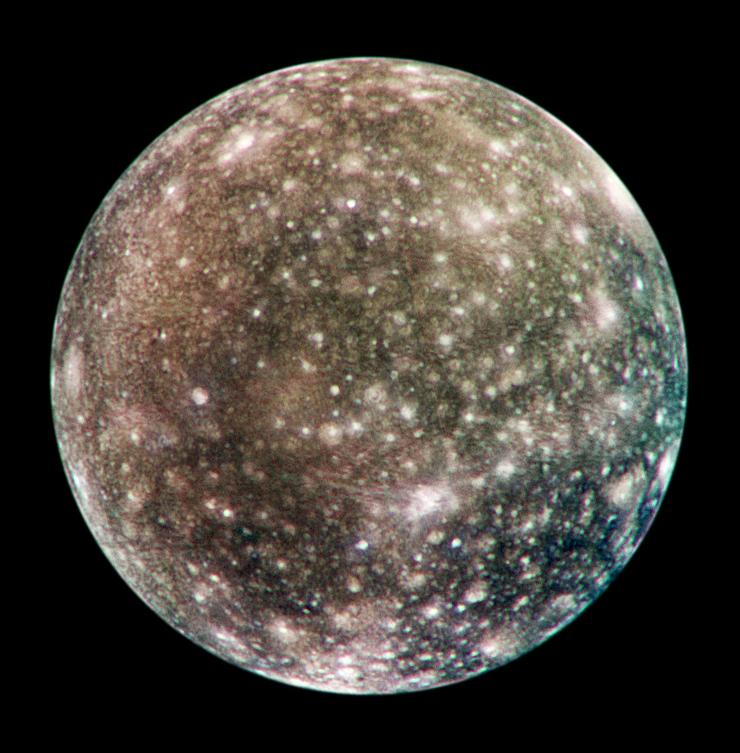
Callisto looks like an odd target only at first glance. It is Jupiter’s second largest moon and almost as big as Mercury, with a surface that NASA describes as the most heavily cratered in the Solar System, about four billion years old. It orbits roughly 1.9 million kilometres from Jupiter, some 4.5 times farther out than Io. There are no active volcanoes and no shifting crust. For a lander, a world where nothing has happened for aeons is a gift.
The two instruments go after the moon’s biggest open question. Data from NASA’s Galileo spacecraft in the 1990s hinted at a salty ocean perhaps 250 kilometres beneath the ice, possibly in contact with rock. A magnetometer on the surface would measure the moon’s magnetic environment from a fixed point, the kind of record that helps show whether a buried, electrically conducting ocean is really there. The composition analyser can then examine up close the bright icy patches and the darker, ice-poor material that Galileo could only see from orbit.
None of this is imminent. The notice gives no launch date and says the selection timetable will be announced separately, and a call for instruments is a statement of intent rather than flight hardware. NASA also notes that more recent work suggests any ocean may lie deeper than first thought, or may not exist at all. And with only a wisp of an exosphere above the ground, there is no air to brake against; the engines must do all the work.
Galileo Galilei first spotted Callisto on 7 January 1610. More than four centuries later, the plan is a small machine on its ancient ice, listening for an ocean that may or may not be there.
