

Astronomers use Type Ia supernovae as cosmic yardsticks, yet they still cannot say how long a white dwarf waits before it blows itself apart. The answer might be billions of years, or barely longer than the life of the star that made it. A nearby supernova discovered at the start of November, SN 2026ahvu, has landed in exactly the right place to test that question. It is also still brightening.
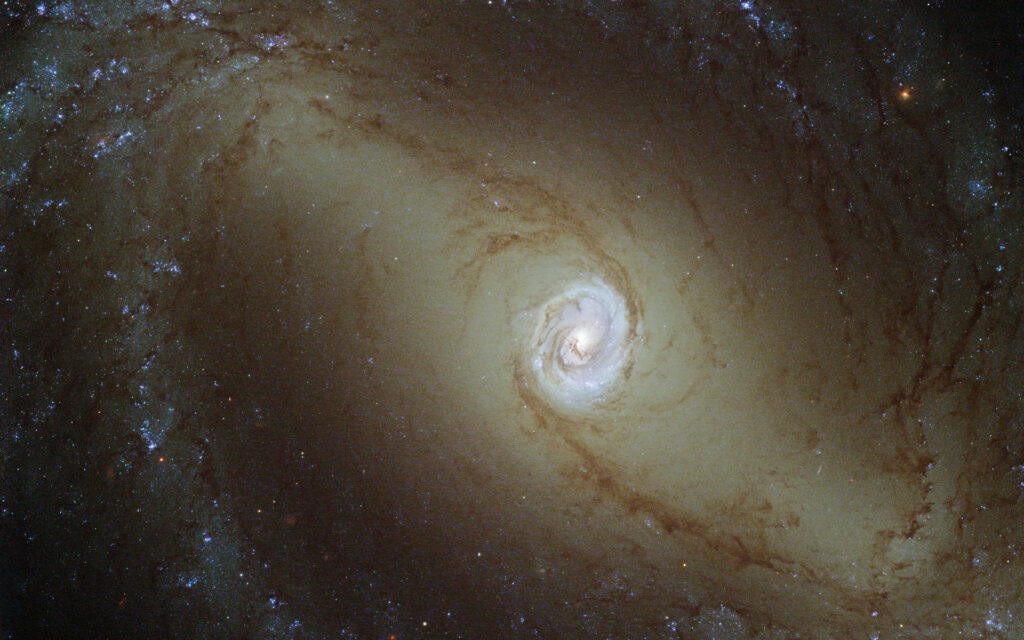
The Asteroid Terrestrial-impact Last Alert System (ATLAS) caught the explosion on 2 November 2026 in NGC 1433, a barred spiral galaxy in the southern constellation Horologium. A spectrum taken the following day with the DEIMOS instrument on the Keck II telescope confirmed a young Type Ia, the thermonuclear detonation of a white dwarf in a binary system. On 12 November, NSF NOIRLab released new images from the Dark Energy Camera and Gemini South, and began coordinating follow-up across several of its telescopes. The supernova should peak between 18 and 23 November at magnitude 10.5 to 12.1, within reach of modest amateur telescopes under southern skies.
More surprising work happened in the archives. A team led by Sumit Sarbadhicary of Johns Hopkins University went back to archival Hubble and James Webb Space Telescope (JWST) images from the PHANGS survey of nearby galaxies. The supernova, they found, sits between two compact star clusters, 0.19 and 0.26 arcseconds away. Their analysis, posted as a preprint on 6 November and not yet peer reviewed, puts the chance of a random alignment that close at roughly 0.4 per cent. Both clusters glow brightly in ultraviolet light, a mark of youth. Fitting their light from the ultraviolet to the near-infrared gives ages of about 37 million years for one and 95 million years for the other.
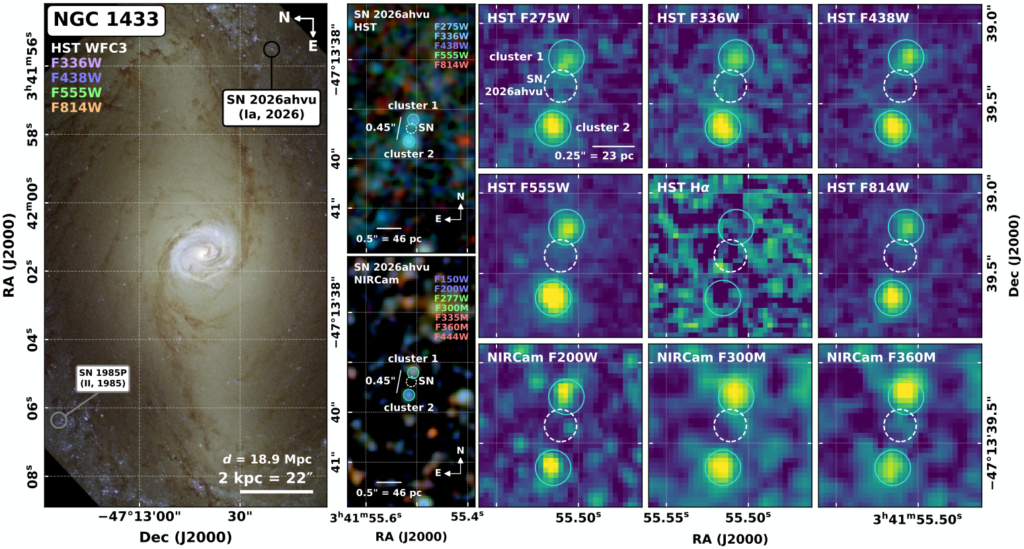
Those ages matter because Type Ia supernovae are thought to come in two broad populations. One appears to be slow burning, exploding up to several billion years after its stars formed, as pairs of white dwarfs gradually spiral together. A second, prompt population explodes within a few hundred million years, but it has only ever been inferred statistically, from supernova rates averaged over whole galaxies. The authors say no individual Type Ia had previously been tied to a young cluster of known age. The only earlier cluster link, SN 2019ein, sat near what looks like an ancient globular cluster, which points the other way.
The younger cluster is the more startling candidate. White dwarfs come from stars of less than about eight times the mass of the Sun, and the shortest lived of those stars burn out in roughly 40 million years. A birthplace only 37 million years old would mean the white dwarf exploded almost as soon as it existed, right against the theoretical floor. The older cluster is the safer bet. It is two to four times more massive, and a close encounter near its core could have kicked a binary a short distance away. Even then, a delay under 100 million years would be the first prompt Type Ia measured against a dated cluster.
Getting this right reaches well beyond one galaxy. Type Ia supernovae are the standard candles behind measurements of cosmic expansion, and they forge much of the iron in the Universe. Both roles depend on knowing which kinds of binary systems produce them, and how quickly. A clean example of the prompt channel gives theorists a fixed point where they have had only averages.
There are real caveats. ATLAS has not yet published a formal uncertainty on the supernova position, which matters when the gap to each cluster is a fraction of an arcsecond. The younger cluster has little mass, which makes its age less certain, and the supernova lies about five times its half-light radius from its centre. Counting proximity to any patch of ultraviolet light, rather than to catalogued clusters, raises the odds of coincidence to roughly 4.6 per cent. Even the distance to the galaxy is disputed: one method puts NGC 1433 at 9.1 megaparsecs (about 30 million light-years), another at 18.9 megaparsecs (about 62 million light-years).
That last problem may solve itself within days. Type Ia supernovae reach a peak brightness that can be calibrated with care, which is why cosmologists lean on them, and the authors expect the coming peak to settle the distance quickly. A single explosion may end up measuring how far away it is and how long its white dwarf waited before going off. Not bad for light that set out tens of millions of years ago.
