

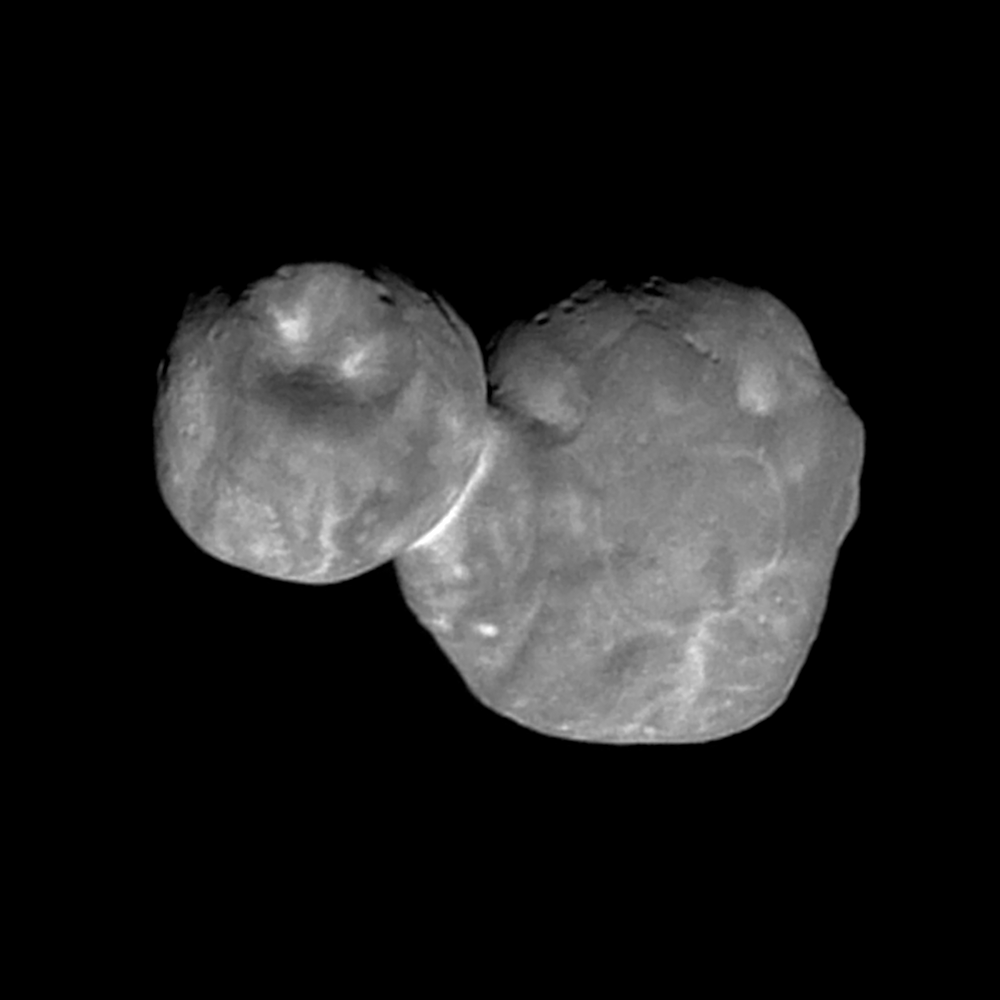
Most of the water in the young Solar System has been rewritten many times over: melted, mixed and traded with rock and gas until its original chemistry is hard to read. The icy bodies beyond Neptune should hold the least disturbed record, but no spacecraft has brought any of it home. A new study argues that we have been collecting it anyway, one speck at a time. Twelve grains of Kuiper belt dust, caught high above Earth, carry the oxygen signature of a primordial water reservoir that seems to have stayed sealed off from the inner Solar System since the planets formed.
The work, led by Lindsay Keller of NASA’s Johnson Space Center with colleagues there and at the University of California, Los Angeles (UCLA), was published in Science Advances on 11 November 2026. The team examined 12 hydrated interplanetary dust particles, each 10 to 30 micrometres across, drawn from NASA’s cosmic dust collection. Hydrated means the grains are built largely from minerals that only form when liquid water reacts with rock. The dust was gathered in Earth’s stratosphere, so every grain has crossed most of the Solar System to get there.
Proving where a grain came from is the first trick. Energetic particles thrown out by the Sun punch microscopic damage trails through crystals, and the longer a grain drifts, the more trails it collects. These grains carry between 50 billion and 200 billion tracks per square centimetre, roughly 100 times more than dust from the asteroid belt or from Jupiter-family comets would gather on the way in. That long exposure points to a source beyond the giant planets, and the Kuiper belt is the biggest dust factory out there. The grains are also rich in carbon, about four times the level in CI chondrites, the most primitive meteorites in the collections.
Inside, the grains are mostly saponite, a layered clay, with a little serpentine and small crystals of magnesium and iron carbonate. Those minerals record a time when ice inside a parent body melted and soaked into the surrounding dust at low temperature. The water itself is long gone. Its oxygen is not.
Oxygen comes in three stable forms: oxygen-16, oxygen-17 and oxygen-18. Ice that formed far from the young Sun is expected to be enriched in the two heavier ones, because ultraviolet light breaking apart carbon monoxide gas leaves heavy oxygen free to end up in water. (Heavy here refers to oxygen, not the deuterium-rich heavy water of nuclear reactors.) The team measured the grains with an ion microprobe at UCLA, then worked backwards through the reactions that built the clays to estimate the original water. Its excess of oxygen-17, a quantity written as Δ17O, averages about +62 parts per thousand. Water inferred from carbonaceous chondrite meteorites sits at roughly +3 to +7.
In the grains themselves the signature is diluted, since only one oxygen atom in eight in the main clay-forming reaction comes from water. Meteorites tell a different story because their parent bodies formed closer in, where the authors argue the water kept exchanging oxygen with surrounding gas and dust until its heavy signature was largely worn away. As for why the outer reservoir stayed apart, simulations predict that Saturn raised a pressure bump in the disc of gas around the young Sun within its first few million years, slowing or stopping icy material drifting inward, so Saturn, perhaps helped by the ice giants, may have acted as a gate. The journal’s summary calls the result evidence for a long suspected but hard to prove reservoir.
The catch is the sample size and the arithmetic. Twelve grains is a small number from which to describe a reservoir spanning billions of kilometres. The water values come from a mass balance that assumes a single main reaction and leaves out water held between the clay layers, so the authors treat them as upper limits. The case for a Kuiper belt origin also rests on track counts rather than on any orbit traced back to a source, a limitation the full paper states plainly. Only material collected at the source could test the idea directly.
Until then, the evidence keeps arriving on its own. The authors cite estimates that up to a quarter of the interplanetary dust reaching the inner Solar System may come from the Kuiper belt. Some of it already sits in sample drawers in Houston, scarred by the Sun and still carrying the oxygen of water that melted, briefly, in the dark beyond Neptune.
