

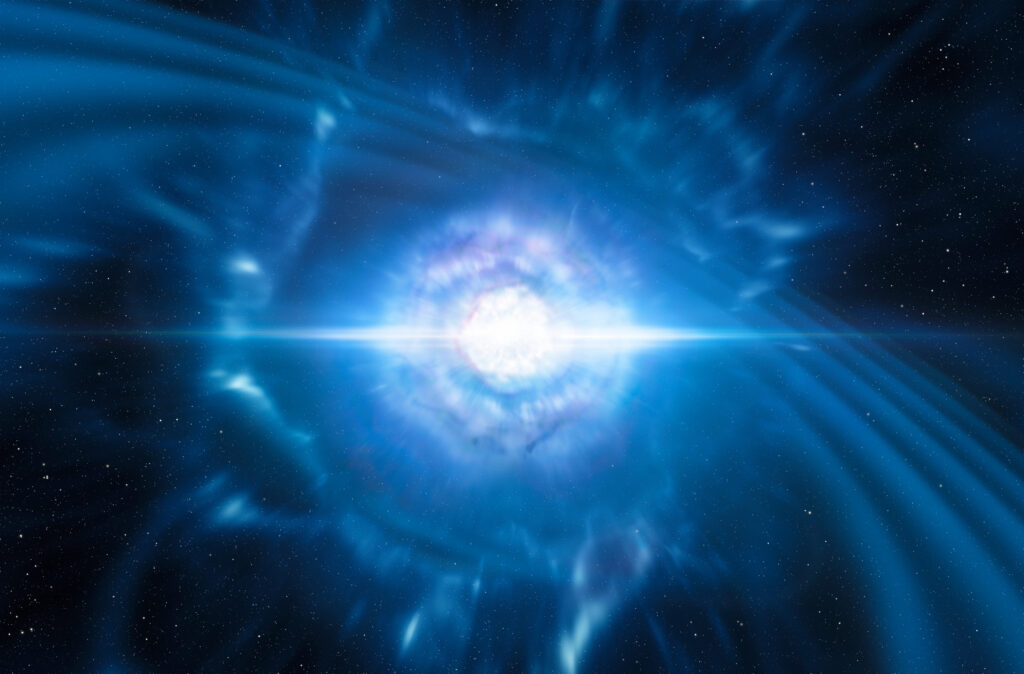
Neutron stars pack more than a Sun’s worth of matter into a ball the width of a city. Physicists badly want to know how much mass one can carry before it collapses into a black hole, because that ceiling records how matter behaves at densities no laboratory can reach. A team led from China now reports a likely supermassive neutron star sitting close to that limit, found not by its own light but by the slow sway of a red giant it orbits.
Catalogued as J0008+0128, the system lies about 4,800 light years away. Xinlin Zhao of Chongqing University, Song Wang and Jifeng Liu of the National Astronomical Observatories of the Chinese Academy of Sciences and their colleagues describe it in Science Advances, published online on 11 November 2026, with an open preprint on arXiv. The visible star is a red giant more than five times wider than the Sun and roughly 1.7 times its mass. Its partner gives off no detectable light at all.
The team tracked the giant’s motion along our line of sight using 16 infrared spectra from the Apache Point Observatory Galactic Evolution Experiment (APOGEE), nine optical spectra from China’s Large Sky Area Multi-Object Fiber Spectroscopic Telescope (LAMOST) and two observations with the Nordic Optical Telescope. The star swings towards and away from us at up to about 17 kilometres per second, completing a lap every 1,218 days on a nearly circular orbit. That wobble alone sets a minimum mass for the hidden companion of 1.7 to 2.5 solar masses, depending on which estimate of the giant’s own mass is used.
Velocities alone cannot reveal the tilt of the orbit, so the researchers turned to the European Space Agency’s Gaia mission, which charts stellar positions with exquisite precision. Gaia’s second and third data releases treated the star as single, so its small orbital wobble leaked into the catalogued positions, parallaxes and proper motions. By modelling how the orbit would distort those values, the team pinned the inclination at about 73 degrees. The result is a companion of 1.8 to 2.8 solar masses, with a best estimate of 2.2.
A star of that mass would be hard to hide. A normal main sequence star weighing 1.8 to 2.8 Suns would shine at 11 to 81 times the Sun’s luminosity, against the giant’s 16, and would leave obvious fingerprints in the combined light. Spectral disentangling, a technique that separates the overlapping spectra of two stars, found no second set of absorption lines. A pair of white dwarfs is possible in principle, but it would need an improbably narrow range of temperatures to fit both the ultraviolet limits and the system’s age of roughly two and a half billion years. What remains is a compact object, most likely a neutron star.
Where 2.2 solar masses sits is the interesting part. Theory and earlier measurements suggest a slowly rotating neutron star cannot exceed roughly 2.15 to 2.3 solar masses, while the lightest known black holes weigh around five. The closest comparison is a companion of 2.09 to 2.71 solar masses orbiting the pulsar PSR J0514-4002E, reported in Science in 2024. J0008+0128 offers a quiet example in our own galaxy that astronomers can keep watching.
Stranger still is the orbit. The two objects are about 3.4 astronomical units apart, and the giant fills only about 2 per cent of its Roche lobe, the region within which it holds on to its own gas. Heavy neutron stars in tight binaries usually bulk up by stripping a partner; this one could not have. When the team searched about 300,000 simulated binaries from the POSYDON population synthesis code, none passed through a configuration like this. A conventional history would need a very gentle supernova kick, below about 20 kilometres per second, and an unusually efficient escape from an earlier phase in which both stars shared one envelope of gas.
A second route runs through a triple system. The giant may once have been the outer member of a trio whose inner pair later merged, either two neutron stars or a neutron star and a white dwarf. Such a merger adds mass without delivering a large kick, which suits the low eccentricity. The inferred mass is comparable to the remnant left by GW170817, the neutron star collision detected in 2017, which is estimated at no more than about 2.3 solar masses.
The catch is one the paper states openly. The mass range is wide, and its upper end approaches three solar masses, where a low mass black hole becomes just as plausible. The giant’s own mass, on which everything depends, varies between survey pipelines. The companion is silent too: the Einstein Probe saw no X-rays, and the Five-hundred-meter Aperture Spherical radio Telescope (FAST) detected no pulses. The team cannot yet exclude that the dark object is itself a tight pair of compact objects circling each other in less than about 20 to 30 days.
Help arrives soon. Gaia’s fourth data release, due on 2 December 2026, will publish the time series of individual measurements behind the catalogue averages. For J0008+0128, that means watching the giant trace its orbit directly rather than inferring it from averages. If the mass holds near 2.2 Suns, a red giant 4,800 light years away will have weighed one of the densest objects nature allows short of an event horizon.
