

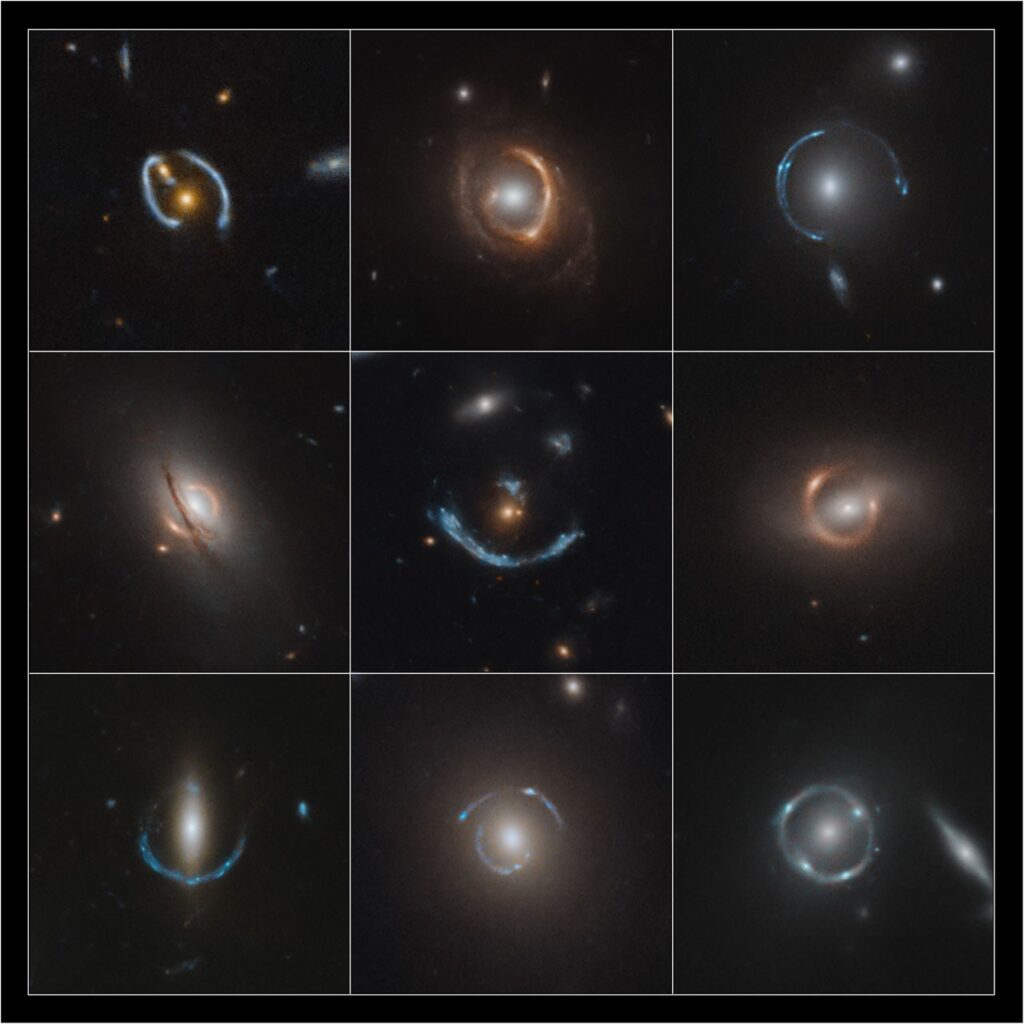
Dark matter cannot be seen, but it can be weighed, and the best scales in the universe are galaxies that bend light. On 12 November 2026 NASA released a gallery of nine gravitational lenses photographed by the Hubble Space Telescope, a starting set for a much larger hunt by the new Nancy Grace Roman Space Telescope. The prize is a test of what dark matter is made of.
A gravitational lens forms when a massive foreground galaxy sits almost exactly in front of a more distant one. Its gravity bends and magnifies the background light into arcs. The variety here is striking. One panel shows a near complete Einstein ring, another a single background galaxy copied four times, and a third a foreground galaxy cut by a dust lane, which is rare in a lens. Most of the lensing galaxies are old, compact ellipticals, though two appear to carry spiral arms.
These targets were found by software. A neural network combed the DESI Legacy Imaging Surveys and flagged about 3,500 lens candidates; Hubble then took short snapshot exposures of 51 of them and confirmed every one as a genuine lens.
Cold dark matter, the standard model, predicts that galaxies should be peppered with small dark clumps of one million to one billion solar masses. For scale, the dark halo of the Milky Way is about 1.3 trillion. Clumps that small hold no stars, so they show up only through gravity, as tiny kinks in a lensed arc. Find them in the expected numbers and the model passes another test. Fail to, and it has a problem. Hubble supplies the sharpness. Roman, launched in August, sees mainly infrared light across a far wider field, so it should collect lenses in bulk, and the team plans to train search software on the Hubble arcs before turning it loose on Roman images.
No clump has been detected in these images yet. Each measurement depends on a precise model of the lensing mass and on distances to both galaxies, and for roughly a third of the systems the background galaxy is too distant for DESI spectra, so its distance needs infrared spectroscopy from the Keck Observatory instead.
The pictures look like jewellery. To the people modelling them, each one is a scale with something invisible sitting on it.
