

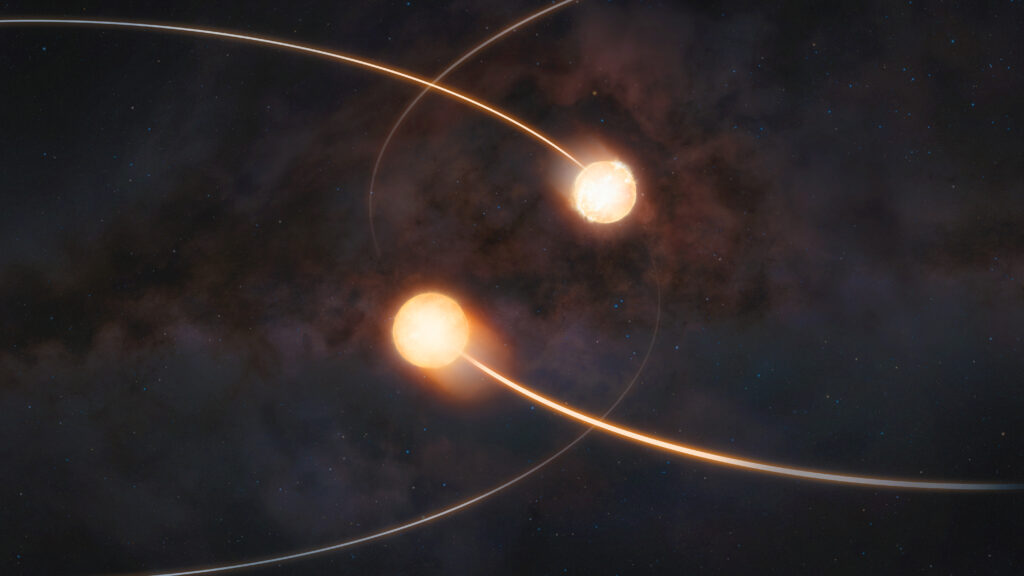
Mass is the one number that decides almost everything about a star: how hot it burns, how long it lives and what it leaves behind. It is also maddeningly hard to measure. The only direct method is to watch two stars orbit each other and let Newton do the arithmetic, which means seeing both of them clearly. For one young red dwarf binary 59 light-years away, optical telescopes never quite managed it. Radio telescopes now have, and the result is one of the sharpest stellar weigh-ins on record.
The system is DG Canum Venaticorum (DG CVn), a pair of red dwarfs, the small, cool stars that are among the most common in the Milky Way. In a paper published on 17 November 2026 in Astronomy & Astrophysics, a team led by Paul Boven of the Joint Institute for VLBI ERIC (JIVE) and Leiden Observatory combined 18 years of data from the US National Science Foundation’s Very Long Baseline Array (VLBA). The VLBA is a network of 10 radio dishes spread across North America that works as a single telescope thousands of kilometres wide. The National Radio Astronomy Observatory announced the result the same day.
DG CVn was never meant to be the story. It was observed from 2007 as part of the Radio Interferometric Planet Search, which hunted for the tiny wobble an orbiting planet induces in its star. Instead, the star lurched far more than any planet could explain. The culprit was a stellar companion, first resolved with adaptive optics in 2000 but only loosely constrained: early estimates put the orbit at around seven years, uncertain by a factor of three. Even the European Space Agency’s Gaia mission left DG CVn out of its third data release, presumably because its software recognised that the source was not a single star.
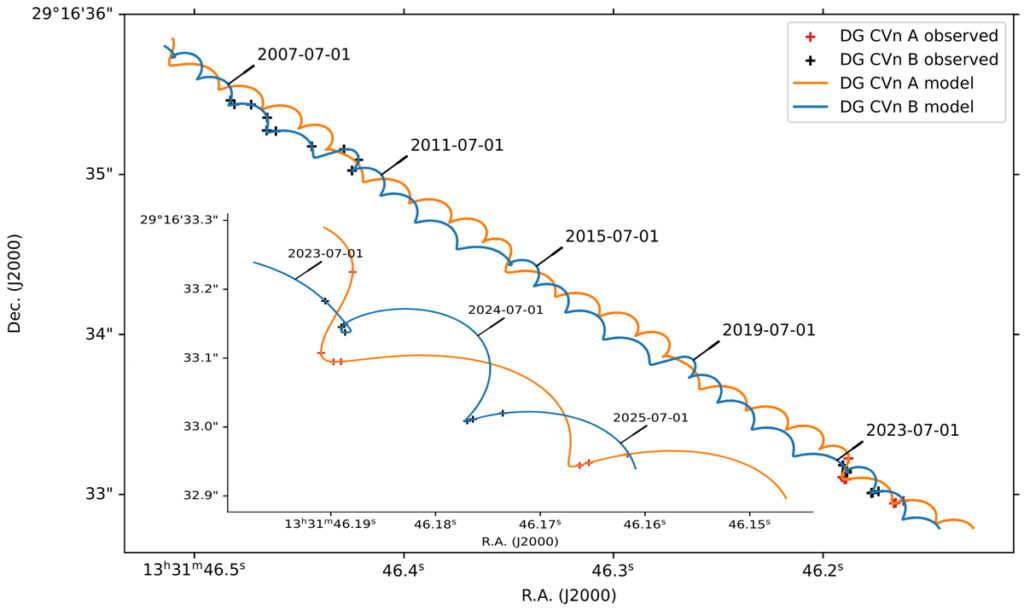
What changed was the discovery that both stars shine in radio. Both are magnetically active, and they produce nonthermal emission, radio light generated by fast electrons spiralling in magnetic fields rather than by heat. The brighter of the two, DG CVn B, typically gives off three times the radio luminosity of its partner. Seven new VLBA sessions between 2023 and 2025 caught both stars every time, adding to archival VLBA and Green Bank Telescope observations from 2007 to 2010. In all, the team logged 27 positions, each pinned down to better than a thousandth of an arcsecond.
Fitting an orbit to those points gives numbers with startlingly small error bars. The stars circle each other every 1,647.6 days, or 4.511 years, on a stretched ellipse with an eccentricity of 0.76. At closest approach they come within 0.586 au of each other, a little over half the distance between Earth and the Sun. Parallax, the small yearly shift in a nearby star’s position as Earth moves around the Sun, puts the system at 18.185 parsecs, about 59.3 light-years. With distance and orbit fixed, the masses follow: 0.385 solar masses for DG CVn A and 0.356 for DG CVn B, determined to a precision of about 0.16 per cent.
That precision matters beyond one system. Models of how small stars evolve depend on accurate masses, and young red dwarfs that are still contracting towards stable hydrogen burning are hard to calibrate. DG CVn shows why. Earlier distance estimates based on brightness placed it much closer than it really is, most likely because both stars are overluminous at their age of 30 to 150 million years. The system also contains a complex periodic variable, a rare kind of young red dwarf whose light rises and falls in puzzling repeating patterns. The team reports the first dynamical mass for any binary containing one.
The orbit also writes rules for planets. Because the stars swing so close, the discs of gas and dust around each one would have been truncated as they formed. Using standard stability criteria, the team calculates that a planet orbiting a single star would need a period shorter than about 23 days, while one circling both stars would need at least 36 years. The technique behind the measurement is the same one astronomers hope will eventually reveal planets directly, through the reflex wobble they impose on radio-loud dwarfs.
There are limits. The scatter left over after the fit, 0.1 to 0.2 milliarcseconds, is several times larger than the errors on individual sessions. That points to unmodelled effects: calibration quirks, shifting reference quasars, or radio emission that does not sit exactly at each star’s centre. Positions alone also leave a mirror ambiguity in how the orbit is oriented, which radial velocity measurements could settle if the stars’ rapid rotation and tight separation had not so far defeated them. And naming DG CVn B as the flaring star is tentative. Both may contribute to the outbursts, one of which was, when it struck, the highest-energy stellar flare NASA’s Swift observatory had ever recorded.
Future arrays such as the Square Kilometre Array and the Next Generation Very Large Array should bring many more such stars within reach, and Gaia’s fourth data release will flag binaries worth following up. For now, DG CVn offers a tidy lesson. A planet hunt that found no planet found something better: two restless stars, weighed to a fraction of a per cent by the static they broadcast across 59 light-years.
