

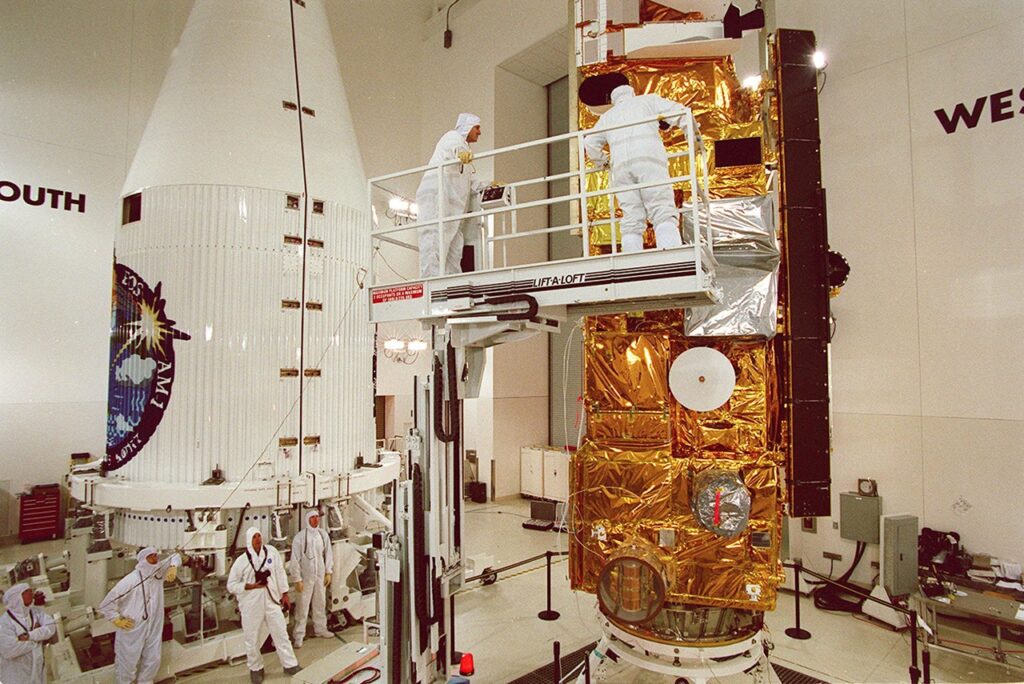
Most satellites are built to a warranty, and the good ones outlive it. Few have outlived it like this. NASA’s Terra satellite, designed for a six-year mission when it launched on 18 December 1999, will stop collecting science data on 1 December, the agency announced on 17 November. After 27 years of watching Earth’s land, air, oceans and ice, its systems are ageing and its orbit is drifting.
Terra was the flagship of NASA’s Earth Observing System, a fleet built to study the planet as one connected machine. It carries five instruments. The best known is the Moderate Resolution Imaging Spectroradiometer (MODIS), whose daily views of fires, dust storms and snow cover have become a standard reference for researchers. Alongside it fly ASTER, CERES, MISR and MOPITT, which record fine surface detail, the planet’s energy budget, clouds and pollution. MOPITT and parts of CERES and ASTER were already switched off to save power.
The real limit was fuel. Terra flies a Sun-synchronous polar orbit about 705 kilometres up, so it passes over any given spot at the same local time each day and the lighting stays consistent from year to year. For about two decades the team held its equator crossing at 10:30 in the morning, give or take two minutes, with regular small burns. The last of those came in February 2020. Since then the crossing time has crept earlier, bringing a lower Sun and longer shadows into the images and taking Terra out of the formation it shared with Aqua and Aura.
That long, steady record is the point. Terra has tracked land use change, wildfire behaviour, the drift of dust and smoke, atmospheric composition and ice cover. Its data have informed decisions on public safety, farming and water supplies. The archive will stay free to anyone who wants it.
The catch is continuity. A climate trend is only as trustworthy as the consistency of the measurements behind it, and Terra’s final years were gathered under different lighting and from a slightly lower orbit than its first two decades. NASA expected the effect on science to be minimal, but anyone stitching early and late data together will still need to account for it.
In January the team will burn the last of the fuel to lower the orbit, then switch every system off. Terra will begin a slow fall towards the planet it photographed for a generation. For two decades it kept the same appointment with the equator every morning. It has earned the lie-in.
