

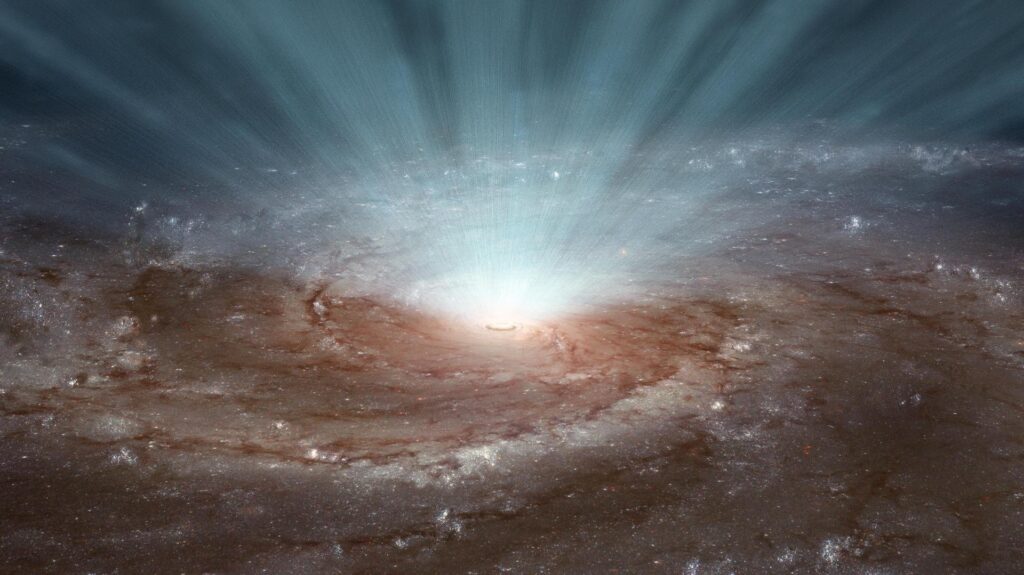
Galaxies have a size limit that nobody has fully explained. The biggest ones should keep pulling in gas and turning it into stars, yet the brightest galaxies in the universe are far rarer than gravity alone predicts. Astronomers have long blamed quasars, the blazing discs of matter around feeding supermassive black holes, for blowing that fuel away or heating it until it cannot cool. Now a team using the Atacama Large Millimeter/submillimeter Array (ALMA) has measured the heat around a single quasar pair directly, and found far more of it than the system’s gravity can account for.
The result, published in Nature Astronomy on 18 November 2026, comes from Kirsten Hall of the Center for Astrophysics | Harvard & Smithsonian and colleagues at Johns Hopkins University and the University of Arizona. Their target is J1549+1245, two quasars seen as they were 2.8 billion years after the Big Bang, at a redshift of 2.37. Hall first presented the measurement in July at a conference held at ESO’s headquarters in Garching, and the talk slides are openly available.
Astronomers detect this kind of gas by looking for an absence. Every direction in the sky is bathed in the cosmic microwave background, the leftover glow of the Big Bang. When that faint radiation passes through a cloud of very hot, thin gas, free electrons knock some of its photons to higher energies. The result, named the Sunyaev-Zel’dovich effect after the two physicists who predicted it in the early 1970s, is a small dip in the background at lower frequencies and a matching excess at higher ones. Its depth tracks the total thermal energy of the gas, so a single measurement works as thermometer and scale at once.
Hall’s team observed at 101.6 GHz with ALMA and its smaller companion, the Atacama Compact Array, which is better at catching faint signals spread over wide patches of sky. Around the two quasars they found a dip detected at six sigma, a level of confidence that leaves little room for a statistical fluke. Dust and radio jets can mimic or mask the effect, so the team combined the ALMA data with observations from the Very Large Array and the Submillimeter Array and modelled each source of light in turn. In one of the quasars the measured brightness falls to a minimum near 120 GHz, deeper than dust and radio emission alone can produce.
Even by quasar standards, the figures are large. The hot gas holds about 9.7 × 1060 erg of thermal energy, roughly eight billion times what the Sun will radiate over its entire ten billion year life. That is 3.6 times more than the gas in a dark matter halo of 10 trillion solar masses should carry if gravity alone had heated it. The team also sees signs of hot gas 100 to 600 kiloparsecs out (up to about two million light-years), possibly pushed there by outflows from the quasars. The excess amounts to at least 0.6 per cent of all the energy the quasars are expected to emit over their lifetimes.
That fraction sounds modest. It is enough. According to the authors, energy on this scale could halt star formation in the host galaxy and heat the wider intergalactic gas, which would explain why the number of very bright galaxies drops away so steeply. Computer simulations of galaxy formation have relied on this kind of quasar feedback for about two decades, usually as a tuned ingredient rather than a measured one. A direct reading of how much heat one system has poured into its surroundings gives modellers a number to test against.
Several of the same researchers have chased this signal before. In 2016 they stacked data from the Atacama Cosmology Telescope and the Herschel space observatory for a large sample of radio-quiet quasars from the Sloan Digital Sky Survey and found evidence for the effect at three to four sigma. Dust dominated the light in every band, though, and a sufficiently elaborate dust model could explain the dip away. Resolving one system in detail with ALMA removes much of that ambiguity.
It is still one system, and an unusual one. Two quasars feeding side by side may well produce more heat than a typical lone quasar, so the result cannot yet be stretched to the whole population. The energy estimate also depends on modelling the dust and radio emission correctly, and on the assumed mass of the dark matter halo. What the field needs next is a sample: many quasars at similar distances, observed the same way, to show whether J1549+1245 is the rule or the exception.
For now, the evidence is a hole in the oldest light there is. About 11 billion years ago, two black holes heated a stretch of space so thoroughly that the microwave background still carries the dent. Galaxies stop growing for many reasons, but this is one of the most direct measurements yet of a black hole cooling its neighbours’ prospects by heating their gas.
