

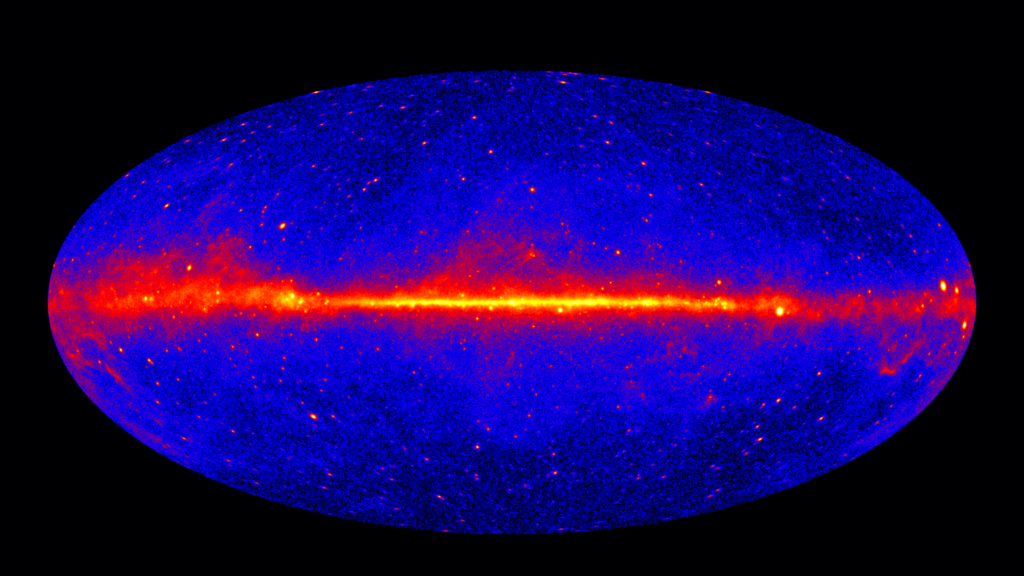
Astronomers can now map the sky in almost every kind of light, from metre-long radio waves to gamma rays carrying trillions of electronvolts. One stretch of the spectrum has stayed stubbornly dim. Gamma rays with energies of around a million electronvolts, the band astronomers call the MeV gap, are hard to catch and harder still to trace back to where they came from. A new catalogue built from 14 years of observations by NASA’s Fermi Gamma-ray Space Telescope now lists 450 objects shining in that band, just over twice as many as its predecessor.
The Second Catalog of Low-Energy Fermi-LAT Sources, or 2FLE, was published on 12 November 2026 in The Astrophysical Journal Supplement Series by the international collaboration behind Fermi’s Large Area Telescope (LAT). The lead author, A. Adelfio, works at Italy’s National Institute for Nuclear Physics in Perugia, and one of the corresponding authors, Lea Marcotulli, leads a research group at the German laboratory DESY, which announced the result. The catalogue covers gamma rays from 20 to 200 million electronvolts (MeV); even the lower end carries about 10 million times the energy of visible light.
Why is this band so awkward? At these energies a gamma ray tends to ricochet off electrons rather than being absorbed cleanly, a process called Compton scattering that scrambles any record of its original direction. Detectors in orbit also glow faintly, as cosmic rays make their materials slightly radioactive. Fermi’s LAT does not focus light at all. It works like a particle detector, converting each incoming gamma ray into an electron and its antimatter twin, a positron, inside thin sheets of tungsten, then following the pair through layers of silicon. At 200 MeV that trail points back to within about 4 degrees of the source. At 20 MeV the blur widens to a circle about 20 degrees in radius; the full Moon is half a degree across.
The team’s answer was patience and statistics. They took data gathered between August 2008 and August 2022 and stripped out interruptions, solar flares and bright gamma-ray bursts, leaving about 10.3 years of usable observations. They divided the sky into 266 overlapping patches and modelled the diffuse gamma-ray glow of the Galaxy, the Sun and the Moon before hunting for point sources. Only detections at roughly five sigma, the standard physicists use to rule out a statistical fluke, made the cut. The previous catalogue, 1FLE, found 198 sources using 8.75 years of data.
Of the 450 sources, 377 match objects already known at other wavelengths, and 325 of those lie beyond the Milky Way. Flat-spectrum radio quasars, a type of blazar, account for 218 entries, almost half the catalogue. A blazar is a galaxy whose central supermassive black hole fires a jet of plasma almost straight at Earth. The brightest extragalactic source is the blazar 3C 454.3, while the most distant sits at a redshift of 4.3, so its light set out when the Universe was young. Closer to home, 52 Galactic sources are mostly pulsars, led by the Crab pulsar, the brightest object in the entire list. The globular cluster M2 also appears for the first time in any Fermi catalogue.
This is more than stamp collecting. In Fermi’s main catalogue of 5,835 sources, over 80% have spectra that fade as energy rises, a strong hint that most of them pour out the bulk of their power in the MeV range rather than where Fermi sees best. The 2FLE catches flat-spectrum radio quasars near the peak of their high-energy output: they make up 78% of its blazars, a larger share than in any of Fermi’s higher-energy catalogues. Its sources also sit further away on average, at a median redshift of 0.97 against 0.56 for Fermi’s main catalogue of active galaxies. For researchers trying to understand how black hole jets accelerate particles, much of the energy budget lives in exactly this band.
Then there are the strangers. Seventy-three sources have no known counterpart, and 60 of them have never been recorded in gamma rays at all. One, 2FLE J0340.8+5258, sits close to the plane of the Milky Way and lines up with an ultra-high-energy source seen by China’s Large High Altitude Air Shower Observatory (LHAASO). Combined, the data trace its output from 20 MeV to 1.6 PeV, a factor of about 80 million in energy, with no optical or infrared counterpart yet identified.
Blurred vision is the catch. With error circles this wide, neighbouring sources can merge into one, and the authors estimate that blending affects around a fifth of the catalogue. They suspect that the seven most significant unassociated sources are the combined glow of nearby known blazars and pulsars rather than new objects. Spectral uncertainties may also be underestimated by about 20% for sources with a neighbour closer than 3 degrees. Each newcomer needs follow-up at other wavelengths. The full list is public on the Fermi Science Support Center, and the paper first appeared as an arXiv preprint in October.
The team expects the 2FLE to remain the most sensitive MeV catalogue for years to come, which says as much about the gap as about the catalogue. A telescope designed for higher energies has been squeezed for everything it can give at the edge of its range. The MeV sky is still a fog. It now has 450 lights in it, and 60 of them had gone unnoticed until now.
