

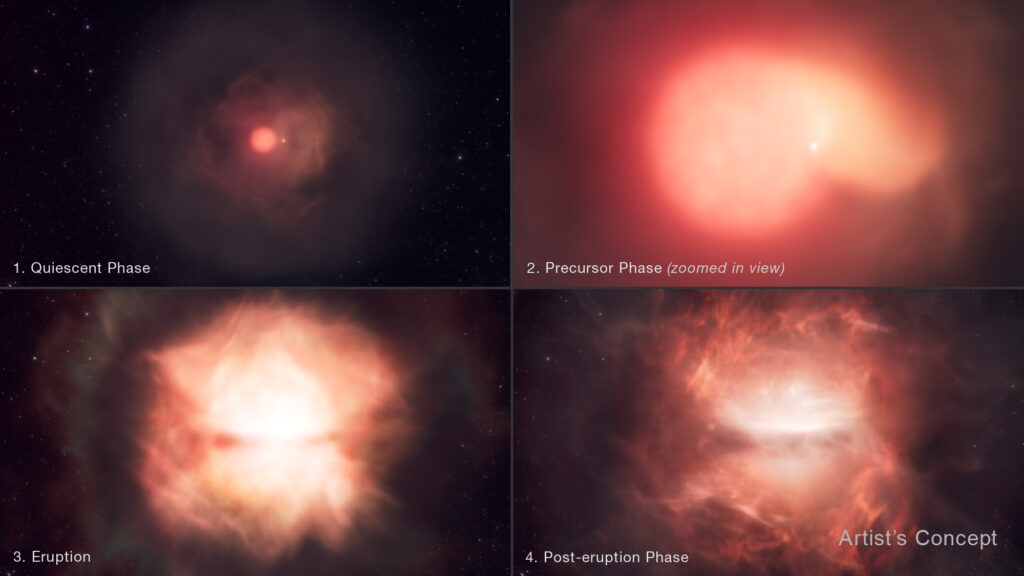
Most of the tightest stellar pairs in the universe, including the white dwarf, neutron star and black hole binaries whose collisions send out gravitational waves, are thought to pass through a brief and violent phase in which one star lives inside the other. Theorists have described this common envelope stage for decades. Nobody had watched it unfold from start to finish. A team led by Viraj Karambelkar of Columbia University has now done so, following a giant star merger in the Andromeda galaxy through seven years of data.
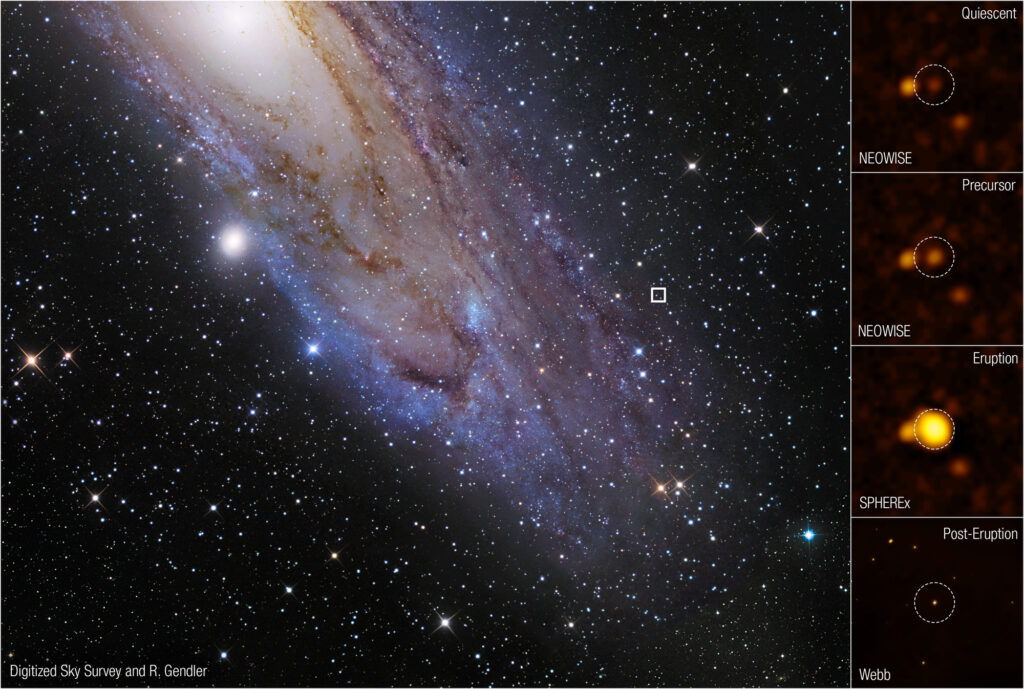
The system, catalogued as AT 2025abao and nicknamed Bao, lies in the outskirts of our nearest large neighbouring galaxy. The results were published in Nature on 18 November 2026, alongside NASA’s account of the observations. Before the merger, the pair was badly mismatched. The primary, Big Bao, was a bloated giant of about seven solar masses, 350 times the Sun’s radius and 18,000 times as luminous. Its partner, Little Bao, held about 0.7 solar masses.
Mergers like this are hard to catch because nobody knows in advance where to look. As Karambelkar put it, they are “very, very difficult to observe in real time.” Bao gave itself away slowly. Archival data from NASA’s NEOWISE infrared survey show the giant shining steadily until 2018, when it began to brighten. The team flagged it as an unusual variable in February 2023. In September 2024 the Wide-field Infrared Transient Explorer (WINTER) caught it producing fresh dust, and in July 2025 NASA’s SPHEREx mission saw it fade in visible light while brightening in the infrared, as a star wrapping itself in dust would.
Then it erupted. The Zwicky Transient Facility picked up the outburst on 17 October 2025, Swift and Gemini North followed in November, and the James Webb Space Telescope (JWST) observed it on 24 December 2025, just 47 days after the peak. No event of this kind had been followed up so soon. The team’s model matched Webb’s mid-infrared measurements, which trace dust the giant had been shedding for centuries.
The physics runs roughly as follows. Once the companion grazed the giant’s surface, it was orbiting inside the giant’s own tenuous outer layers, a shared envelope of gas. Drag from that gas sapped its orbital energy, so it spiralled inward, and the lost energy was dumped into the envelope, heating it and pushing it outward. Bao completed this in about seven orbits, or roughly seven years, where previously known mergers involving smaller stars took thousands. The team concluded that Little Bao ended up inside the giant’s core.
That speed is more than a curiosity. A release from the Rochester Institute of Technology, whose astrophysicist Jason Nordhaus made predictions about this phase in 2019, calls it one of the most uncertain stages in a star’s life and the main route by which the universe builds tight binaries. Models of how many compact pairs should exist depend heavily on one number: how efficiently the inspiralling star’s lost orbital energy goes into throwing off the envelope. Bao lets researchers measure that directly, from the amount of material the eruption expelled. Because the light from the envelope leaks out gradually, it also offers a rare look beneath the surface of a giant star.
The catch is that not everyone reads Bao the same way. A preprint posted in October by Zhuo Chen and colleagues, not yet peer reviewed, modelled the same event with a heavier companion of about 1.4 solar masses. In their simulations the companion and the giant’s core were still orbiting each other, on an eccentric path, at least 400 days after the engulfment began. In that picture Bao marks the birth of a close binary rather than a merger. Some questions stay open even on the merger reading: NASA notes that only future observations will show how the newly single star’s mass settles, and whether it has been rejuvenated by its meal is not yet known.
More cases should follow. NASA expects the Roman Space Telescope, and especially its Galactic Bulge Time-Domain Survey, to find similar events. Bao was spotted because a giant star grew a little brighter year after year and someone kept watching. The next one may already be doing the same, with something small circling deep inside it.
