


Mars is famously dry, yet its air may be quietly trading atoms with water at the ground. A new analysis of more than a decade of atmospheric samples from NASA’s Curiosity rover finds that heavy oxygen in Martian carbon dioxide rises every spring and summer. The best explanation on offer involves water films on Mars only a sliver thick, clinging to soil grains or coating the surface.
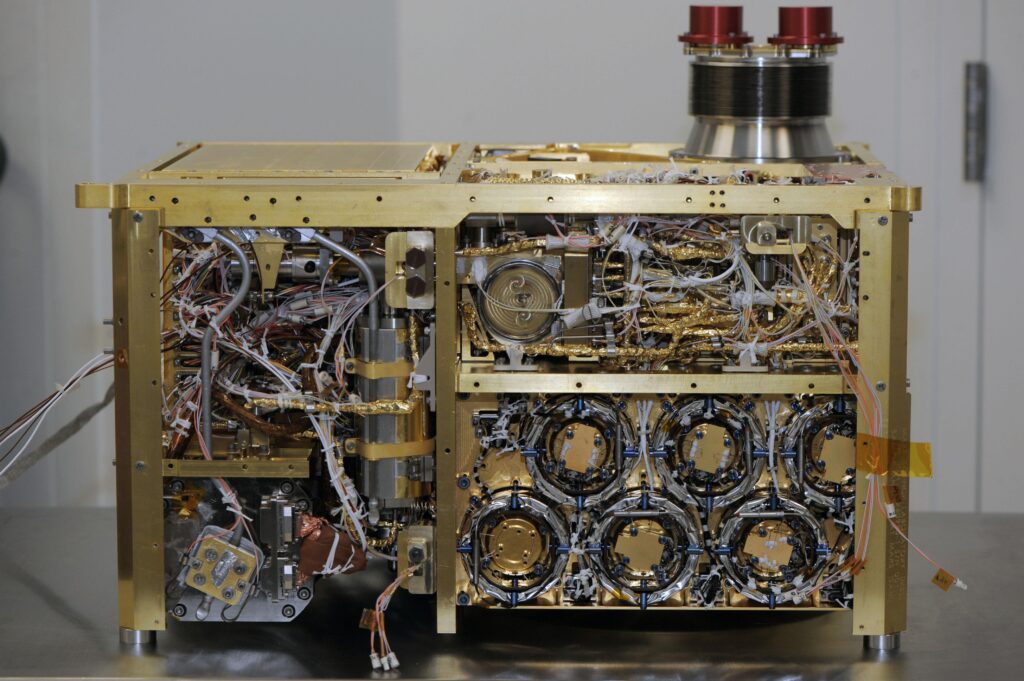
The study, led by Heather Franz of NASA’s Goddard Space Flight Center, was published in the Proceedings of the National Academy of Sciences on 16 November 2026. It draws on repeated air samples analysed by the rover’s Sample Analysis at Mars (SAM) suite at Gale crater across eight Mars years, from 2012 to 2025. The team describes it as the first long-term record of the isotopic make-up of the planet’s carbon dioxide gathered on the surface.
Isotopes are versions of an element with different masses; oxygen-18 carries two more neutrons than ordinary oxygen-16. Paired daytime and night-time samples showed no meaningful difference. The seasons told another story. Oxygen-18 crept upward in the spring and summer of both hemispheres, most strongly as Mars approached perihelion, its closest point to the Sun. Carbon isotopes shifted far less.
Some seasonal swing was expected. Each winter a share of the carbon dioxide freezes onto the polar caps and returns when it sublimes, a cycle that Curiosity’s own pressure readings trace. The team tested that cycle, gas sticking to and leaving the soil at lower latitudes, and the splitting of carbon dioxide by sunlight. None was enough on its own. Only letting the gas swap oxygen with water already rich in oxygen-18 reproduced the enrichment, which points to water that still takes part in chemistry today rather than ice locked away at the poles.
Nobody has seen this water directly, and that is the catch. The exchange is a modelled explanation for an isotopic pattern, and every sample came from one site near the equator, so the authors cannot say how much of the signal is local, regional or global. Weaker enrichment near aphelion, the farthest point from the Sun, fits the idea that colder conditions slow the swap. It is consistency, not proof.
Measurements from other parts of the planet will be needed to settle the question. Until then, the clue sits in the thin air above Gale crater, where a rover sent to read ancient lake beds has found the present-day water cycle written in a single heavy atom.
