

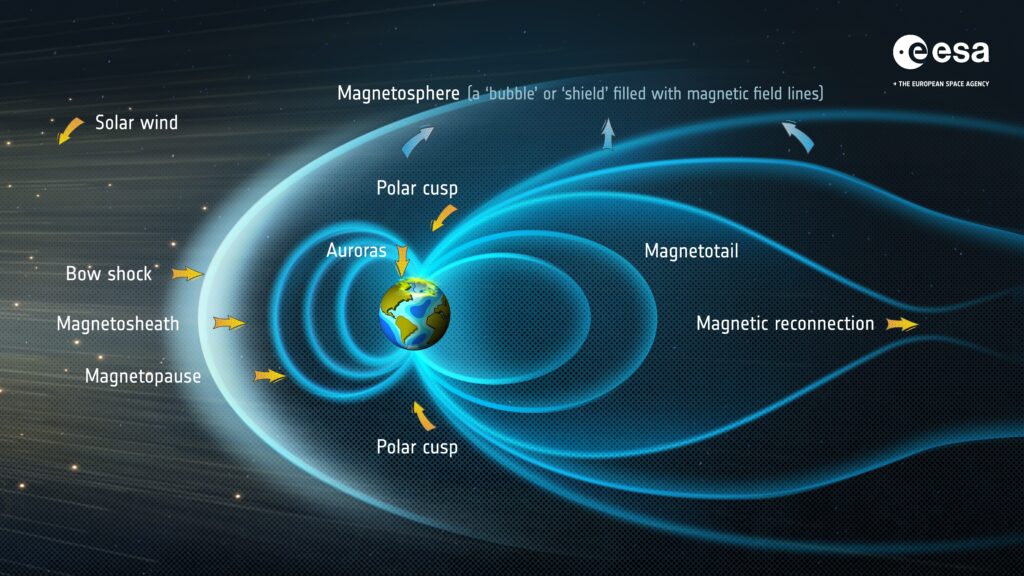
Earth sits inside a magnetic bubble that the solar wind batters, stretches and occasionally tears open, and the physics deciding how much energy gets in works on many sizes at once. On 19 November 2026 the European Space Agency (ESA) chose a mission built to watch those sizes together: Plasma Observatory, a fleet of seven spacecraft that will become its next medium-class science mission.
ESA’s Science Programme Committee picked it for the M7 slot, ending a contest that began with a call for ideas in December 2021 and drew 27 proposals. Three concepts survived to the final study phase. According to the Paris Observatory’s LIRA laboratory, which works on the mission, the beaten finalists were THESEUS, a gamma-ray burst hunter, and M-MATISSE, a Mars mission.
Its predecessor, ESA’s four-spacecraft Cluster, showed that the solar wind meets Earth’s magnetic field on scales from a few kilometres to tens of thousands of kilometres, yet it could sample only one scale at a time. Plasma Observatory gets around that with geometry. Its seven identical spacecraft will fly as two tetrahedra sharing a corner, with gaps from about 30 km to 5,000 km. That lets one event be measured at the ion scale, where single particles spiral around field lines, and at the fluid scale, where the plasma flows like a gas. The fleet will follow an elongated orbit of 8 by 17 Earth radii, roughly 51,000 to 108,000 km, reaching the turbulent boundary where solar wind meets magnetosphere.
The targets are three processes that heat and accelerate charged particles: shock waves, turbulence and magnetic reconnection, in which tangled field lines snap and rejoin, releasing stored energy. Together they drive the space weather that can upset satellites and power grids. They also operate in plasmas across the Universe, from the solar corona to black hole jets, so the magnetosphere doubles as a laboratory on our doorstep.
Selection is not a licence to build. The mission still needs formal adoption before construction, and ESA foresees launch only at the end of the next decade; Queen Mary University of London, part of the team, gives a target of 2037 and a cost of about €670 million. Holding seven spacecraft in a precise, two-scale formation is also a clear step up in complexity from Cluster’s quartet.
The queue behind it is already forming, with four concepts (CALICO+, FOSSIL, PRIAMOS and SPARK) advancing towards a medium-class choice in 2030. For Plasma Observatory, the next decade means turning a tidy sketch of two linked pyramids into seven working spacecraft. Only then will scientists see the whole storm at once, rather than one raindrop of it.
