

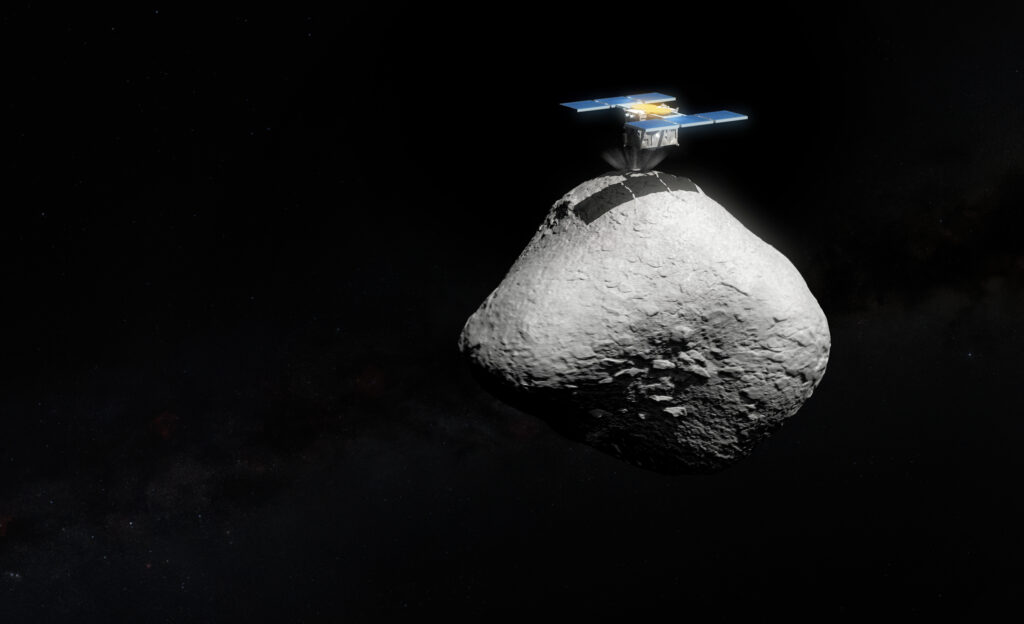
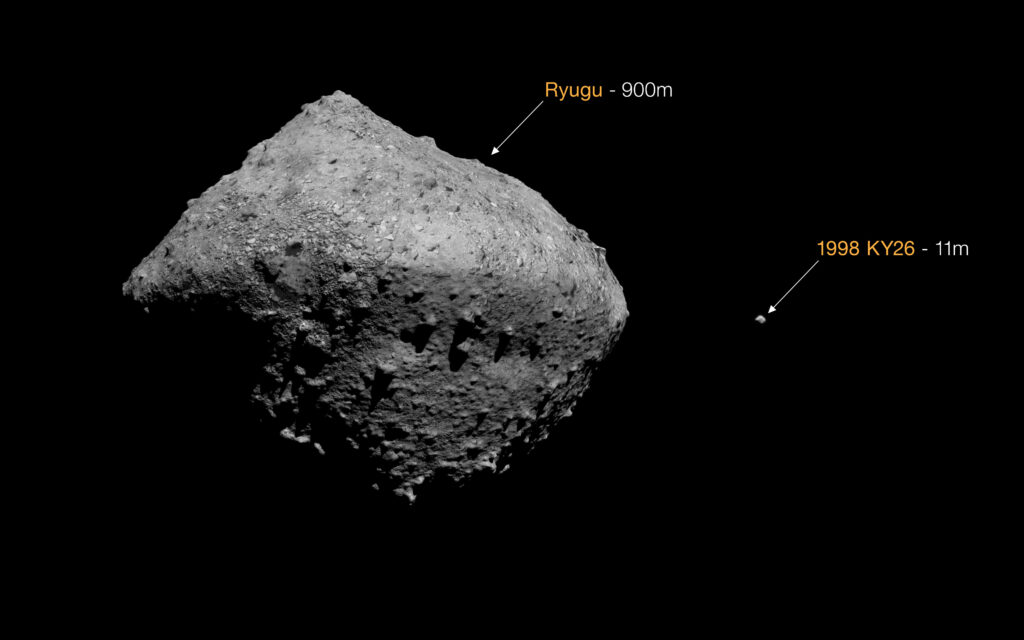
Every asteroid visited by a spacecraft so far has been more than 100 metres across. Smaller rocks, a few tens of metres wide, are faint, hard to track and entirely unexplored, even though the object that exploded over Chelyabinsk in 2013 was only slightly bigger than the 11 metre asteroid Japan’s Hayabusa2 was due to land on in 2031. That landing is now off. Failing engines have forced a new plan, and the Hayabusa2 flyby that replaces it will be one of the most demanding ever attempted.
Japan’s space agency, the Japan Aerospace Exploration Agency (JAXA), told a government space policy subcommittee on 16 November 2026 that it was abandoning the rendezvous with asteroid 1998 KY26, and set out the details at a press briefing the following day. Instead of matching orbits with KY26 and attempting a touchdown, the spacecraft will race past a different near-Earth asteroid, 2015 BM510, in April 2028.
Old age is the culprit. Hayabusa2 launched in December 2014, collected samples from asteroid Ryugu and delivered them to Earth in December 2020, then carried on with an extended mission. It steers with four ion engines, which push the craft by accelerating charged xenon gas: frugal, gentle and patient. Three of the four had already worn out. The team kept the last one going by feeding it more propellant than its design allowed, and in August 2026 its ion source short-circuited and took a power supply with it.
By then the engines had logged more than 20,000 hours of thrusting and changed the spacecraft’s speed by a cumulative 2.044 km/s, more than the original Hayabusa managed. A sensor new to this mission had also detected unexpected erosion of the spacecraft’s surfaces, wear that ground testing had not anticipated.
Arithmetic did the rest. Engineers found they could still run a hybrid, pairing one engine’s neutraliser (the part that keeps the exhaust electrically balanced) with another engine’s ion source, but they cannot predict how long it will last. Reaching KY26 would have needed a further 650 m/s of speed change, more than 10,000 hours of engine time, and even the Earth swingby planned for December 2027 needed about 200 m/s. The chemical thrusters can reliably deliver only about 30 m/s. A flyby of 2015 BM510 needs roughly 24 m/s.
Scientifically, the loss stings. Ground observations published in 2025 showed that KY26 is just 11 metres wide and spins once every 5.35 minutes, and its orbit carries a tiny push that gravity alone does not explain. Some researchers had wondered whether it was a dark comet venting hidden ice. A thermal modelling study in Icarus this autumn found it far too warm to keep ice for long, which points to sunlight as the source of the push. A visit would have settled the argument.
Its replacement is, if anything, stranger. 2015 BM510 is estimated to be between 17 and 74 metres across and rotates about once every 49 minutes. It is a D-type asteroid, a dark, reddish class thought to be rich in organic material and water and to sit somewhere between comets and the most primitive asteroids. No spacecraft has visited a fast-spinning D-type, and nothing this small has ever been the target of a flyby. The smallest so far is Selam, a 220 metre moonlet that NASA’s Lucy found by chance in 2023.
Hayabusa2 will approach fast and nearly blind. It will pass at about 6 km/s, aiming for a few hundred metres from the asteroid’s centre. Because 2015 BM510 is so small and dark, the telescopic navigation camera should first pick it out only about 10 hours before closest approach, leaving a short window for corrections commanded from the ground before onboard guidance takes over. At Torifune, the team had 14 days’ notice. That July 2026 flyby still passed about 400 metres from the surface at 5.3 km/s, missing its aim point by roughly 120 metres, and it is the main reason JAXA judges the new attempt feasible.
Success would matter beyond one rock. Steering precisely onto an object tens of metres across is exactly the skill a future deflection mission would need against bodies of that size. The scientific puzzle is just as concrete: how does a fragile, primitive body hold together while spinning this fast? Inside about 10 km, the cameras should resolve detail that no telescope on Earth can match.
The risks are plain. The asteroid’s size is uncertain by a factor of four, so its brightness on approach is a guess until telescopes study it between late 2026 and early 2027. Ageing hardware adds risk too: a reaction wheel suffered an anomaly in March 2025, and the flyby has been planned around it. A single high-speed pass also gives one fleeting look rather than months of mapping or a sample. KY26’s odd push, meanwhile, goes back to the telescopes.
JAXA also plans to practise close manoeuvres around the last of the small target markers Hayabusa2 carried to guide its landings at Ryugu, treating it as a stand-in for the tiny asteroid it can no longer reach. It is a fitting coda. A probe that spent nearly a year and a half beside Ryugu will meet its final asteroid with 10 hours’ warning and a few seconds at closest approach, threading a needle it cannot see until its final hours.
