
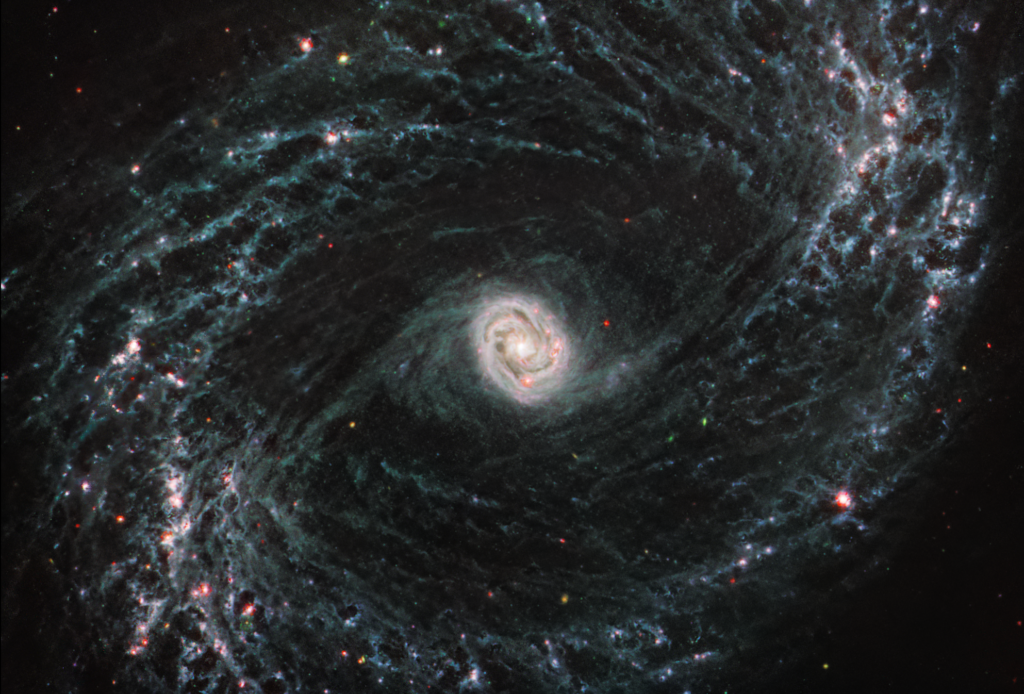
Every map of the Milky Way is drawn from the inside. We sit within the disc, peering through dust at structures we can never see face on, so the familiar picture of a barred spiral with four sweeping arms is partly measurement and partly reconstruction. A new study suggests one stretch of that picture needs redrawing. Part of the Norma arm, long counted among the Galaxy’s major spiral arms, may instead be a shock front running along the edge of the central bar, and stars appear to be forming inside it.
The work comes from Hillary Davis, who has just completed her PhD at the University of Sydney, with colleagues in Sydney and at Lund University in Sweden. It was published in Nature Astronomy on 20 November 2026. It is a reinterpretation rather than a new observation. The team compared existing radio measurements with a new generation of computer simulations built to behave as much like the Milky Way as possible.
Those measurements concern masers, the microwave equivalent of lasers. In the dense clouds around newborn massive stars, water and methanol molecules can amplify radiation into intense, compact beams, which makes them excellent beacons. Radio surveys, including the BeSSeL Survey and Japan’s VERA project, have measured their distances directly by parallax, the tiny shift in apparent position as Earth orbits the Sun. A string of these masers near one end of the bar has been used to trace the Norma arm. The regions they mark are less than a million years old, so they still sit almost exactly where their stars were born.
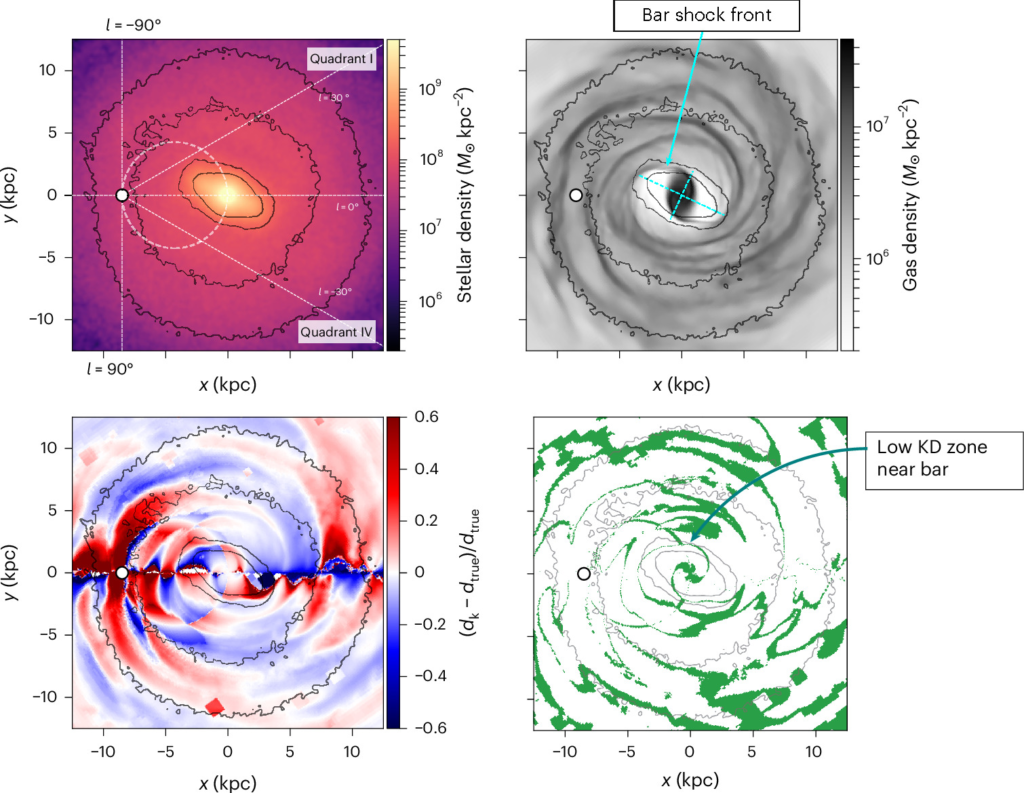
A galactic bar is a vast, elongated concentration of stars that rotates as a single pattern. Gas crossing it does not flow smoothly. Along the bar’s leading edges it piles up and is squeezed in shocks, forming the dark dust lanes seen in many barred galaxies. Davis and her colleagues followed a simulated Milky Way analogue for about 4.3 billion years, resolving detail down to 74 parsecs (one parsec is about 3.26 light-years). They then asked how its gas would look in the velocity maps radio astronomers make of our own Galaxy. A distinctive bump in those maps, which they call the “second peak”, turned out to mark the point where the bar’s shock front crosses the line of sight.
Applied to real observations of carbon monoxide gas, and laid over the Norma masers, the comparison was striking. The fit is close. The masers follow the curve of the simulated shock front once the model is enlarged slightly. Stretching and rotating it to fit gives a bar with a half-length of about 4.3 kiloparsecs (roughly 14,000 light-years), a half-width of 2.3 kiloparsecs and a tilt of about 20 degrees from our line of sight to the Galactic Centre. The fit also implies a slowly turning bar, with a pattern speed of no more than 40 kilometres per second per kiloparsec.
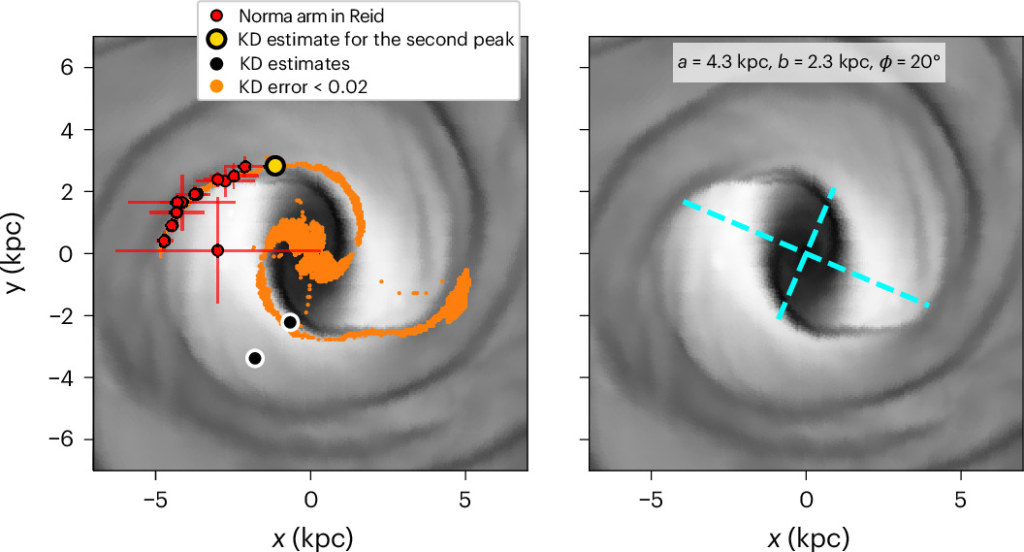
Those numbers bear on a long-running argument. Some studies favour a long, slow bar about five kiloparsecs in half-length; others prefer a short, fast one closer to 3.5 kiloparsecs. The new estimate sits on the long side and agrees with a 2015 measurement of 4.6 kiloparsecs based on the distribution of red giant stars, reached by an entirely different route.
The second implication concerns where stars are born. In many nearby barred spirals the dust lanes hold plenty of dense gas yet make few stars, probably because the same shocks and shearing flows that gather the gas also stir it too violently to collapse. If the Norma masers really sit in the Milky Way’s dust lane, our Galaxy belongs with the exceptions, building stars in a place where most of its neighbours do not. The authors connect this to recent work showing that long, slow bars tend to host the most star formation in their bar regions.
Caution is still warranted. The case is persuasive rather than proven. The alignment was judged by eye, and the simulated galaxy had to be stretched unevenly, by 16 per cent in one direction and 24 per cent in the other, without adding mass, which the authors concede makes it less realistic. Their quoted uncertainties come from the masers’ parallax errors and leave out the spread between different ways of measuring a bar; applied to the same scaled model, those methods give half-lengths from 3.9 to 4.95 kiloparsecs. Distances to gas near the Galactic Centre are hard to pin down, and the result covers only one side of the bar. Even the University of Sydney announcement is careful, with Davis saying that at least part of the arm “may not be a spiral arm at all”.
None of this changes what the Milky Way is, only how well it has been read. The arms were mapped by joining dots, each one a stellar nursery with a carefully measured distance, and the dots have not moved. Only the line through them has.
For a galaxy we will only ever see from somewhere in the middle of the crowd, that is a useful reminder that the map is a hypothesis. Part of what was drawn as a road may be a traffic jam at the bar’s edge, and one busy enough to build stars.
