

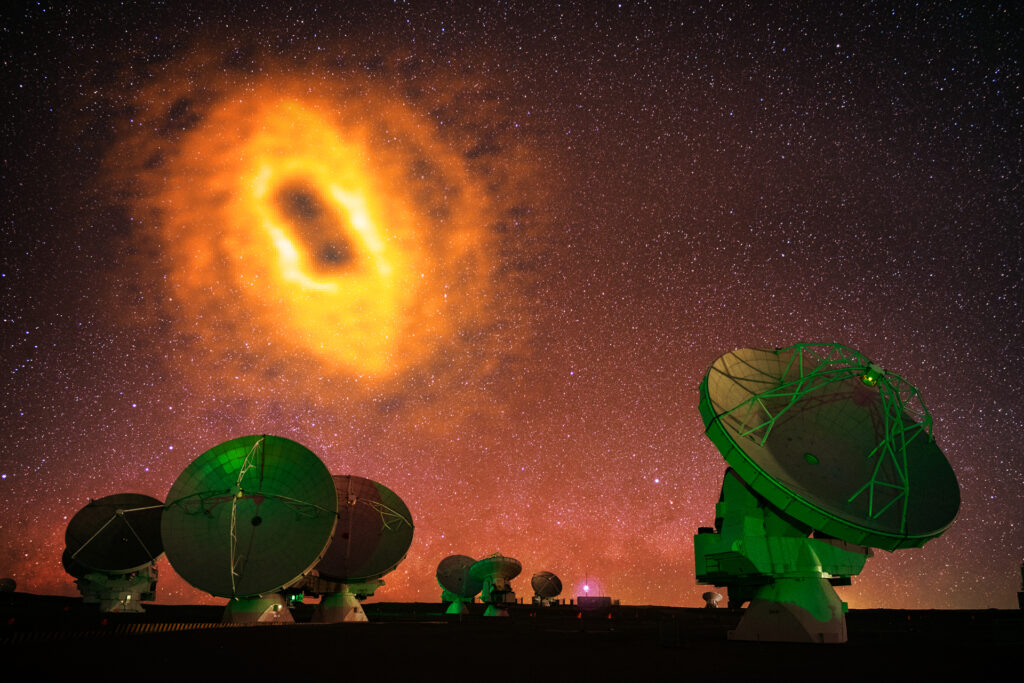
Stars like the Sun do not go out with a bang. They swell into red giants, cast off their outer layers and leave behind a glowing shell of gas called a planetary nebula. The handover between those stages is thought to take only a few thousand years, so catching a dying star in the middle of it is largely a matter of luck. Astronomers using the Atacama Large Millimeter/submillimeter Array (ALMA) have now had that luck, and the star in question turns out to have kept a record of its own decline.
Its name is IRAS 06530-0213, a pre-planetary nebula about 12,000 light-years away in the constellation Monoceros. A team led by Raghvendra Sahai of NASA’s Jet Propulsion Laboratory describes it in a paper in The Astrophysical Journal, announced by the National Radio Astronomy Observatory on 20 November 2026. ALMA mapped the faint millimetre glow of carbon monoxide and other molecules around the star, using data gathered between 2022 and 2024. The object is the first to be presented in detail from PANORAMA, an ALMA survey of stars caught in this brief transitional phase.
Most striking is a thin, almost perfectly circular ring roughly half a light-year across. It is really a hollow spherical shell, which looks like a ring because we see the most gas where our line of sight skims its edges. The shell is expanding at about 12.4 kilometres per second; run that motion backwards and it left the star roughly 6,500 years ago. Late in life, stars like this one burn hydrogen and helium in layers around a spent core, and every so often the helium layer ignites in a brief runaway known as a thermal pulse. Each pulse jolts the star and flings gas into space. The team argues the ring is debris from the last such pulse before the star began its final transformation, which Sahai describes as “a star’s final nuclear heartbeat, frozen in gas”.
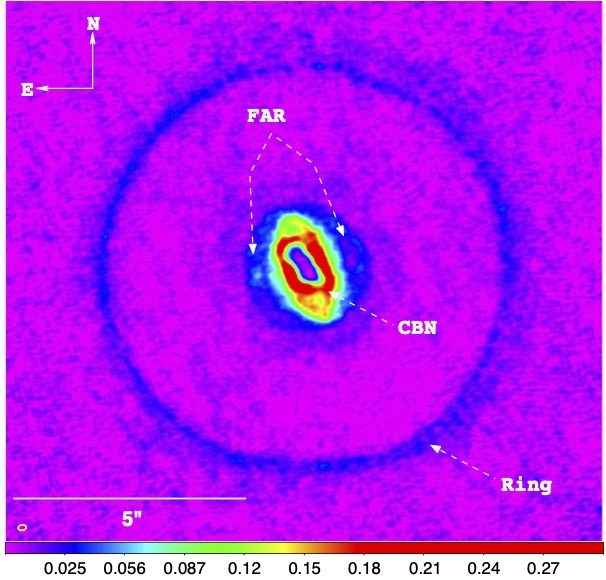
Everything inside the ring reads like a diary written from the outside in. After the pulse, the star’s mass loss fell to a trickle for about 2,000 years. It then surged for close to a millennium, producing a lumpy shell of curved filaments that now holds most of the expelled material: an estimated 0.12 to 0.25 solar masses of molecular gas, several times the mass of the ring. Closest to the star sits the newest chapter, a pinched, hourglass-shaped (bipolar) nebula with a dense doughnut of gas around its waist. Their expansion speeds suggest these inner structures formed within the last 700 years or so. In astronomical terms, the star left the red giant stage last week.
Shells blown off by thermal pulses have been seen before around carbon-rich giants still in their bloated phase, but never around a star that had already started turning into a planetary nebula. That gives theorists a dated sequence for a single object: pulse, lull, surge, then sculpting. It also bears on an old puzzle. Red giants lose gas in fairly round winds, yet most planetary nebulae are lopsided, lobed or pinched. The favoured explanation is a companion star that feeds a small disc, which in turn launches jets that carve the outflow into shape. The filaments around IRAS 06530 appear to trace a spiral, the pattern usually blamed on an orbiting partner, and the team estimates such a companion would lie roughly 135 to 355 times the Earth to Sun distance from the dying star.
Two findings refuse to sit neatly in that picture. ALMA sees no compact dusty disc at the centre; any disc would have to be more than 50 times fainter than the one around the well-known Red Rectangle nebula. Nor is there any of the fast gas, typically 50 kilometres per second or more, that marks most jet-carved nebulae at this stage. Nothing here appears to move faster than about 16.5 kilometres per second. The authors suggest a short-lived disc may have powered a brief burst of jets and then faded away, leaving the hourglass without its sculptor.
The chemistry is stranger still. In the dense gas near the star, the heavy isotopes carbon-13 and oxygen-17 (versions of those elements carrying extra neutrons) are far more common than in the Sun. The ratio of ordinary carbon to carbon-13 is about 18, against roughly 89 in the Sun, and oxygen-17 is enriched by a factor of roughly 50 to 175. Standard models of how such stars forge and mix their elements cannot produce that pattern, and some researchers have proposed bursts of explosive nuclear burning instead. Every age and mass quoted here also depends on the star’s distance, which Gaia measurements place anywhere from about 9,500 to 16,300 light-years.
For now, IRAS 06530 is a single case, and the rest of the PANORAMA sample will show whether its quiet, discless centre is typical or a fluke. Either way, the ring will keep drifting outwards a little each year, a timestamp from the last time this star’s nuclear furnace flared before the long fade towards a white dwarf.
