

Black holes are supposed to take their time. Gas falls in, heats up and glows, and that glow pushes back on the next mouthful, setting a speed limit on how fast any black hole can grow. The limit makes the early Universe awkward, because astronomers keep finding giants that seem to have had too little time to get big. The newest is the most distant quasar yet found: a black hole of roughly 360 million Suns, seen just 630 million years after the Big Bang, and oddly relaxed about it.
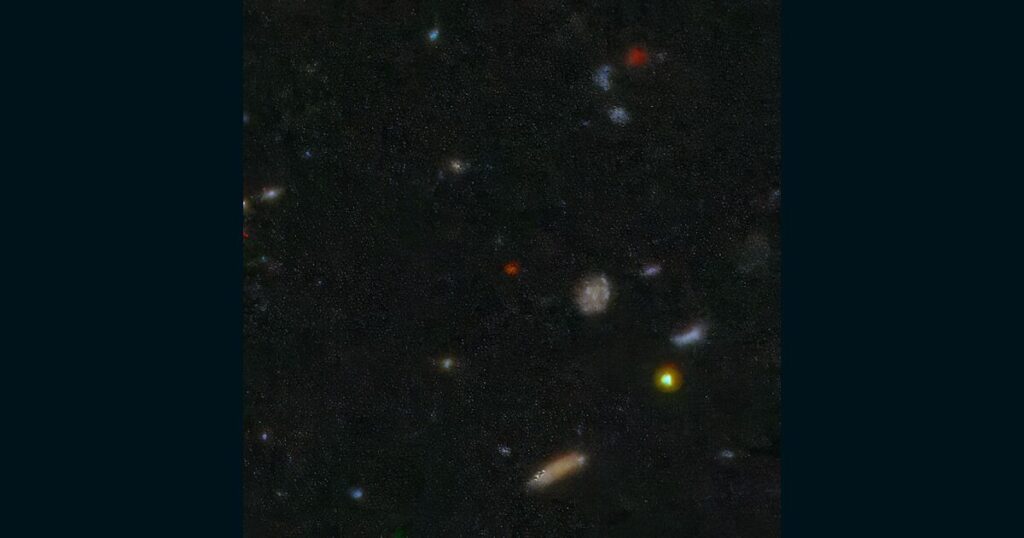
The object, catalogued as J1504+6252 and nicknamed Dún Aonghasa after a prehistoric cliff-top fort on Ireland’s Atlantic edge, was picked out of survey images from the European Space Agency’s (ESA) Euclid space telescope. The discovery paper, led by Julien Wolf of the Max Planck Institute for Astronomy and published in Astronomy & Astrophysics on 24 November 2026, puts it at a redshift of 8.13. Redshift measures how far the expansion of the Universe has stretched an object’s light. This is the first quasar confirmed beyond eight, and according to ESA it pushes the record about 40 million years further back than the previous holder, another Euclid find announced in July.
Finding it took a relay of telescopes. A quasar this remote vanishes at visible wavelengths, because neutral hydrogen between it and us absorbs everything bluer than a particular ultraviolet line, and cosmic expansion then drags whatever survives into the infrared. Euclid saw nothing in its optical band and a faint point of light, around magnitude 23, in its near-infrared bands. Three independent selection methods flagged the same source from about 3,600 square degrees of sky.
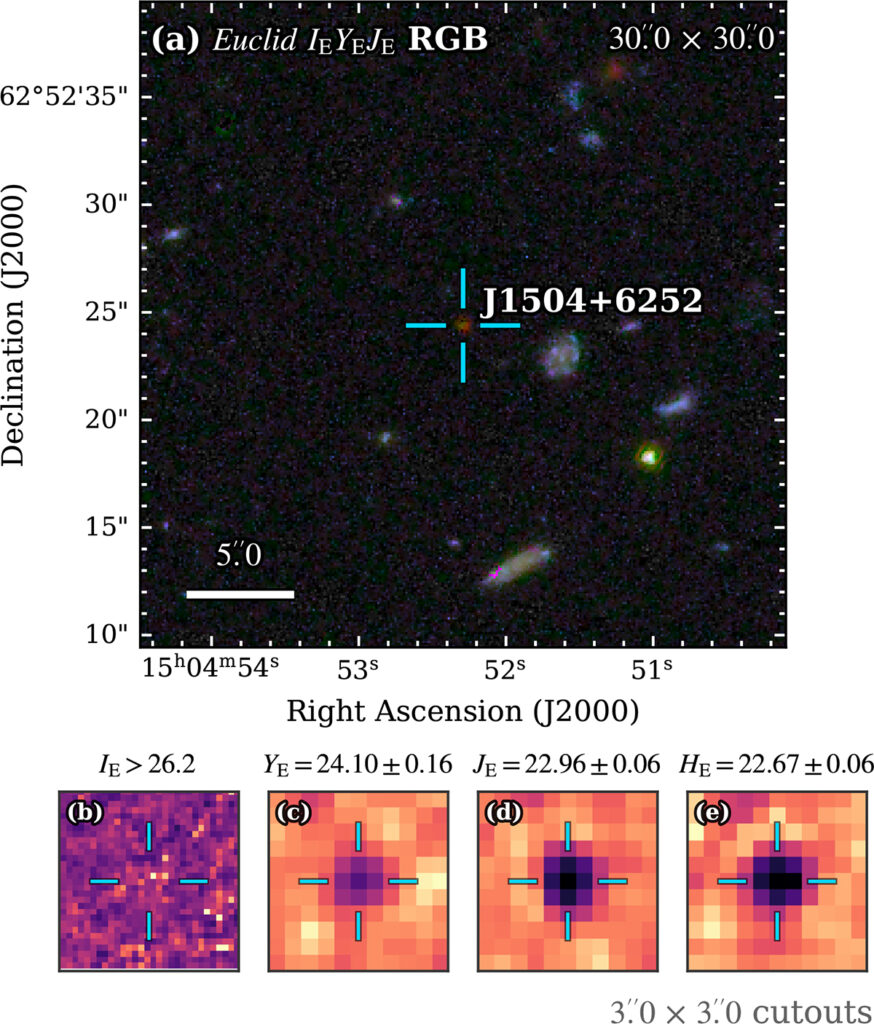
Then came the confirmation. The Keck Observatory in Hawaii caught a faint blue glow in January, the Hubble Space Telescope picked out the sharp break in its spectrum in May, and the Large Binocular Telescope in Arizona confirmed that break days later. In June the James Webb Space Telescope (JWST) delivered a spectrum clean enough to weigh the black hole. Webb measured the widths of broad emission lines from hydrogen and magnesium, which come from gas whirling close to the centre; faster gas means a heavier black hole.
The answer is about 360 million solar masses. More surprising is how little the quasar seems to be eating. Comparing its output with the Eddington limit, the brightness at which radiation pressure balances gravity, gives a value near 26%. That is low for the early quasars found so far, which tend to blaze close to the limit. ESA calls it a rarity among distant quasars for exactly this reason.
That calm is the interesting part. A black hole this big, this early, must have grown fast at some point, so the team ran the numbers backwards. If growth began at a redshift of 20 and the black hole fed nonstop at the Eddington limit, it needed a starting seed of roughly 100,000 solar masses. That points towards direct collapse, in which a pristine gas cloud falls straight into a black hole, rather than the remains of a single early star weighing closer to 100 Suns. Let the black hole feed less than about half the time, and the required seed outgrows every population the team considered.
Light seeds are not ruled out. Accretion faster than the Eddington limit, where infalling gas traps its own radiation and so drags in more mass without shining proportionately brighter, could let a stellar remnant catch up. Primordial black holes, formed in the first instants after the Big Bang, offer another route. The quasar’s sleepy state adds a twist: its rapid growth must already be behind it. A black hole of the same mass feeding at full tilt would be about 3.8 times brighter and easy prey for Euclid, so either such siblings are out there, perhaps hidden by dust, or this one has already finished its sprint.
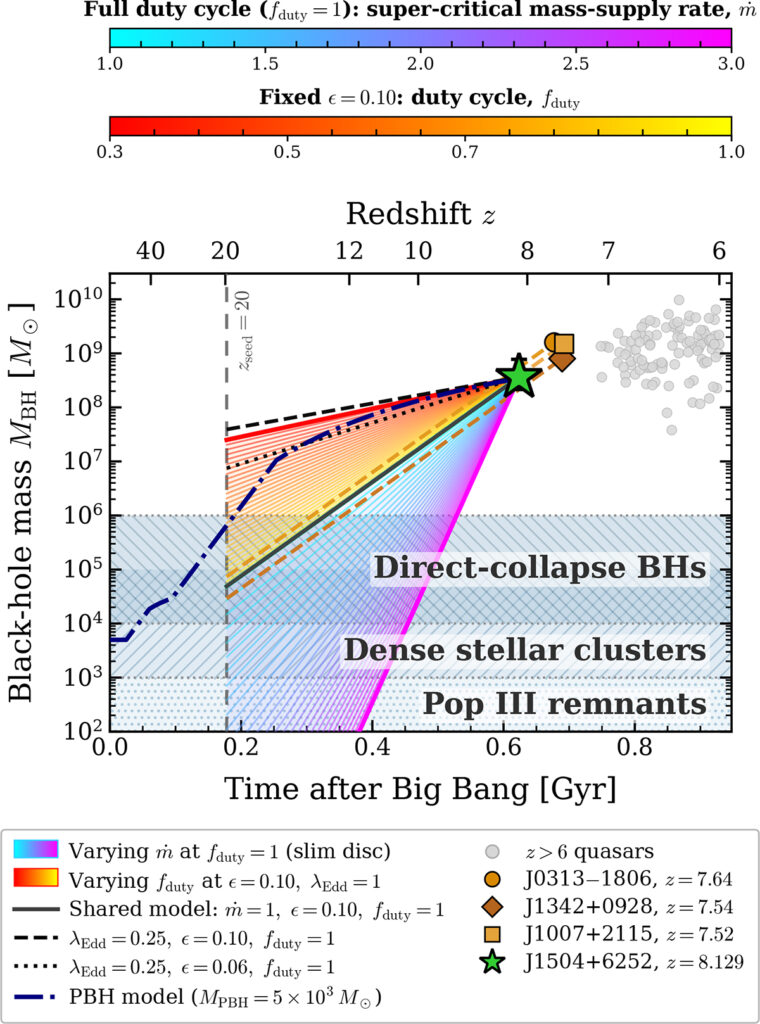
The catch lies in the scales. Black hole masses at this distance come from single-epoch estimates, recipes calibrated on nearby quasars that convert a line width and a brightness into a mass. Different recipes give central values from about 210 million to nearly 800 million Suns, and the authors state plainly that this one object cannot tell the formation pathways apart. A modest boost from an unseen gravitational lens cannot be excluded either, although Euclid’s images show no arcs or doubled images. The numbers are also tiny. Scaling earlier predictions, the team expects perhaps two to six such quasars in the sky searched so far, and confirming this one took four observatories and half a year.
Dún Aonghasa’s namesake stands where the island stops and open ocean begins. The quasar sits at a similar edge in time, at the current limit of what astronomers can see. Beyond it lie the first few hundred million years, when the seeds of these giants were planted. That this one turned up already fully grown, and resting, suggests the planting began even earlier than the models would like.
