

A massive star spends millions of years building itself in layers. Hydrogen and helium sit on the outside, carbon, neon, oxygen and silicon burn in shells further in, and iron collects at the centre once there is nothing left worth fusing. The textbook picture keeps those shells tidily stacked until the end. New Webb observations of Cassiopeia A dust suggest that one star broke the pattern in its final hours, and the evidence survived the explosion in grains of sand and soot.
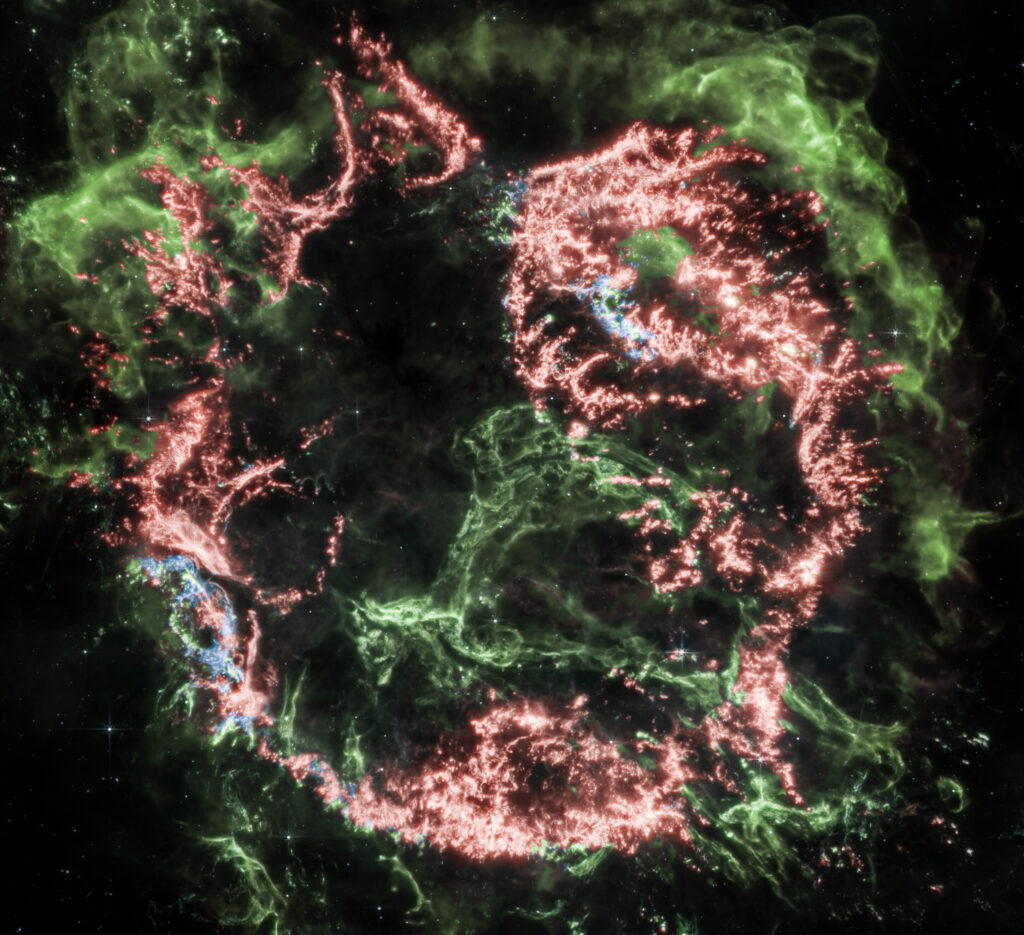
The study, led by Tea Temim of Columbia University, was published on 23 November 2026 in The Astrophysical Journal Letters. It uses the Mid-Infrared Instrument (MIRI) on the James Webb Space Telescope (JWST) to study Cassiopeia A, or Cas A, the wreckage of a star that exploded about 11,000 light-years away. Light from the blast reached Earth roughly 340 years ago, which makes Cas A the youngest known remnant of an exploded massive star in our galaxy. Its debris now spans about 10 light-years.
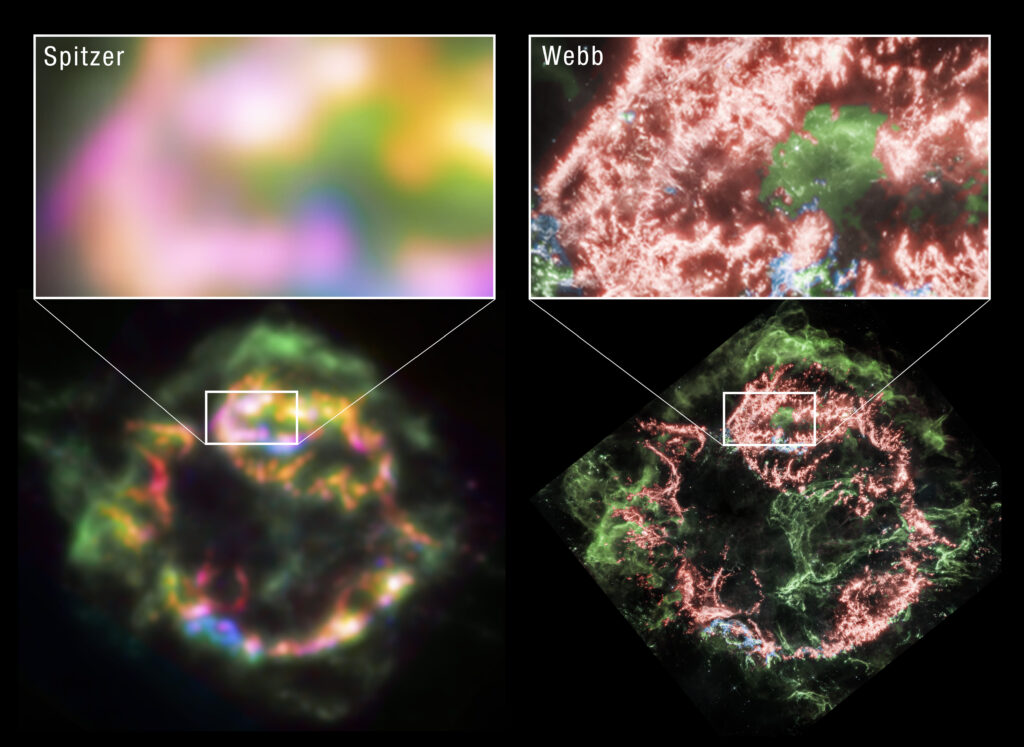
Dust makes a good witness because its chemistry depends on the gas it condensed from. Older maps from NASA’s retired Spitzer Space Telescope could flag promising regions, but they blurred many clumps of debris into one smudge. Webb is sharp enough to isolate individual clumps, each roughly the size of our Solar System, and read their make-up from the way they glow in infrared light. The team pointed it at three regions picked from the Spitzer data.
Two of those regions sit in the reverse-shocked zone, where a shock wave rebounding inward slams into debris still coasting outward from the blast. One patch turned out to be dominated by silica, the mineral of sand and glass. The other is dominated by carbon dust. The third target is the Green Monster, a green loop Webb first picked out in 2023. Its dust is rich in complex magnesium silicates, and it is not explosion debris at all: it formed from material the star shed before it died.
So why would two neighbouring clumps of ejecta make such different dust? The answer the team favours is a shell merger. In this late stage of a star’s life, the boundary between two burning layers gives way: the oxygen-burning shell swallows the carbon and neon layer above it, and violent convection (the churning that moves heat through a pan of boiling water) burns neon and carries freshly made silicon outwards. That reshuffles which elements travel together when the star blows apart, and so which grains can later form. Webb found signs of this mixing across much of the remnant.
X-ray astronomers got there first. Data from NASA’s Chandra X-ray Observatory and the JAXA-led XRISM mission had already hinted at a merger, and a 2025 analysis by Toshiki Sato and colleagues argued that the mixing began within about 10,000 seconds of the core collapsing, a matter of a few hours. A newer Chandra study, posted as a preprint in October 2026 and not yet peer reviewed, found the mixing was lopsided, with neon-rich debris concentrated to the north and oxygen and silicon-rich material more prominent to the southeast. Webb’s dust now points the same way. Co-author Dan Milisavljevic of Purdue University described it as showing “what was happening, we think, in the hours leading up to core collapse”.
The result matters for two reasons. Very young galaxies in the early Universe hold large amounts of dust, and supernovae are a leading suspect for making it, yet observations have struggled to account for all of it. Knowing which grains form in which parts of the debris helps astronomers estimate how much dust an exploding star really delivers to its galaxy. The second reason is subtler. Sato’s group argues that unevenness inside a star just before collapse could help drive the explosion itself, and even shape how fast the leftover neutron star is kicked across space.
There is a catch: this is one remnant, studied in close detail at three hand-picked spots. Linking dust types back to a merger relies on comparing the measured chemistry with models of how the star’s interior evolved, and the researchers frame their conclusion with care rather than certainty. Whether shell mergers are common among massive stars, or a quirk of this one, is a question Cas A alone cannot answer. The dust budget problem is not solved either; this work explains which dust formed here, not whether supernovae make enough of it.
Still, the method is the real prize. A star that exploded centuries ago cannot be observed directly, but its last few hours appear to be preserved in specks of silica and carbon drifting through the wreckage, waiting for a telescope sharp enough to read them.
