

Almost everything known about the ground on Titan, Saturn’s largest moon, comes from radar maps, infrared glimpses through a thick orange haze and one brief look from the Huygens probe in 2005. NASA’s Dragonfly rotorcraft is designed to change that by flying from site to site across the surface. This month it gained the equipment that will let it see where it is going.
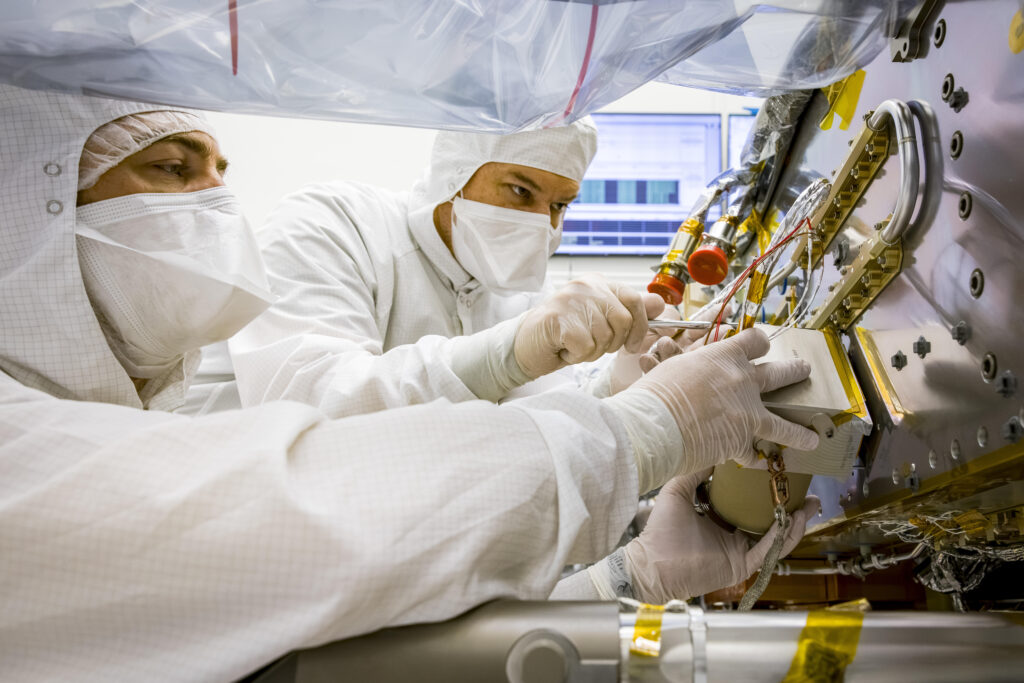
By mid-November, technicians at the Johns Hopkins Applied Physics Laboratory (APL) in Maryland had installed all seven cameras of the DragonCam suite on the car-sized lander, NASA reported on 24 November 2026. The cameras were built by Malin Space Science Systems. They are the first of Dragonfly’s science instruments to arrive, and they returned test pictures on 9 November.
Each camera has a job. A forward wide-angle camera with a 90-degree field of view works alongside a medium-angle camera that sees part of the same scene in finer detail, giving stereo views of the terrain ahead. Two side-mounted cameras complete the panoramas. Two more point straight down to judge whether a spot is safe for the drill and the seismometer, while a microscopic imager studies millimetre-sized sand grains at the drill site. All of them peer out through windows in a foam enclosure, because Titan’s surface sits at about minus 179°C (minus 290°F).
Light is the other problem. A Titan night lasts nearly eight Earth days, so an onboard array of LEDs spanning infrared to ultraviolet will light up the ground, reveal the colour of its materials and possibly make some organic molecules fluoresce. That context matters. The 875 kg rotorcraft, lifted by eight sets of coaxial rotors, should visit 20 to 30 sites over a primary mission of more than three years, and every sample it drills needs a picture of where it came from.
The catch is time. The mass spectrometer, the drill, the gamma-ray and neutron spectrometer and the weather and seismic package still have to be delivered and tested over the coming months. Dragonfly is not due to launch until July 2028, and it will not reach Titan until late 2034.
For now, the test panorama shows a cleanroom in Maryland, tinted yellow because the cameras record light differently from the human eye. The next views of that kind should show dunes that no one has ever seen up close.
