

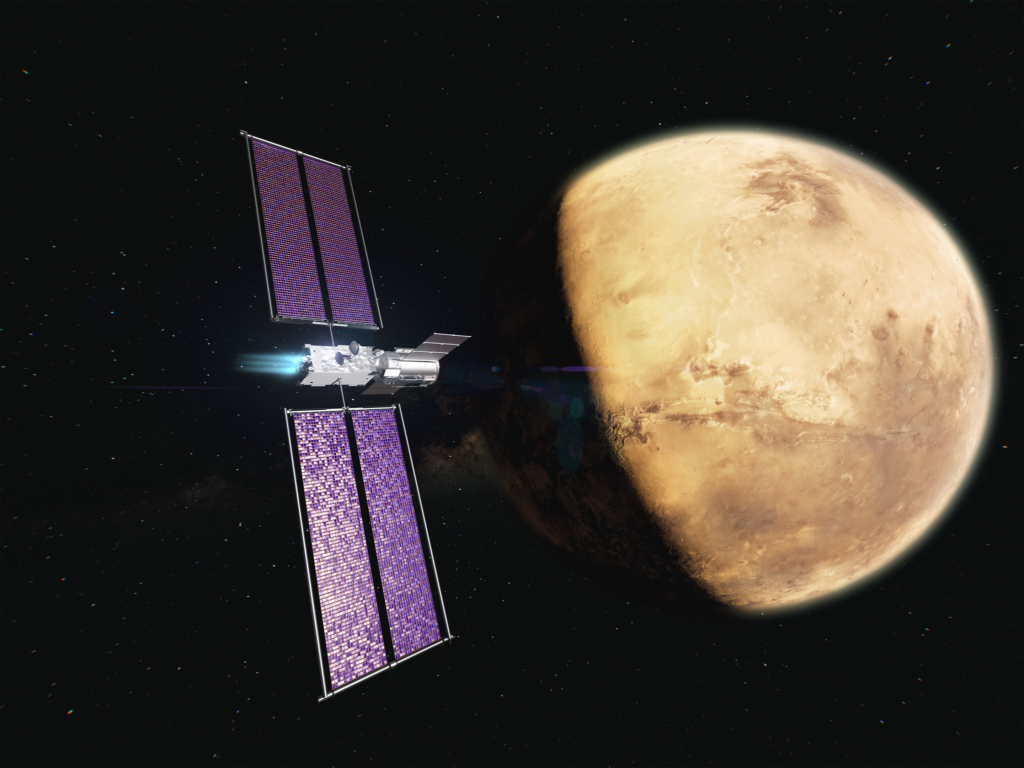
Every spacecraft is a power budget with a mission attached. Close to the Sun the budget balances itself: unfold a solar array and sunlight pays the bills. Further out, or through a long lunar night, the sums turn harsh. NASA’s answer is to carry its own power station. On 24 November 2026 the agency said it had locked in the main design of Space Reactor-1 (SR-1) Freedom, the spacecraft meant to become the first fission-powered craft to travel beyond Earth orbit.
Engineers from NASA, the US Department of Energy and industry settled the choices at a mission design review held in October at NASA’s Glenn Research Center in Cleveland. According to NASA’s announcement, the team chose a shorter boom between the reactor and the main body of the spacecraft, which saves weight and simplifies assembly. Better shielding means the reactor can now sit closer to the rest of the craft while still protecting its electronics and cargo from radiation. The communications system is getting larger X-band dishes for the long haul home. Launch is targeted for late 2028, with arrival at Mars in 2029.
The machine itself is a chain of energy conversions. At the tip of the boom sits a reactor designed by the Department of Energy’s Idaho National Laboratory and fuelled with high-assay low-enriched uranium (HALEU), a grade richer than ordinary power station fuel but far below weapons grade. Its heat drives a closed Brayton cycle supplied by Sierra Lobo: a sealed loop of gas is heated, spins a turbine and generator, is cooled, and goes round again. Hall thrusters then use the electricity, stripping electrons from a propellant gas and flinging the resulting ions out of the back with an electric field. The push is gentle. It also uses propellant far more sparingly than any chemical rocket.
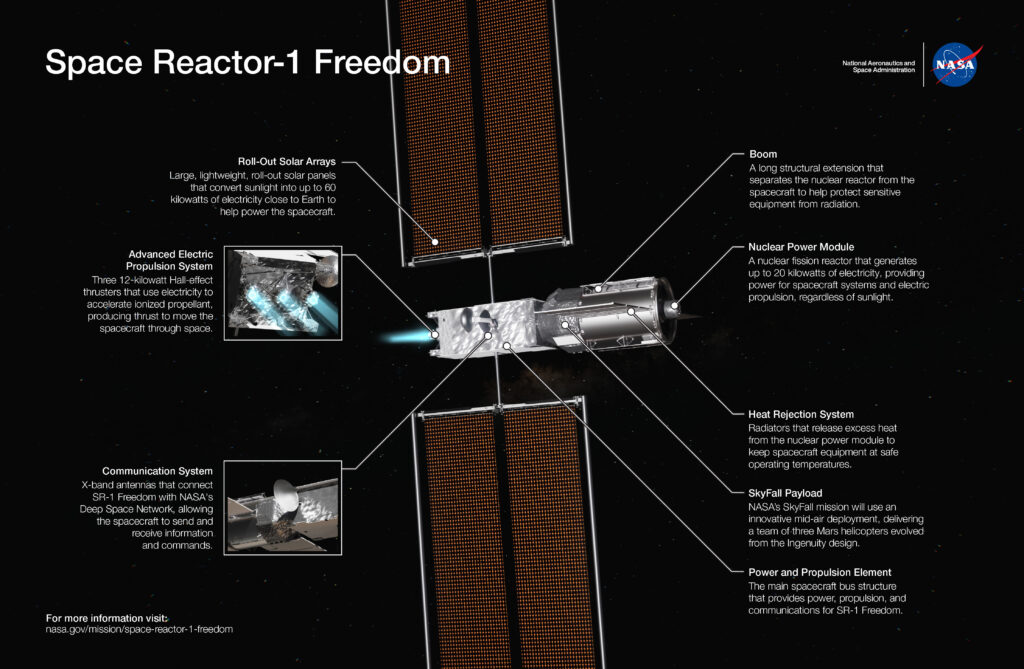
In raw numbers, the scale is modest by design. According to the mission page, the spacecraft weighs about 12,000 kilograms and the reactor system delivers 20 kilowatts of electricity. Its bus, the Power and Propulsion Element, is rated at 48 kilowatts and drives a 12 kilowatt Hall thruster from NASA’s Advanced Electric Propulsion System. The reactor will therefore supply well under half of what the spacecraft can use. For a pathfinder, proving the principle is enough.
Heat may be the hardest problem of all. A heat engine only works if it can throw away the heat it fails to convert, and in a vacuum the only way to do that is to radiate it from large panels. NASA has given Johns Hopkins University’s Applied Physics Laboratory a $39.3 million contract to design, build and test this heat rejection system, with Advanced Cooling Technologies providing heat pipes and composite radiators. How many radiator panels SR-1 will carry is one of the questions the review left open.
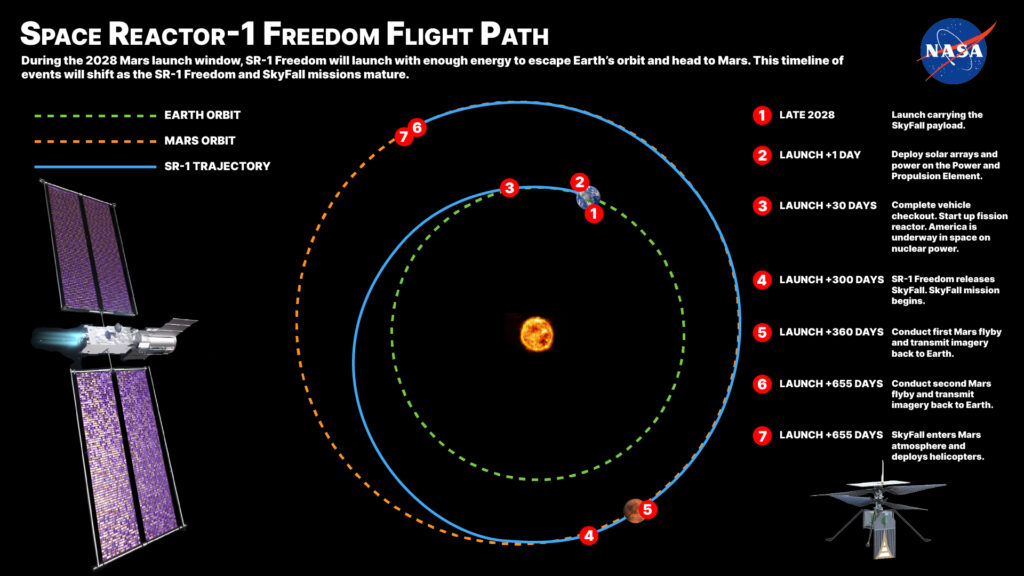
The flight plan is cautious. The reactor stays switched off until the spacecraft has left Earth orbit. Once clear, it starts up and its power is raised gradually; it then runs for an initial period while performance data stream home, and shuts down. Solar arrays carry the cruise to Mars, where the spacecraft makes several flybys and releases SkyFall, a capsule holding three helicopters descended from Ingenuity. They will deploy in mid-air and use ground-penetrating radar and cameras to search for buried ice. With the delivery done, the reactor is restarted to gather more data.
SR-1 is a rehearsal for something larger. NASA plans a follow-on, Lunar Reactor-1, to keep its Moon Base running through the lunar night and in places where solar power alone falls short. Flying a reactor in open space first, without the added risk of a landing, lets engineers test the hardware, the supply chain and the safety approvals one step at a time. Programme director Steve Sinacore described the mission as “the first freight run on the railroad of the solar system”.
The catch is that much of SR-1 is still on the drawing board. The review left the reactor’s output level, how long it will run and the number of radiators to be decided. The reactor and its Brayton converter are still in development, and the heat rejection contract has only just been awarded. The deadline cannot move either: Mars launch windows open roughly every two years, and missing the late 2028 opportunity would mean a long wait. Readers should also be clear about what this demonstration is not. For most of the journey, the Sun will be doing the work.
If SR-1 flies, the helicopters will make the headlines. The more valuable cargo will be quieter: a log of temperatures, power levels and thruster hours from a reactor running far from home. Every future outpost that has to keep the lights on through a long dark night will be reading it.
