

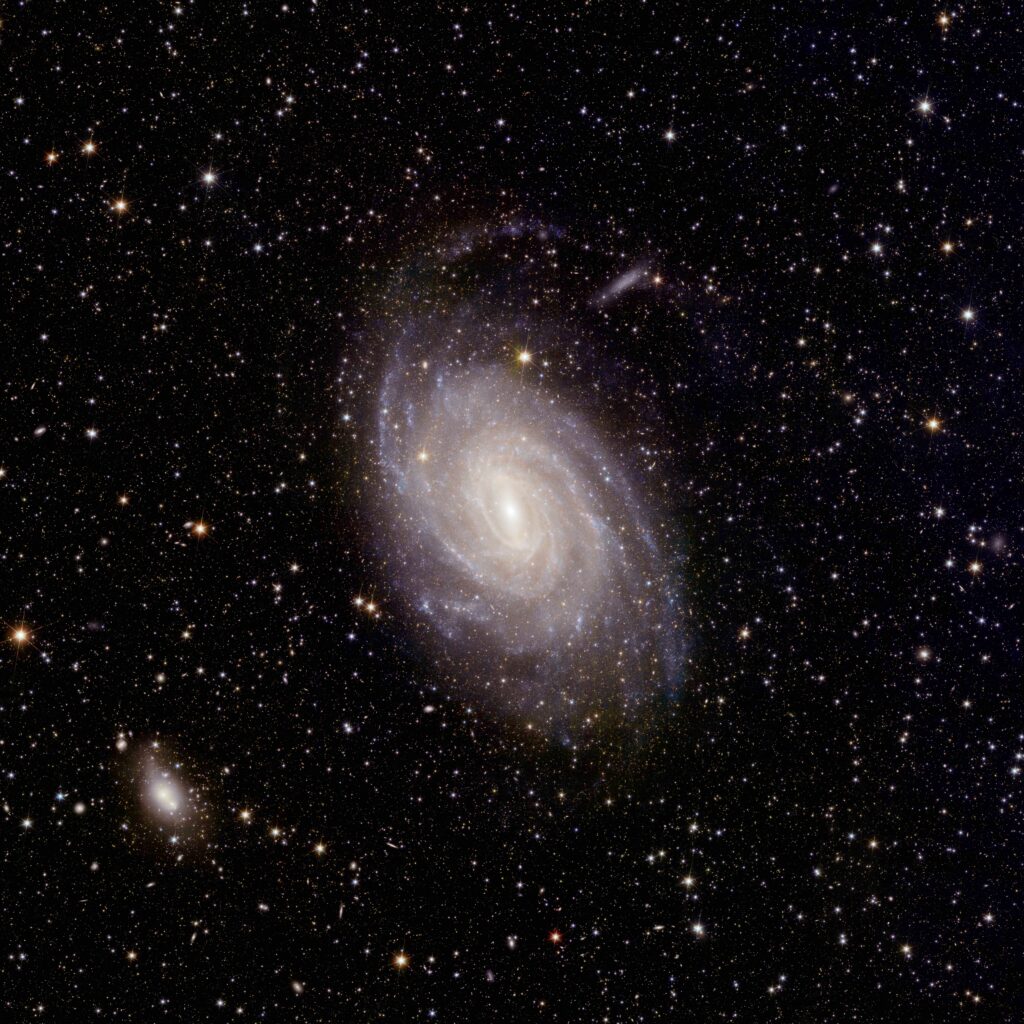
Astronomers almost never see a star before it explodes. The usual routine is to spot the blast, then search old images for whatever sat there. For one unusually feeble explosion in a galaxy about 30 million light-years away, that search came up empty in a far more useful way. A deep image from the European Space Agency’s Euclid telescope, taken 11 months before the blast, shows no bright star at the site, and that absence rules out most of the suspects behind what is possibly the faintest supernova ever recorded.
The explosion, SN 2024vjm, was picked up on 13 September 2024 by the BlackGEM telescope array at La Silla in Chile, on the outskirts of the spiral galaxy NGC 6744. An international team led by Erez Zimmerman and Avishay Gal-Yam of the Weizmann Institute of Science followed it with telescopes on the ground and in space, including the James Webb Space Telescope (JWST). Their analysis was published in Nature Astronomy on 26 November 2026, following a preprint posted in February.
It belongs to a rebellious offshoot of the Type Ia family. Ordinary Type Ia supernovae are thermonuclear explosions of white dwarfs, the dense cores left behind by Sun-like stars, and they are so consistent in brightness that cosmologists use them as standard candles to measure the expansion of the Universe. Type Iax events are weaker and far more varied. The leading idea is that a white dwarf feeding on a companion star ignites but fails to blow itself apart completely. The faintest examples never fitted that picture well, and some researchers suspected collapsing massive stars instead.
This is where Euclid’s timing paid off. The telescope, built to map dark matter across billions of galaxies, imaged NGC 6744 on 4 October 2023 as one of its early release observations. By averaging nearly 300 BlackGEM images, the team pinned the supernova’s position to within 10 milliarcseconds, smaller than a single Euclid pixel. No point source sits in that pixel. Even if every scrap of light there belonged to a progenitor star, it would be fainter than the luminous blue star found before the brighter Iax event SN 2012Z, and fainter than the source linked to another faint example, SN 2008ha.
That limit clears most of the line-up. Massive hydrogen-rich stars, most Wolf-Rayet stars (massive stars stripped of their outer hydrogen) and helium giants like the one proposed for SN 2012Z all fall above the threshold. What survives are dim systems: a white dwarf paired with a low-mass star, two white dwarfs together, or a white dwarf drawing material from a hot subdwarf, a small helium-burning star. The team concludes that a massive star origin is unlikely and that SN 2024vjm was a white dwarf going off.
Its light supports that verdict. Thermonuclear supernovae shine by the radioactive decay of nickel-56, and the light curve of SN 2024vjm can be explained by that decay alone, with no other power source required. There was very little nickel to go round: the preprint puts it at about 0.0036 times the mass of the Sun, roughly a hundred times less than a normal Type Ia produces. At its peak the supernova reached an absolute magnitude of about minus 12.7 in blue light, the faintest of any well observed supernova; one rival, SN 2021fcg, may have been dimmer but was too poorly observed to be sure.
The surprise is in how it faded. Normal Type Ia supernovae follow the Phillips relation, in which fainter explosions fade faster, and that rule is what turns them into cosmic yardsticks. SN 2024vjm does the opposite. It dimmed more slowly than brighter members of its class, and the spectra explain why. Its debris spread outwards at around 3,000 kilometres per second at first and fell below 1,000 kilometres per second within three weeks of peak, a gentle drift by supernova standards. Packed that densely, the ejecta trapped gamma rays from the radioactive decay for 70 to 80 days, against roughly 30 to 45 days in ordinary Type Ia events, so the glow leaked out slowly.
A tenth of a solar mass of debris has a further consequence. Even the lightest white dwarfs weigh more than that, so the explosion must have left something behind: a surviving remnant star, scorched but intact. Knowing every way a white dwarf can explode also helps cosmologists keep such oddballs out of the standard candle samples used to measure dark energy.
The case is not closed. The Euclid result is an upper limit rather than a detection, and diffuse light from a nearby smudge the team calls S1 spills into the key pixel, so any real progenitor is probably fainter still. A few massive star systems could also slip under the limit, though the lack of bright young stars nearby argues against them. The reversed brightness trend among faint Iax events rests on a handful of objects and amounts to only about a two sigma correlation, well short of firm.
That should change as surveys go deeper. The Vera C. Rubin Observatory will catch many more faint transients, while Euclid and the Nancy Grace Roman Space Telescope keep photographing galaxies before anything happens in them. Each new explosion will arrive with its before picture already on file. For SN 2024vjm, the most revealing thing in that picture was an empty pixel.
