

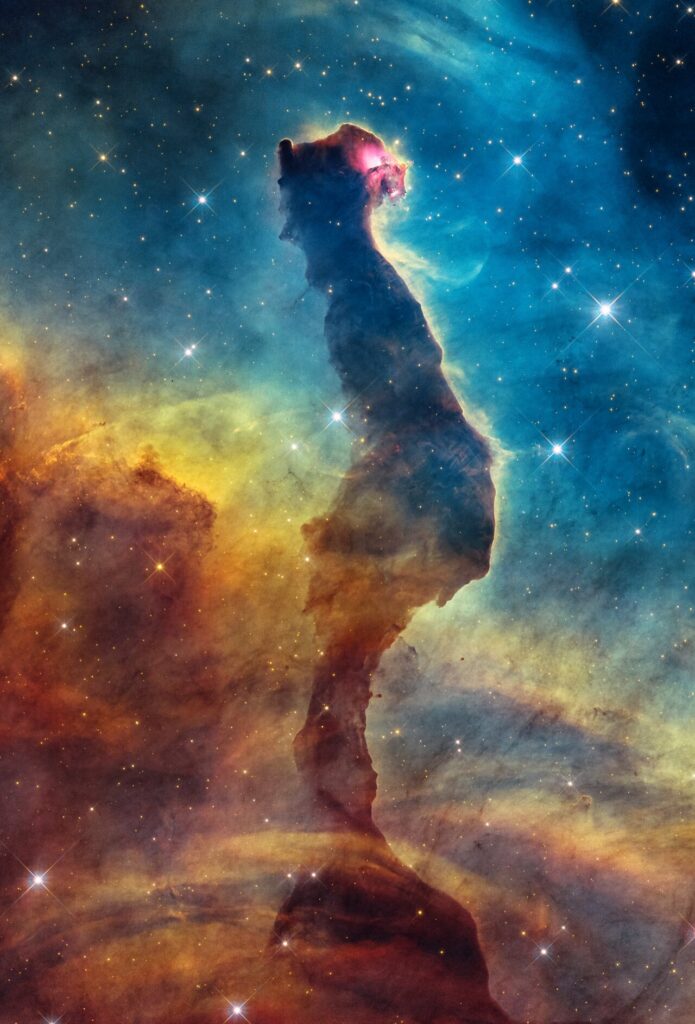
Star-forming clouds do not get to grow old quietly. In the Carina Nebula, about 7,500 light-years away, the most massive stars flood their surroundings with ultraviolet light and fierce winds, stripping away the gas that could build their successors. New views from the Hubble Space Telescope and the James Webb Space Telescope (JWST) show one small holdout: the Cat’s Head Nebula, a dusty pillar shaped like a cat sitting with its back to the viewer, head turned and one eye glowing.
NASA, ESA and the Space Telescope Science Institute released the images on 29 October 2026. Hubble photographed the pillar in visible light, through filters that pick out glowing oxygen, hydrogen and sulfur as well as starlight scattered by dust. Webb observed the same patch with two instruments, its near-infrared camera (NIRCam) and its mid-infrared instrument (MIRI). No research paper accompanies the release. This is a picture to read, not a result to cite.
In Hubble’s view the cat is an opaque brown silhouette. Along its right edge runs a hazy yellow rim of ionised gas, meaning atoms that ultraviolet light from nearby massive stars has stripped of electrons. That rim is probably where photoevaporation is under way: radiation heats the surface of the cloud until its gas boils off into space. The denser core of the pillar resists for now, which is why it survives as a recognisable shape.
Infrared light slips through dust far more easily, so Webb sees what Hubble cannot. In the near-infrared image the pillar turns semi-transparent and a dense field of stars appears, some still wrapped in dust. The red eye resolves into what looks like a young star buried in the cloud, and a faint jet from the cat’s belly may trace an outflow from another newborn star. MIRI picks up warm dust and polycyclic aromatic hydrocarbons, carbon-based molecules that glow when starlight excites them.
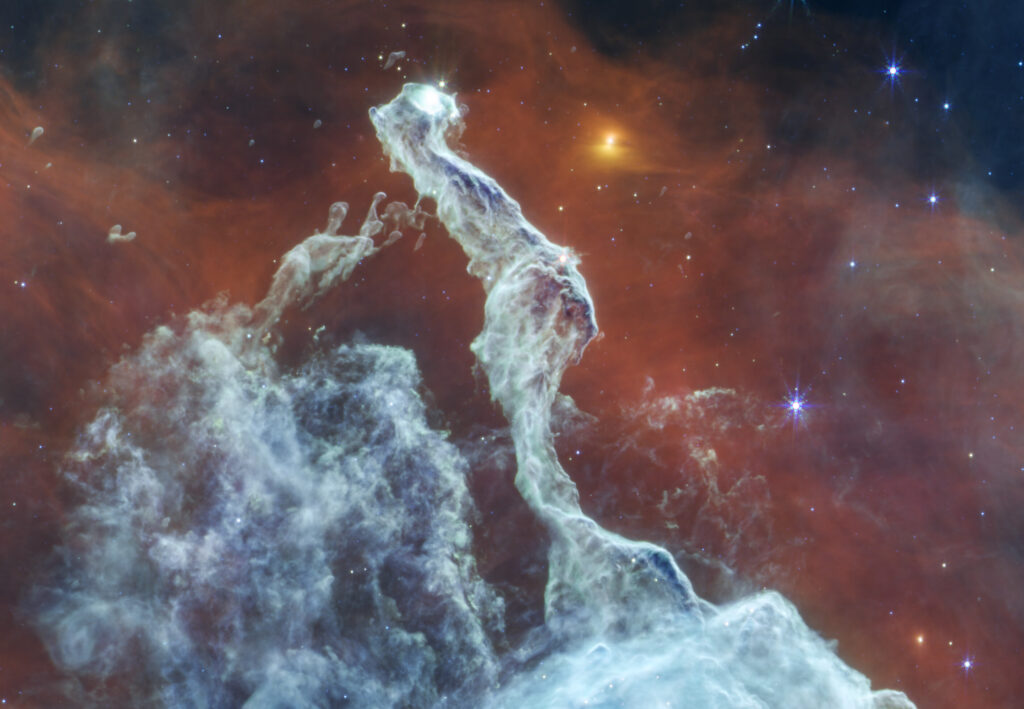
Pillars like this are where Carina builds its next generation of stars, under the same radiation that is tearing them down. A day earlier, a Chandra and Webb image of another ghostly Carina cloud used X-rays to pick out young stars hidden inside it. The catch is that pictures alone cannot settle the details. Colour changes in the MIRI image may reflect shifts in molecular emission and local irradiation rather than temperature, and a bright source to the right of the pillar sits on a narrow filament that may or may not be physically linked to it.
Spectra, not snapshots, will decide those questions. For now the cat sits in the glare and holds its pose. It will not last, but the stars forming inside it should long outlive the pillar that made them.
