

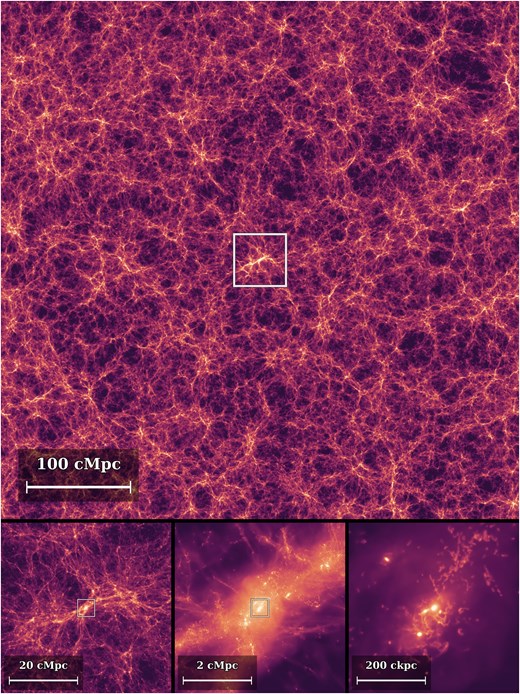
The early universe was cleared of its fog twice. The first time, ultraviolet light from young galaxies stripped electrons from the hydrogen gas filling intergalactic space, a change astronomers call reionisation. The second clearing, helium reionisation, needed far harsher light, and a new simulation called Lumina suggests it came from feeding supermassive black holes. Lumina is the first model to follow both transitions in the same virtual universe, letting each one shape what happens next.
Led by Oliver Zier of the Center for Astrophysics | Harvard & Smithsonian, a former postdoctoral researcher at MIT, the work was published in Monthly Notices of the Royal Astronomical Society on 26 October 2026. Its 11 authors include researchers from MIT, the University of Texas at Dallas, York University in Canada and the Max Planck Institute for Astrophysics in Germany. Lumina builds on IllustrisTNG, a widely used simulation of galaxy formation, and adds a model of how radiation travels through gas. It ran on Frontier, a supercomputer at Oak Ridge National Laboratory in Tennessee, at its peak using around 15,000 graphics processors.
Size is the point. Lumina follows a cube of space 500 megaparsecs on a side, about 1.6 billion light-years, roughly 100 times the volume of earlier simulations of this kind. Inside it, about half a trillion elements (dark matter particles and cells of gas) evolve from about 45 million years after the Big Bang through the first two billion years. “One of Lumina’s major advantages is its sheer size,” says co-author Xuejian Shen of MIT. The bright, hungry black holes that matter most are rare, and a smaller box might contain hardly any.
The two transitions differ because of how tightly atoms hold their electrons. Stripping hydrogen takes photons carrying at least 13.6 electronvolts, ultraviolet light that young stars produce in abundance. Removing helium’s second electron takes 54.4 electronvolts, four times as much, and few stars shine that hard. In Lumina, starlight completes the hydrogen job in most of the volume by redshift 5.2 (redshift is a measure of cosmic time in which larger numbers mean earlier), though stubborn neutral patches linger until redshift 4.75. Helium holds out longer: its second electron gives way as accreting black holes come into their own, and the process is nearly complete by redshift 3.
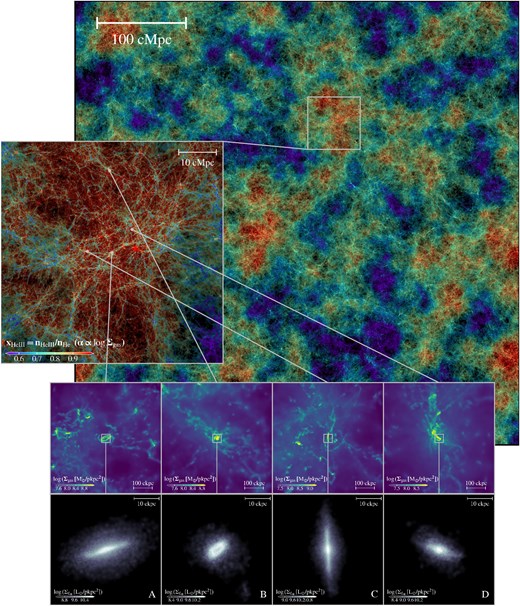
That division of labour has consequences astronomers can check. Helium reionisation heats intergalactic gas, and the simulation shows a clear late rise in temperature as the black holes do their work. Observers estimate that temperature from the way intervening gas absorbs the light of distant quasars, so Lumina hands them a prediction to test. The team reports that the simulated universe scatters the cosmic microwave background, the Big Bang’s afterglow, by an amount that agrees well with measurements from the Planck satellite. The collaboration is also making Lumina available for comparison with observations from telescopes such as the James Webb Space Telescope and the Nancy Grace Roman Space Telescope.
There is a catch, as there always is with simulations: they are only as good as the physics fed into them. The share of starlight allowed to escape each galaxy was fixed at 18 per cent, calibrated in smaller test boxes rather than calculated from first principles. To keep the run affordable, light in the simulation travels at a fifth of its true speed, a common shortcut that the authors acknowledge may bias the final stages, when ionised bubbles merge. Black hole growth, the engine of the helium result, rests on simplified recipes for how gas falls in and how energy comes back out. The helium finding is a prediction that fits current constraints, not a measurement.
Still, the picture that emerges has a pleasing symmetry. Stars lit the first lamps. Much later, the universe’s hungriest objects finished the job, clearing what remained with light too harsh for most stars to make.
