

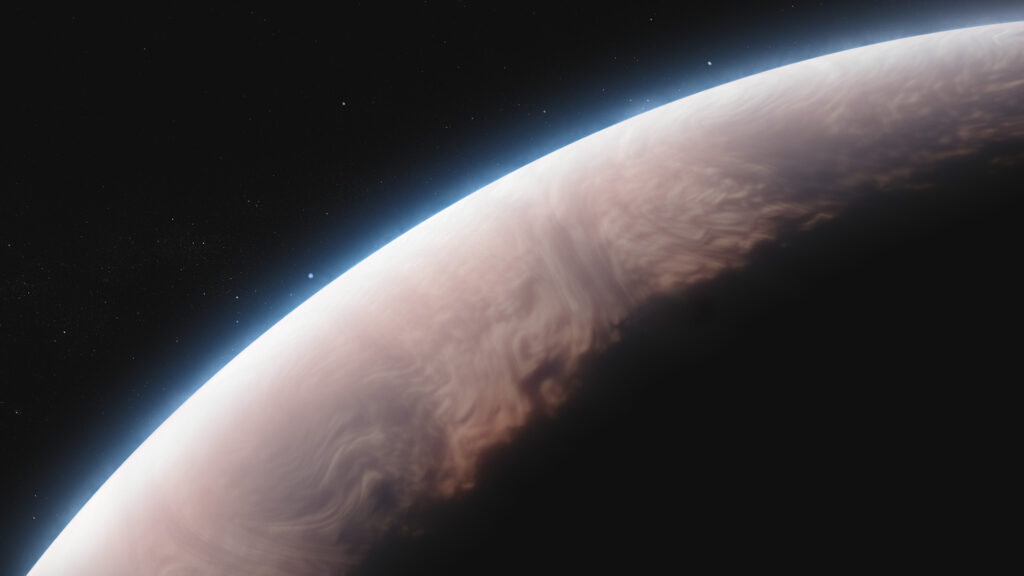
Astronomers usually picture a distant planet’s atmosphere as a neat ring of light, the same thickness all the way round. That keeps the maths manageable, but it is wrong, as a team using the James Webb Space Telescope (JWST) has now shown. Their map of the hot Jupiter atmosphere of WASP-17b, seen against its star from about 1,300 light-years away, reveals a slightly squashed outline with one side puffed up more than the other.
The work, led by Lili Alderson of Cornell University with Hannah Wakeford of the University of Bristol, was published in Nature Astronomy on 14 October 2026. It used observations from the TST DREAMS programme and a technique the Bristol group calls transmission strings.
When a planet crosses its star, starlight filters through the thin ring of gas at its edge, known as the limb, and each gas leaves its fingerprint in the spectrum. Standard analysis blends the whole limb into one averaged spectrum. Transmission strings instead separate the light arriving from different angles around the edge. That reveals how far the atmosphere extends at each point.
WASP-17b makes a forgiving test subject. It is about twice Jupiter’s width but less than half its mass, circles its star every 3.7 days and reaches roughly 1,500°C (2,700°F), according to NASA. It is also tidally locked, so one face sits in permanent daylight.
The map shows the evening side of the equator standing taller than the morning side. Winds carry heat away from the dayside and inflate the atmosphere as it crosses that edge. Gas that has cooled over the nightside arrives at the morning limb shrunken. Water and carbon dioxide look fairly even around the limb, and the temperature contrast between the two sides matches what theory predicted.
That agreement matters more than it sounds. A 2025 JWST study of nine hot gas giants, posted as a preprint and not peer reviewed at the time, found that cloudy mornings and clear evenings can distort averaged spectra. Averaging can inflate estimates of metallicity (the share of elements heavier than helium) as much as a hundredfold. Reading each limb directly removes that guesswork.
This is one planet and a proof of concept. Hot Jupiters are big, hot and puffy, which makes their limbs far easier to read than those of the small rocky worlds astronomers most want to study. Separating conditions by latitude has barely begun, and mapping weather remains future work. As Wakeford puts it, “Planets are temperamental, their atmospheres complex and chaotic.”
Of the more than 6,000 confirmed exoplanets, nearly all are still drawn as perfect circles in the equations. WASP-17b now has a lopsided one. It will not be the last.
