

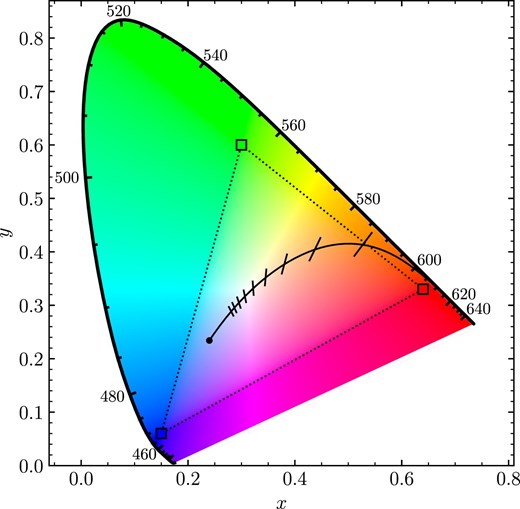
Ask an astronomer what colour a star is and the honest answer is a temperature. Cool stars glow orange-red, hot ones blue-white, and almost everything in between follows the same well worn track, because starlight behaves much like the glow of an idealised hot object whose colour depends on heat alone. That track runs from red through yellow and white to blue. It never passes through green. A new study of white dwarf colours has now found a star that would look green to a human eye, along with others in pink, cyan and yellow.
The work, led by Mark Hollands at the University of Warwick, was published on 15 October 2026 in RAS Techniques and Instruments. White dwarfs are the exposed cores of stars like the Sun, which have stopped burning fuel and now simply cool. None is close or bright enough to show its colour to the naked eye, so the team worked it out instead. They took routinely collected spectra and ran them through the standard model of human colour vision, the same 1931 colour matching functions that underpin the colours on a computer screen.
Density explains the odd colours. The atmospheres of the coolest white dwarfs reach about one gram per cubic centimetre, roughly the density of water and millions of times denser than the visible surface of the Sun. At that crush, trace elements such as carbon, calcium and sodium absorb light across far broader stretches of the spectrum than they would in an ordinary star. Whole chunks of the rainbow go missing. Carbon-rich white dwarfs end up pink or purple, while those polluted by debris from asteroids and comets lean towards yellow.
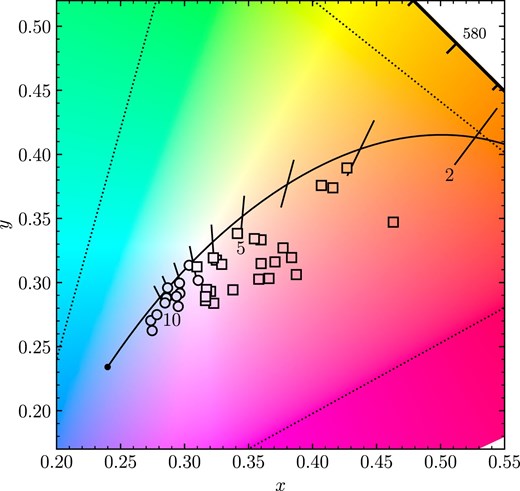
Cooler white dwarfs with a mixture of hydrogen and helium in their atmospheres take a different route. Collisions between hydrogen molecules and helium atoms suppress their infrared light, pushing the remaining glow towards the blue and giving them a cyan or pale blue cast. The green star, WD J1330+6435, is stranger still. At about 4,000°C its atmosphere is laced with calcium, lithium and sodium from rocky material it has swallowed. The sodium absorbs the orange part of the spectrum, and what survives looks chartreuse. Hollands put it simply: “It feels like something out of science fiction.”
At the other extreme sits WD J1011+2845, only about 48 light years from Earth and, the authors argue, probably the reddest star known in perceived colour. Its temperature is around 4,300 kelvin (the kelvin scale starts at absolute zero), and a deep convection zone dredges carbon up to its surface. There the carbon forms molecules that push almost all of its light beyond 600 nanometres, into the orange and red. The result is a deep salmon pink.
The more useful finding may be about ordinary white dwarfs. Of 151 within 20 parsecs (about 65 light years) of Earth, only five stood out, two yellow and three pink, which suggests that roughly one white dwarf in 30 is unusually coloured. The rest have a median colour temperature of about 6,800 kelvin, which the eye reads as white. Textbooks and artists often paint these stars blue. That habit, the team says, comes from surveys selected by brightness, which favour the hotter, bluer and more luminous examples. The average white dwarf, it turns out, really is white.
That matters beyond the pleasure of getting a picture right. A white dwarf’s colour is a compact summary of what is in its atmosphere, and polluted white dwarfs are one of the few places where astronomers can measure the chemistry of rocky planetary material from other systems. The paper also sets out how atmosphere models can produce colour accurate images of stellar discs, a practical tool for anyone who has to show these objects to the public or to students.
The catch is that nobody has seen any of these colours. Every one is calculated, and the method assumes daylight vision, which is not how a dark adapted eye at a telescope works. Some of the most saturated colours also fall outside what a standard screen can display, so the images are approximations. For the infrared faint and carbon-rich stars, the authors used observed spectra because current models struggle to reproduce their extreme features, and they stress that those objects were hand picked rather than representative. The one in 30 figure rests on just five stars.
Even so, the green star is a fine thing to know about. Here is a dead stellar core, far too faint to see unaided, whose colour is set by the remains of rocky bodies that strayed too close. Its tint is a chemical fingerprint of what it has eaten.
