

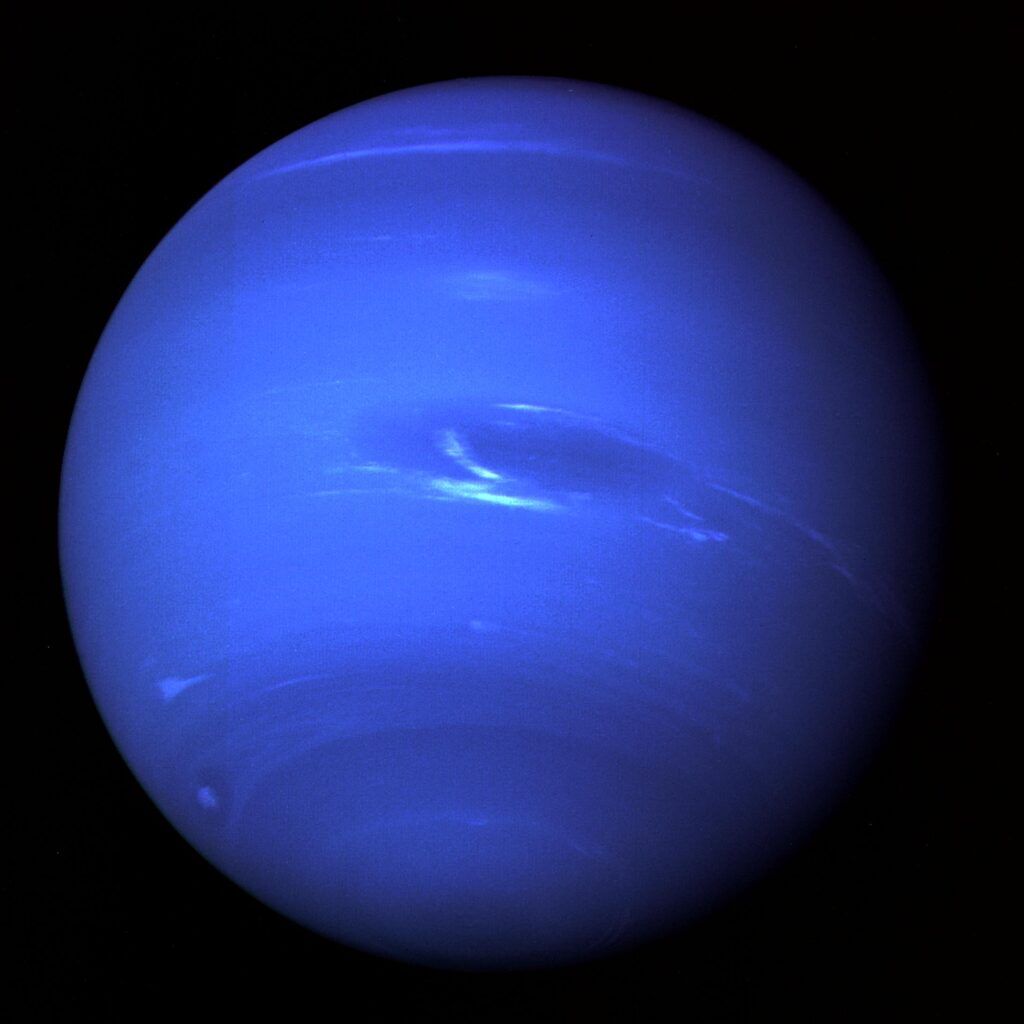
Nobody has ever seen most of what Uranus and Neptune are made of. Beneath their blue hazes lie deep layers of water, ammonia and methane squeezed to pressures far beyond the reach of any probe, so the only way to learn how that water behaves is to recreate its conditions on a laboratory bench. A new experiment on compressed water ice suggests the answer is less tidy than physicists expected.
A team led by Ashkan Salamat of the University of Nevada, Las Vegas, working with colleagues at the University of California, Berkeley and Argonne National Laboratory, reported the result in Communications Chemistry on 15 October 2026. They squeezed tiny samples of ice between the tips of two diamonds and pushed them beyond 222 gigapascals (GPa), more than two million times the air pressure at sea level. Intense X-rays from Argonne’s Advanced Photon Source then revealed how the atoms had arranged themselves.
Squeeze many materials hard enough and their atoms settle into simpler, more compact patterns. Ice had seemed to follow that rule. Its high-pressure form called ice-X places its atoms on a neat cubic lattice, a crystal whose repeating unit has three equal sides at right angles. Above 222 GPa, give or take 12, the X-ray pattern showed that cube being pushed out of shape. The data fit two candidate structures with lower symmetry, and the team’s quantum mechanical calculations strongly favour an orthorhombic one, in which all three sides have different lengths.
That matters because models of ice giant interiors rest on assumptions about how water behaves at such pressures, and estimates of those pressures and temperatures still lean on data from NASA’s Voyager programme. The new measurement sets a new upper limit on the pressures at which ice-X is stable, so any model that treats deep water as a simple cubic solid may need another look. Salamat’s own summary, in the university’s announcement, is that water beyond Earth-like conditions “has more complex behavior than we ever previously imagined”.
There are limits. The experiment examined a small solid sample, while the water deep inside Uranus and Neptune is described as molten and metallic-like, so turning a laboratory crystal structure into a picture of a planet’s mantle needs further modelling. The X-ray data alone cannot choose between the two candidate structures; the preferred one rests partly on calculation. The paper is also an early version that may still be edited before its final form.
Release the pressure, the team says, and the ice would likely rearrange into a structure more familiar on Earth. Deep inside an ice giant, nobody is releasing anything.
