

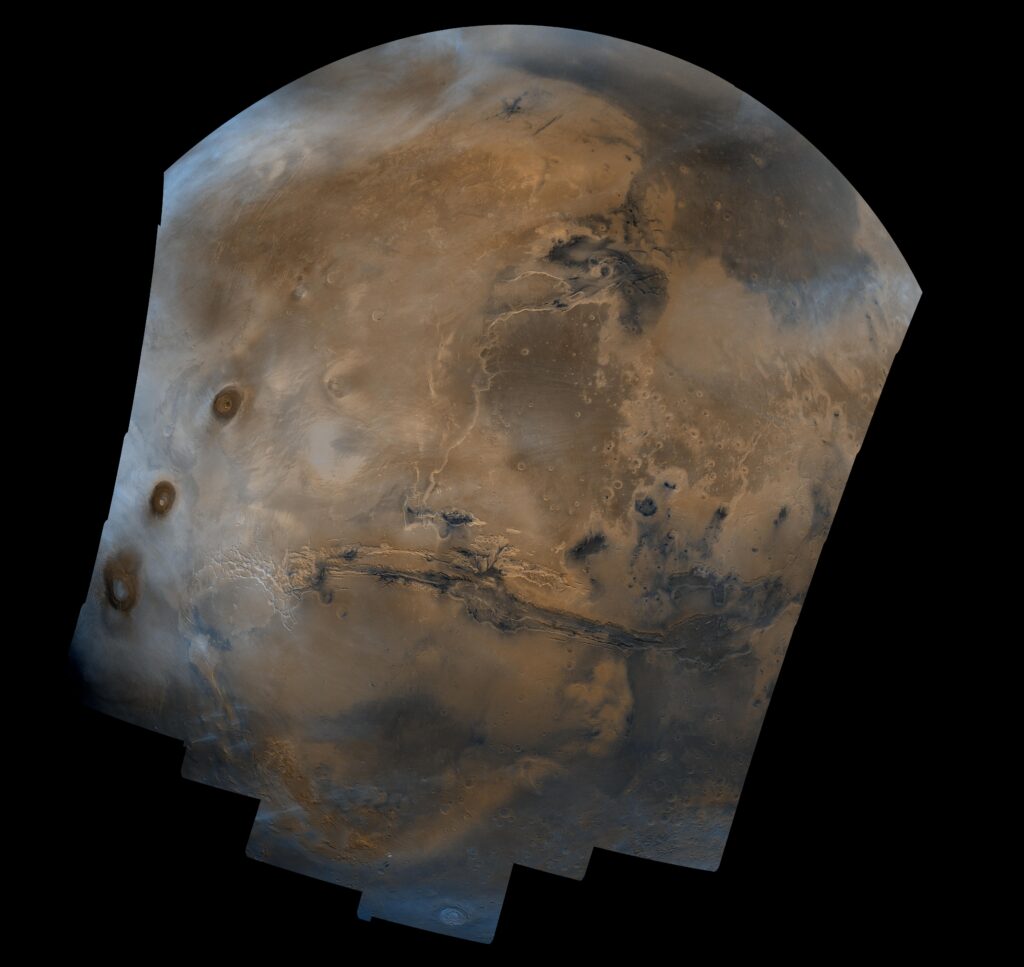
Mars is usually described as a planet whose geological life is largely behind it. Its giant volcanoes are quiet, its global magnetic field is long gone, and its crust has no moving plates to grind against one another. Yet one tremor recorded in 2021 suggests that the largest canyon in the Solar System is still cracking. A new analysis of that Valles Marineris marsquake traces it to faults 20 to 40 km below the surface, which makes this enormous scar an active structure rather than a relic.
The study, led by Jung-Hun Song of Imperial College London with colleagues at Columbia University’s Lamont-Doherty Earth Observatory, is published in Nature Communications. It rests on a single event, catalogued as S0976a, which NASA’s InSight lander picked up on 25 August 2021. The quake came from the opposite side of Mars to the lander. It is also the only marsquake from the mission that could be located in the planet’s western hemisphere, and that location put its source beneath the western end of Valles Marineris.
Some sense of scale helps here. The canyon system runs for nearly 3,900 km, spreads up to 600 km wide and drops more than 9 km deep. Comparing maximum dimensions, Imperial’s release puts it at about nine times the length of the Grand Canyon, more than 20 times its width and roughly five times its depth. It is less a canyon than a crack across a planet.
To work out what happened, the team analysed the amplitudes and directions of the seismic waves that reached InSight and reconstructed the motion at the source. The best fit was a strike-slip rupture, in which two blocks of crust slide sideways past each other along a steep fault. California’s San Andreas Fault moves the same way. The researchers also tested the obvious alternatives. Models of a meteoroid impact, a landslide or other mass movement could not reproduce the recorded waves, and satellite images taken after the event showed no fresh crater and no large new landslide at the source.
That result matters because Mars has no plate tectonics. Its crust behaves more like a single lid that has been cooling slowly for billions of years, so quakes there need a different explanation from most of those on Earth. The authors argue that ancient faults, formed as the canyon opened, remain weak enough to give way under present day stresses. They point to three contributors: the planet’s long-term cooling, the influence of the nearby Tharsis volcanic region and local effects from the canyon itself.
The event also fits a wider pattern. InSight data have now tied active faulting to Valles Marineris, Cerberus Fossae and southern Elysium Planitia, which suggests that stress in the Martian crust differs from region to region rather than being spread evenly. The waves from S0976a passed through the planet’s core on their way to the lander, so the same tremor is also useful for studying the deep interior. As Song puts it, the canyon is no relic, because “faults deep beneath the canyon can still slip and generate marsquakes”.
There is a catch, and it is a big one: this is one quake, heard by one seismometer. InSight sat alone in Elysium Planitia, and locating an event on the far side of a planet from a single station is much harder than pinning it down with a network of instruments, as seismologists routinely do on Earth. One event cannot say how often the canyon’s faults move, or whether S0976a was typical. The balance between cooling, Tharsis and the canyon’s own geometry is an interpretation, not a measurement. No fresh recordings are coming either: NASA retired InSight in December 2022, after the lander had detected 1,319 marsquakes.
Even so, the archive keeps paying out. Recordings made years ago by a lander that no longer answers have turned a famous canyon into a fault zone, and Columbia’s researchers stress that the data still have more to give.
Whichever seismometer next reaches Mars will arrive with a clear question waiting for it. How often does the largest canyon in the Solar System move?
