

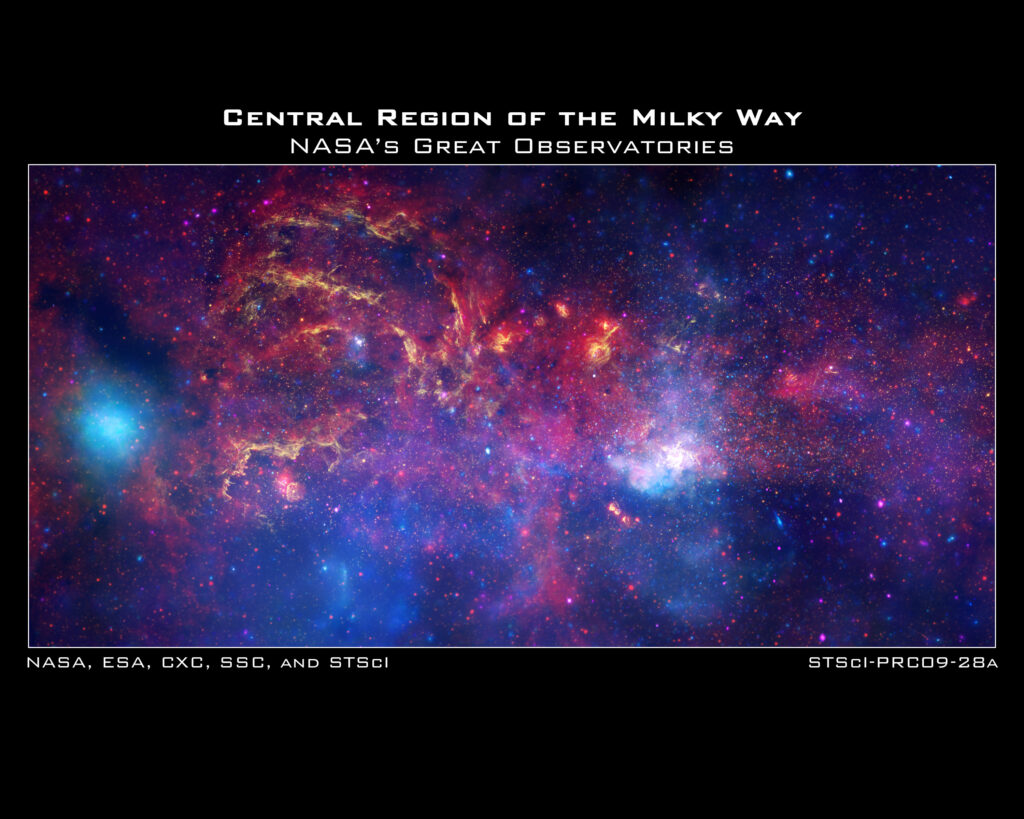
The black hole at the centre of the Milky Way is a picky eater. Sagittarius A* sits inside a swirl of hot gas, yet it swallows far less material than most supermassive black holes, and astronomers have long wanted to know why. One place to look is the menu itself. Using the James Webb Space Telescope (JWST), a team at McGill University has now analysed that menu cloud by cloud, and found metal-rich gas close to the black hole, enriched by generations of stars that lived and died nearby.
Led by PhD student Nicole Ford in Daryl Haggard’s group at the Trottier Space Institute, the study appears in The Astronomical Journal (Ford et al. 2026), and McGill announced the result on 19 October 2026. In astronomy a “metal” is any element heavier than hydrogen and helium, so neon, argon, sulfur, iron and nickel all count. The team pointed Webb’s Mid-Infrared Instrument (MIRI) at the innermost 0.1 parsec around the black hole (about a third of a light-year) in April and September 2024. That region holds the inner part of the Minispiral, a three-armed structure of warm ionised gas and dust wrapped around the black hole, some 8 kiloparsecs (roughly 26,000 light-years) from Earth.
Ionised atoms glow at sharply defined infrared wavelengths, and the strength of each line depends on how much of an element is present and how hard it is being irradiated. MIRI’s spectrograph pulled apart several gas structures that overlap on the sky, partly by their speeds. One, the Bar, is almost at rest relative to us, while compact clumps that appear within about 0.05 parsec of the black hole are rushing towards Earth at around 600 kilometres per second. Comparing lines from atoms stripped of different numbers of electrons let the team work out both the radiation bathing each structure and what it is made of. The light doing the ionising seems to come from Wolf-Rayet stars, massive stars blowing off their outer layers, of which about 30 crowd the central parsec.
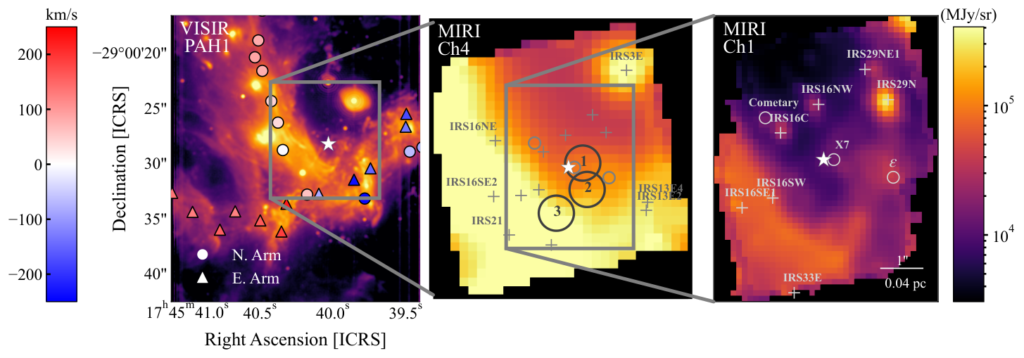
The headline figure is that the gas carries about 1.8 times the Sun’s proportion of metals, with a plausible range of 1.4 to 2.2 times. That sits comfortably alongside estimates for the stars of the nuclear star cluster that orbit Sagittarius A*, which suggests gas and stars share a common origin and supports the idea that stars formed in place near the black hole. Iron and nickel add a second clue. Far more of these elements are free in the gas than is usual in the Galactic Centre, where they normally hide inside dust grains. Something has been smashing the dust, and fast shocks are the leading suspect.
Composition matters because metals help gas shed heat. Gas that cools can clump together and fall inwards; gas that stays hot tends to stay put. Knowing the real recipe of the fuel is therefore a first step towards explaining why Sagittarius A* eats so little, and its closeness allows a cloud by cloud census that no distant galaxy permits. The authors single out the small, fast clumps as especially interesting, since gas pockets like these may be the black hole’s main source of food.
There is a catch, and it is a significant one. Simulations by another group suggest gas may need roughly three times the solar metal content before it cools efficiently enough to settle into a cold disc around Sagittarius A*, and the new measurement falls short of that mark. The numbers also lean on corrections for atoms in states Webb cannot see, which for iron range from a factor of about two to nearly four, and on how much intervening dust dims the light. Telling shock heating apart from starlight will need sharper measurements of the most highly ionised lines.
A companion study led by Mayura Balakrishnan rules out another shortcut. Webb watched the same region for hours while the black hole flickered, and no infrared line brightened in step with its flares over delays of one to eight hours. The gas is too spread out and too slow to react. It records a steady average glow, not a diary of the black hole’s outbursts.
What it does record is history of another kind. Every atom of neon and iron in those clouds was forged inside a star near the heart of the galaxy, scattered when that star died, and left drifting within reach of the black hole. Sagittarius A* is picking at the leftovers of its neighbours, and still barely eating.
