

Some of the most interesting objects in the sky are the hardest to study, because our own galaxy is in the way. Near the plane of the Milky Way, stars, gas and dust block so much light that astronomers call the region the zone of avoidance. Hidden behind it, about 1.55 billion light years away, is a ribbon of radio emission shaped like a treble clef. A team led by Andrea Botteon of Italy’s National Institute for Astrophysics (INAF) now argues that it is a radio phoenix: a cloud of fading particles from an old black hole outburst, brought back to life when two galaxy clusters ran into each other.
The object itself is not new. In 1985 its odd radio signal and its position close to the galactic plane led astronomers to list it as a possible pulsar, the rapidly spinning remnant of a dead star. Later work tied it to a galaxy cluster sitting behind the Milky Way. The new study, accepted by Astronomy & Astrophysics and announced by NASA’s Chandra X-ray Center on 14 October 2026, combines radio maps from the Low Frequency Array (LOFAR) in Europe and the upgraded Giant Metrewave Radio Telescope in India with X-ray data from NASA’s Chandra X-ray Observatory and the German eROSITA telescope.
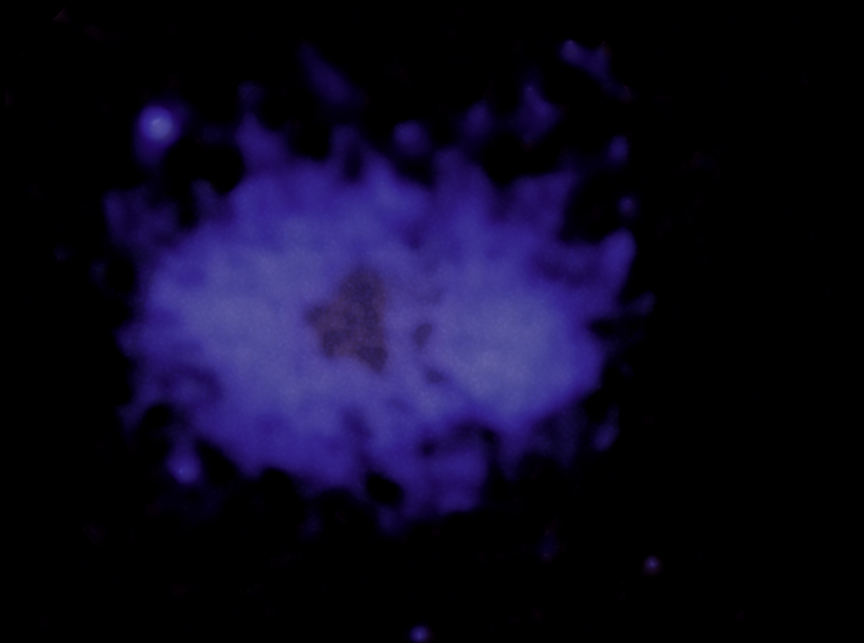
X-rays are the key, because they pass through the dust that hides the cluster from optical telescopes. Chandra watched the field for about 13.5 hours in April 2026, according to the Chandra photo release. It found diffuse gas at tens of millions of degrees filling the space between the galaxies, the signature of a massive cluster. The paper puts the cluster at between 540 and 600 trillion times the mass of the Sun. To look for signs of a collision, the team subtracted a smooth oval model of the hot gas from the X-ray image. What remained was brightest to the left and right of centre. That pattern points to a head-on merger along that axis a few hundred million years ago, with the two clusters now moving apart.
The radio side of the story explains the name. Long ago, a supermassive black hole at the heart of the cluster threw out electrons and magnetic fields at close to the speed of light. Electrons like these glow in radio waves, but they lose energy steadily, so the glow dims and the highest frequencies fade first. Left alone, such a cloud slowly goes dark. Here, the merger appears to have intervened. Gas motions and possibly shock waves from the collision squeezed the old cloud and gave its electrons fresh energy, so it shone again.
Evidence for that revival sits in the spectrum, which falls off unusually sharply with frequency. Between 400 and 650 megahertz the total radio brightness drops by a factor of more than four, and at the tips of the filaments the decline is steeper still. Modelling that ageing, the team estimates the electrons in the central filament are roughly 190 to 200 million years old. The structure is also enormous. It stretches about 760 kiloparsecs, or roughly 2.5 million light years, which is about the distance from the Milky Way to the Andromeda galaxy.
Radio phoenixes are rare, and that makes each one useful. They act as fossils, preserving a record of black hole activity that would otherwise have faded from view, and they trace how a merger stirs the gas inside a cluster. The Treble Clef is especially bright at the lowest radio frequencies, and its filaments are too thin for current maps to resolve. The authors point to LOFAR2.0, the next generation of the array, as the instrument to examine those filaments in detail.
There are honest limits to all this. The ages depend on an assumed magnetic field strength, so they are estimates rather than measurements. The team also reports a faint, cluster-wide glow that could be a radio halo, but it is detected only weakly and overlaps the Treble Clef, so they label it a candidate. Peering through the Milky Way adds its own difficulty, because our galaxy’s gas absorbs part of the X-ray signal and has to be modelled out.
Then there is the shape itself. The resemblance to a musical symbol is pareidolia, the habit of seeing familiar patterns in random data, and the release suggests a dragon seen side on works just as well. The physics is less whimsical. A black hole’s exhaust, abandoned for some 200 million years, was picked up by a collision of two clusters and made to sing again, loud enough to be heard through the whole of our own galaxy.
