

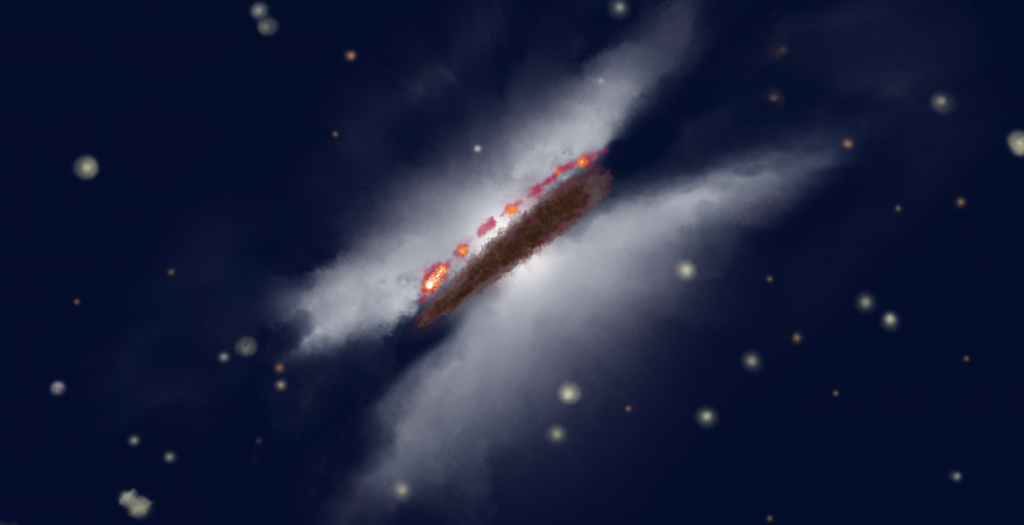
Planets are hard to catch being born. By the time a world is big enough to spot, the disc that built it has usually been carved beyond recognition, and the earliest stage, when a clump of gas first starts to pull itself together, leaves little trace. A disc nicknamed the cosmic hamburger may be an exception. New observations from the Atacama Large Millimeter/submillimeter Array (ALMA) show a narrow arc of sulfur-bearing gas lying beside a suspected clump, a possible sign of a giant planet in its very first moments.
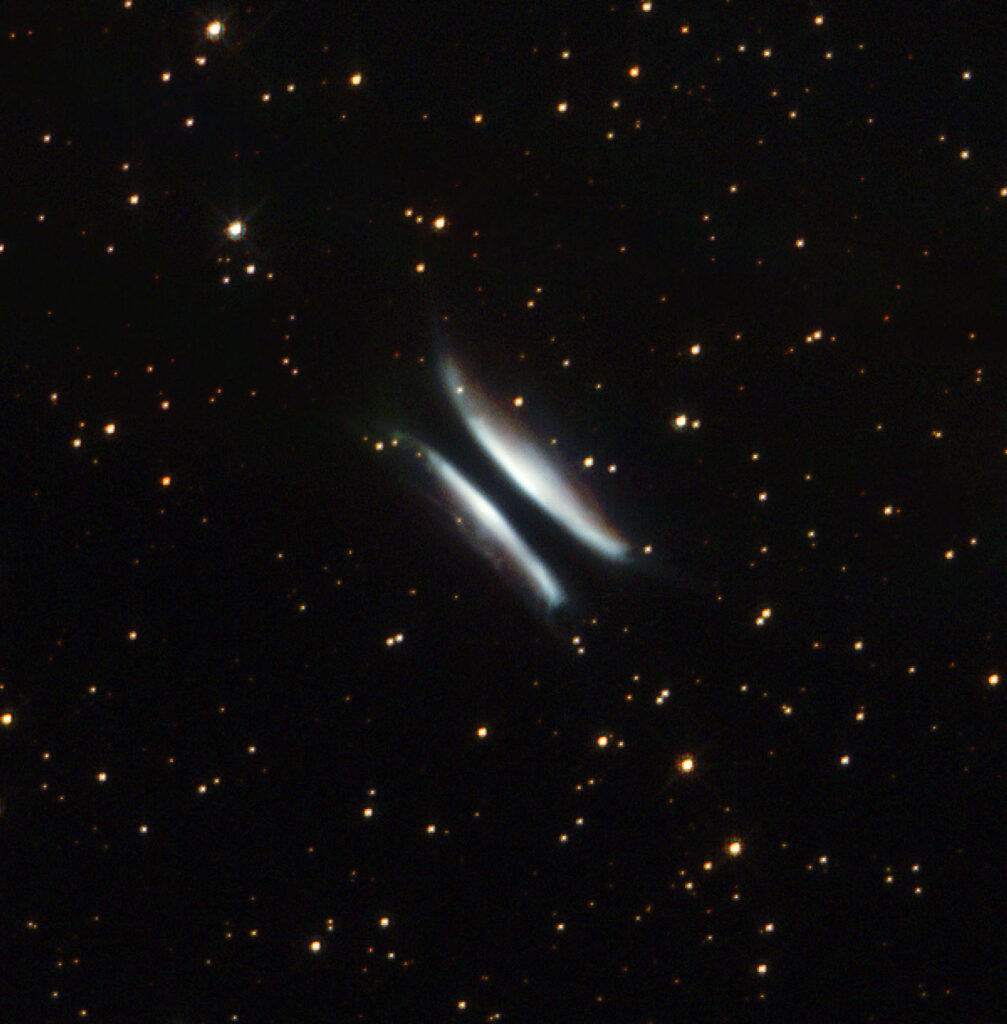
The work, led by Charles Law of the University of Minnesota with 20 co-authors, has been published in The Astrophysical Journal and was announced by NSF NRAO on 19 October 2026. Its target is Gomez’s Hamburger, or GoHam, catalogued as IRAS 18059-3211. The name describes the look: two glowing bulges of reflected starlight, the buns, separated by a dark lane of dust, the patty. Arturo Gomez of the Cerro Tololo Inter-American Observatory found it on sky photographs, and when Hubble imaged it in 2002 it was described as a dying Sun-like star. Later work told a different story. GoHam is a young star still wrapped in the disc from which its planets will form.
That disc is tilted about 85 degrees from our line of sight, so we see it almost exactly edge on. This is awkward for spotting rings and gaps, which show best face on, but ideal for measuring height. ALMA’s resolution of about 0.2 arcseconds let the team map where different molecules sit above the midplane, the disc’s central sheet. Ordinary carbon monoxide glows highest, at a height roughly half its distance from the star. A heavier form of the molecule sits lower, and carbon monosulfide lies closest to the middle. Millimetre-sized dust grains, the raw material for planetary cores, have settled into a thin layer at the centre.
The scale is generous. Carbon monoxide gas extends to about 900 astronomical units (au, the Earth to Sun distance), roughly 30 times the radius of Neptune’s orbit. The dust weighs at least 180 Earth masses, about five times the average for discs around comparable young stars. The team also revised the distance to 139 parsecs (about 450 light years), down from the 250 parsecs earlier studies assumed. That shrinks the disc’s true size and places it on the outskirts of the Scorpius-Centaurus association, a sprawling group of young stars. Gas orbital speeds give the star a mass of about 2.2 Suns.
Chemistry supplies the most telling clue. Sulfur monoxide, a molecule that turns up in the gas where icy grains are warmed, appears in a one-sided arc at the outer edge of the dust. Its brightest part lies about 180 to 195 au from the star. The southern peak sits close to GoHam b, a dense clump proposed as a protoplanet candidate in 2015 using the Very Large Telescope and thought to hold at least several Jupiter masses. One reading is that this clump is collapsing under its own gravity and heating its surroundings as it does. In its paper, the team describes the source as a possible early-stage giant protoplanet or disc fragment.
Why should one warm patch matter? Most giant planets are thought to grow slowly, with a solid core gradually gathering gas. That route struggles to explain gas giants found hundreds of au from their stars, where material is thin and orbits are slow. Gravitational instability offers a shortcut: a heavy disc breaks up directly into planet-sized clumps. Catching a fragment in the act has proved elusive, which is why Law calls GoHam a “benchmark system” for testing formation models.
The catch is that sulfur is an unreliable witness. Sulfur monoxide is also boosted by shocks and by ultraviolet or X-ray light, so a warp exposing the disc’s edge to its star, or a stream of infalling gas striking the outer disc, could produce a similar arc. The new data neither confirm nor rule out GoHam b itself; no clear carbon monoxide signal appears at its position. The lopsided dust, brighter and more extended to the south, could come from a vortex, an eccentric orbit or an unseen planet. Faint gas on the northern side moves in ways ordinary orbital motion does not explain, hinting at a wind, but the team cannot yet say whether starlight or magnetic fields drive it.
Helpfully, the authors spell out what would settle the matter. If a warm clump really sits there, molecules such as sulfur dioxide, hydrogen sulfide and water should be enhanced around it, and future observations can look for them. More than two decades ago this object was filed as a star at the end of its life. It may yet hold one of the youngest giant planets ever seen, so young that it is still little more than a warm knot of gas.
