

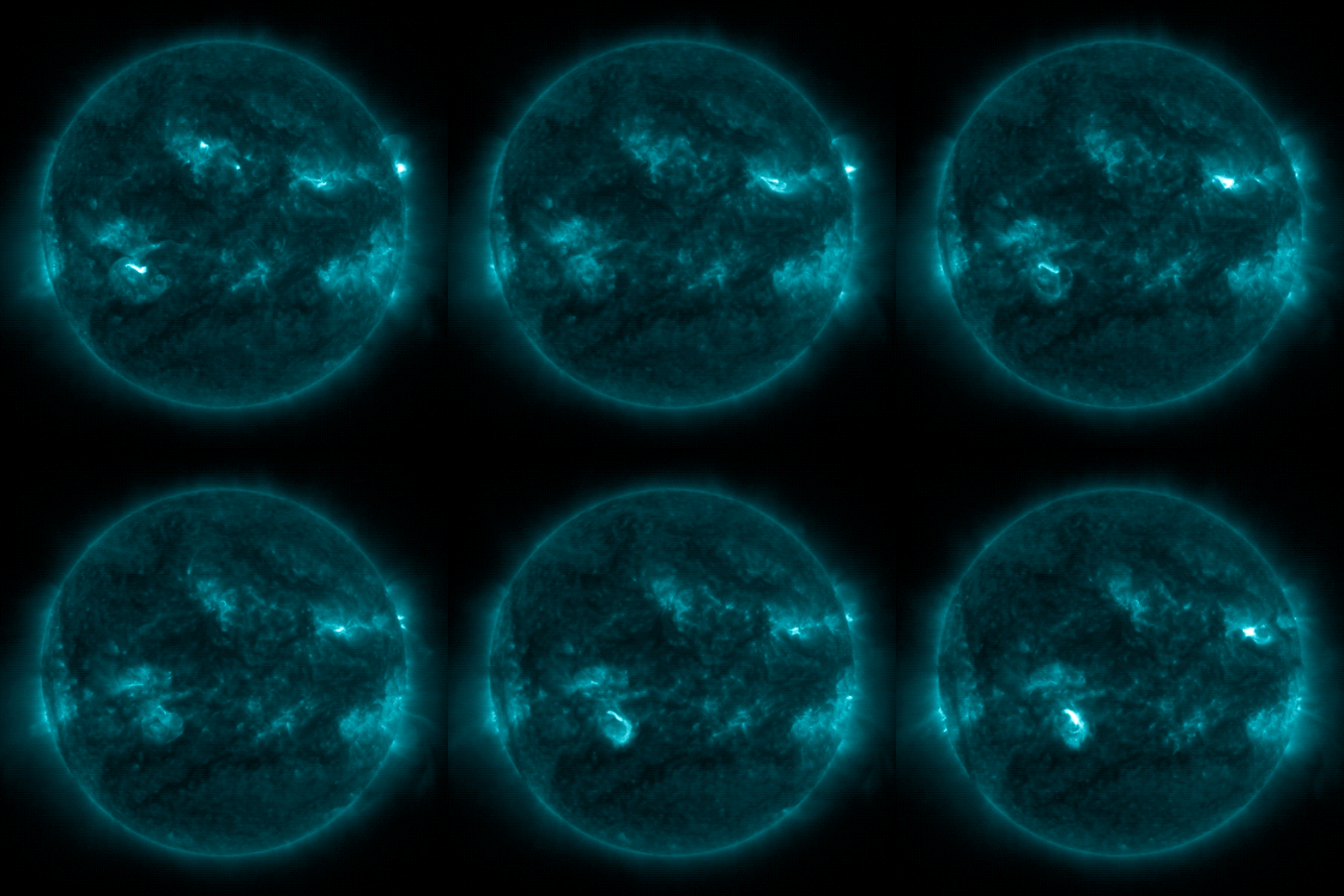
A solar flare is magnetism letting go. Tangled fields above a sunspot snap into a simpler shape and release their stored energy as light and fast particles within minutes. The awkward part is that the solar flare magnetic field is very hard to measure while that release is under way. A team in China has now watched one flare at a much longer wavelength than usual, and the field appeared to weaken just as the flare peaked.
Yuanyong Deng, Xianyong Bai and colleagues at the National Astronomical Observatories of China report the result in Nature Astronomy, published on 23 October 2026. They used AIMS, a 1 metre off-axis telescope described as the first solar telescope dedicated to mid-infrared magnetic field measurement. Its target was an X1.5 class flare (X is the strongest grade on the scale used to rank solar X-ray output) from active region 13936 on 30 December 2024. That is well before AIMS began routine science in October 2025, after about a decade of development.
Their method rests on the Zeeman effect: a magnetic field splits a spectral line into several components. The gap between them grows with the square of the wavelength, while the blurring that hides it grows only in proportion. At 12.32 micrometres, a line of neutral magnesium splits so widely that field strength can be read directly from the separation. Between 04:01 and 04:38 UT, a spectrometer followed the line beneath the flare ribbons, the bright strips where flare energy pours into the lower atmosphere. In the minutes around the X-ray peak, shortly after 04:10 UT, the measured field fell.
One word in the paper’s title carries real weight: apparent. Simulations and inversions (computer fits that rebuild the atmosphere from the observed spectrum) suggest the flare heats the gas so that the magnesium line forms higher up. A higher layer can carry a weaker field, so the drop may reflect a change in where the telescope is looking. The authors leave open a second explanation, a genuine local rearrangement of the field, and do not choose between them. This is also one flare, one active region and a handful of pixels.
Mid-infrared work has its own price. Water vapour in Earth’s atmosphere absorbs this light heavily, so the telescope relies on the Lenghu site, a high, dry summit on the Tibetan Plateau in Qinghai Province. If the method holds across many flares, solar physicists gain a way to watch magnetic energy being spent rather than inferring it afterwards. For now, the Sun has offered one split line and a question about height.
