

Before anyone walks on the Moon again, three spacecraft built by three different organisations have to find each other in orbit, lock together and keep four people alive while they do it. None of that has been tried with a crew. NASA has now published exactly how it intends to try, and the answer is much closer to home than the Moon: Artemis III will spend two weeks in low Earth orbit in 2027, rehearsing the docking and living routines on which the planned 2028 landing depends.
The agency released the plan on 23 October, alongside a news conference at Kennedy Space Center in Florida. The crew is NASA astronauts Randy Bresnik, Frank Rubio and Andre Douglas, with Luca Parmitano of the European Space Agency (ESA). Artemis III was originally meant to be the landing itself. In February, NASA moved the first touchdown to Artemis IV and turned this flight into a test mission, arguing that it should keep the rocket and capsule unchanged and build experience one step at a time.
An empty vehicle goes up first: a test version of Blue Origin’s Blue Moon Mark 2 lander, launched into a circular orbit about 440 km (273 miles) up, where it can wait for as long as 30 days. Only when controllers confirm it is healthy does Orion follow on the Space Launch System (SLS), a few days later. Orion starts in a lopsided orbit that reaches roughly 1,800 km at its highest point, then raises itself into a circle about 555 km up to let its systems settle thermally before it creeps towards the lander.
After two days of checks, Orion docks with Blue Moon and the crew opens the hatch. They then spend about two days inside the lander, testing its cabin, controls and life support and verifying that its atmosphere and pressure hold. This is the part no ground test can replace. It will be the first time astronauts have lived inside one of the vehicles meant to carry them down to the lunar surface, rather than sitting in a mock-up on Earth.
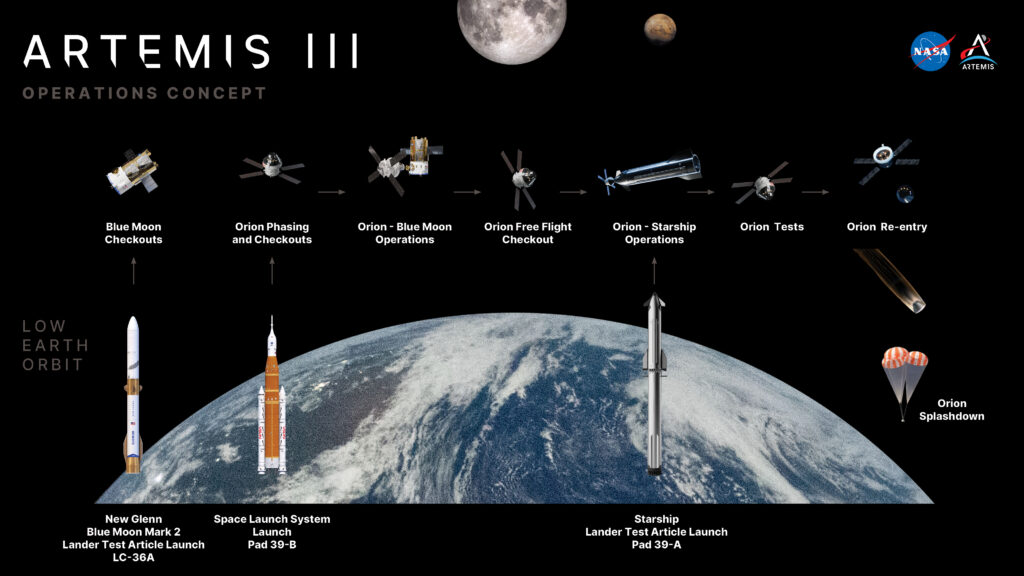
Then it is SpaceX’s turn. Once Orion undocks, a Starship Version 3 test article launches from Florida into a lower orbit of about 380 km, chosen for good communications. Orion docks with a port on Starship’s nose for up to two hours, but the crew stays put and never goes aboard. The two landers even ask for different approaches: Orion joins Blue Moon at a port beside its crew cabin and Starship at its forward end. Up to five more days of tests follow before Orion splashes down in the Pacific off California.
NASA has flown this logic before. In March 1969, Apollo 9 spent about ten days in Earth orbit putting the lunar module Spider through its first crewed trials, docking, undocking and firing its engines with home only hours away. The appeal is the same now. A stuck hatch or a misbehaving life support loop is an engineering lesson a few hundred kilometres up; three days from Earth it is an emergency. Artemis III also carries a list of secondary work, from spacesuit and docking sensor checks to a cell biology experiment. Other trials cover handling returned lunar samples and assessing astronaut health when the crew cannot talk to mission control.
The catch is that a rehearsal is not the performance. Both landers are test articles, the crew never boards Starship, and nothing in the plan exercises a descent, the lunar surface or the long trip out and back. The schedule is unforgiving too. Blue Moon’s 30-day endurance sets a hard window for the SLS and Starship launches from separate pads, so a delay at any one of them ripples into the others. And the landing all this prepares for is meant to follow only a year later.
Jeremy Parsons, who manages the Artemis programme for NASA, put the purpose simply: “Every lesson we learn here gets us closer to landing on the Moon in 2028.” The headline moment of the mission may turn out to be a quiet one. Four people will float through a hatch, about 440 km above the Pacific, into a cabin designed for the Moon, and find out whether it feels like somewhere they could live.
