

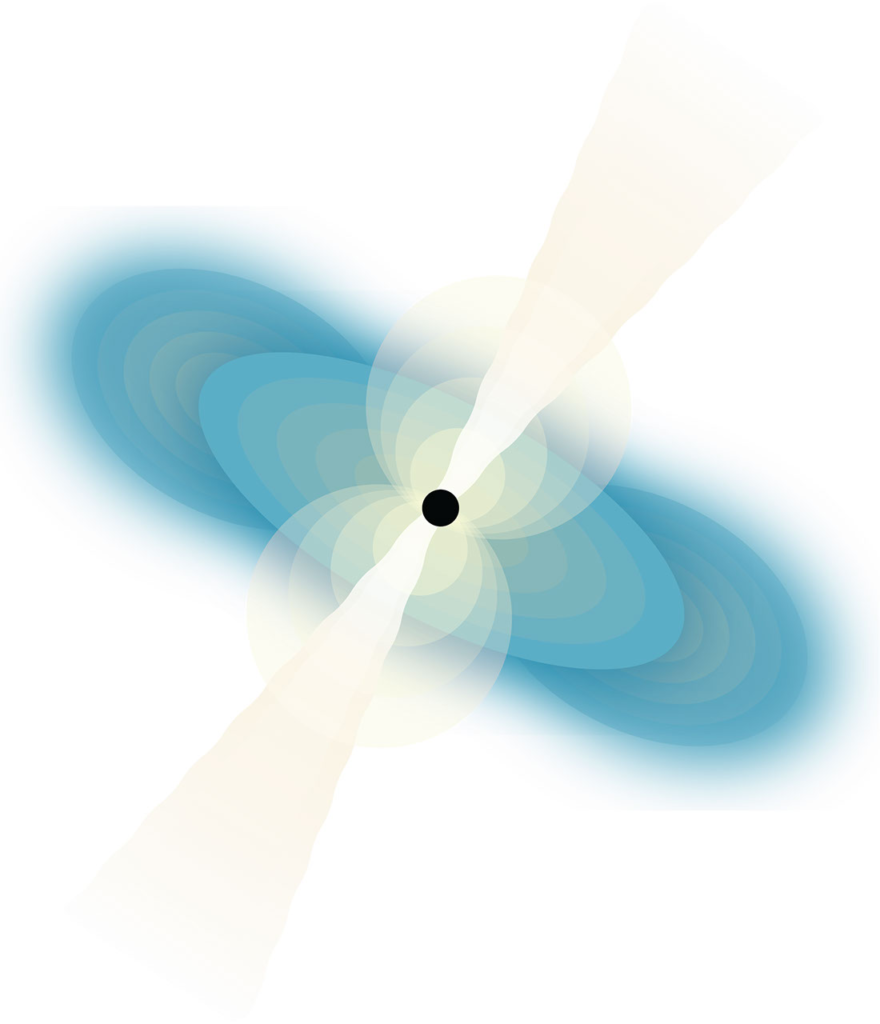
For decades astronomers have sorted gamma-ray bursts, among the most energetic explosions known, into two tidy piles. Short bursts, over in less than two seconds, come from colliding neutron stars. Long bursts come from massive stars collapsing at the end of their lives. One gamma-ray burst recorded in 2016 appears to belong in both piles at once: a short flash typical of a merger, then four minutes of silence, then a long flash typical of a collapse.
The event, catalogued as GRB 160425A, triggered the Burst Alert Telescope on NASA’s Neil Gehrels Swift Observatory at 23:26 UT on 25 April 2016. A team led by Liang Li of Ningbo University, with collaborators in China, Europe, Israel and Japan, has now taken the archive data apart in a paper published in Nature Astronomy on 23 October 2026, with an earlier preprint freely readable. Spectra from ESO’s Very Large Telescope place the source in a galaxy at redshift 0.555, so the light had been travelling for billions of years before it reached Swift.
First came a flash, which the authors label G1, lasting about 1.7 seconds. Then the sky went quiet for roughly 255 seconds before the second flash, G2, ran for about 51 seconds. Swift had already swung its X-ray telescope onto the position within about 200 seconds of the trigger, so it was watching when the second burst arrived, according to the Swift burst catalogue. Duration alone is a blunt tool, though, because some mergers produce long bursts and some collapses produce short ones, so the team ran a full set of tests.
They all pointed the same way. G1 was hard, meaning rich in high energy photons, with a spectral peak of at least 500 keV against about 58 keV for G2. G1 flickered on timescales of about 18 milliseconds; G2 varied over about half a second. In collapsar bursts, lower energy photons tend to arrive slightly after higher energy ones, and G2 showed a lag of about 1.2 seconds while G1 showed no measurable lag. On two widely used relations that link a burst’s energy output to its spectrum and brightness, G1 sat with the mergers and G2 with the collapsars.
That matters because burst classification is how astronomers infer what exploded when they cannot see the explosion itself. The two family model has taken knocks before. GRB 211211A was long but behaved like a merger, and GRB 200826A was short but came from a collapsing star. Each of those was a single odd burst. Several other bursts have shown a quiet gap, yet the authors find that GRB 160425A is the only one where the emission on each side of the gap falls into a different class.
None of the obvious escape routes fits well. Some merger bursts are followed by a softer tail of emission, but none is known to fall silent for four minutes and then return with more total energy than the opening spike. A long burst with a short precursor is no better, since precursors are usually fainter than the main event and G1 peaked brighter than G2. Two unrelated bursts lining up by chance within 250 seconds has a probability of roughly two in a trillion, by the team’s estimate. The host appears to be a pair of interacting galaxies, which leaves open the possibility of two events in one crowded system, though the authors also rate that as unlikely.
All of this rests on one burst, with its gamma rays recorded by a single instrument, and that is the catch. NASA’s Fermi satellite, which could have measured the spectrum independently, had Earth in the way at the time of the trigger. G1’s peak energy lies above Swift’s detection range, so only a lower limit is available, and several derived quantities depend on it. The classification tests are themselves empirical rules of thumb, still argued over in the field. No supernova was seen, but the limits only rule out one as bright as SN 1998bw, the standard comparison for supernovae that accompany long bursts, so a fainter one could have been missed.
Li and colleagues are candid that the sharp opening flash has no satisfying explanation yet. One idea, a collapsing star whose jet switches on and off, normally produces weak precursors, not a bright, hard spike. A clean answer will probably need another double burst caught with today’s wider field monitors and fast follow up.
Classification schemes earn their keep by being simple, and the short and long split has guided burst astronomy for a generation. GRB 160425A suggests that a single source can produce both kinds of flash. Two pulses of gamma rays, four minutes apart, from a galaxy billions of light years away, and a filing system that may need a third drawer.
