

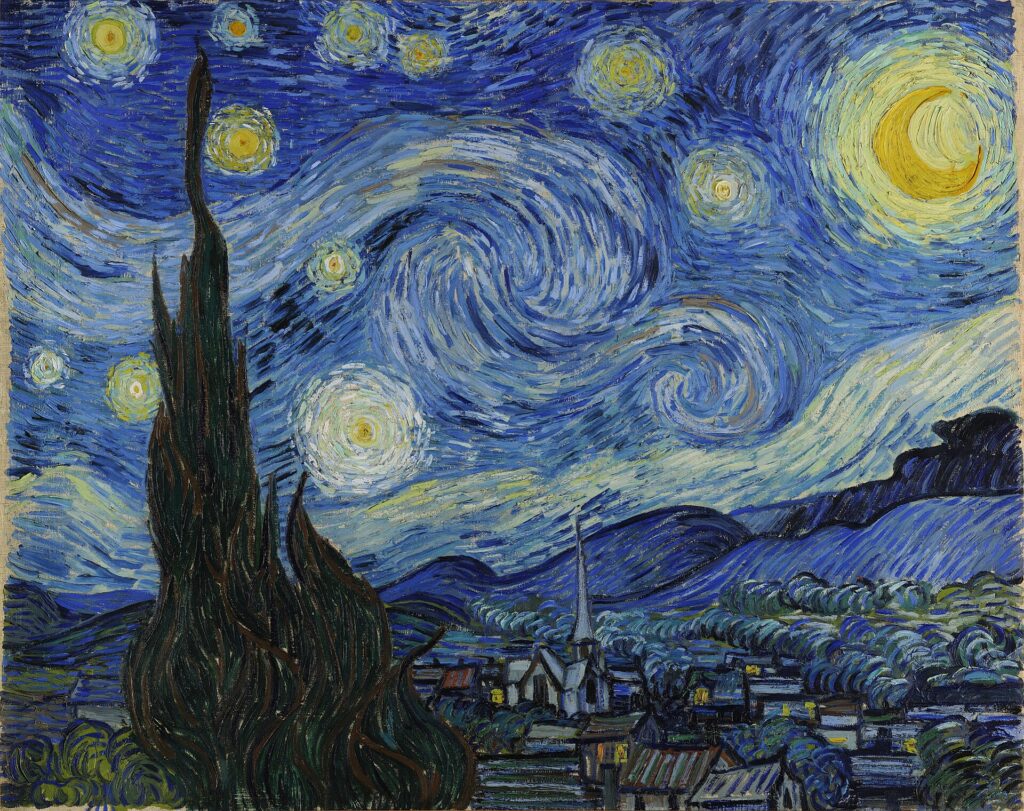
For more than a century, people have argued over whether the swirling sky in Vincent van Gogh’s The Starry Night was something he saw or something he invented. The canvas holds 11 stars, a blazing crescent Moon and one brilliant point long read as Venus, all hanging over a sleeping village. A study published on 22 October in Scientific Reports now argues that the sky was real. Its authors match the central knot of stars to the Hyades, the V-shaped cluster in Taurus, and date the view to a dawn around 22 July 1889, weeks later than art historians have assumed.
Elijah Jeong-hyun Kim and colleagues at SLLAB and the School of Space Research at Kyung Hee University in South Korea did the work. Van Gogh painted the picture while living at the asylum in Saint-Rémy-de-Provence, and the only letter that clearly refers to it, dated 18 June 1889, mentions “a new study of a starry sky”. Earlier astronomical readings treated that letter as the date. One in 1984 proposed a dawn on 19 June and identified the central stars as Aries; another, two years later, preferred 17 or 18 June and called the sky a composite built to evoke a morning, not a record of one.
Their main tool is Procrustes analysis, a statistical method that compares two sets of points after stripping away differences in position, size and rotation, leaving only shape. Before turning it on the famous canvas, they applied it to night scenes by Elsheimer and Millet. They then checked it on two of Van Gogh’s own 1888 night paintings whose viewpoints still exist. Starry Night over the Rhône fits the Big Dipper. Café Terrace at Night fits the Summer Triangle.
Applied to The Starry Night, five of the painted stars line up with the Hyades, with a typical positional error of about 8% of the pattern’s overall size. Of the 120 ways of pairing those five painted stars with the five cluster stars, the anatomically correct pairing gave the best fit. It also came out on top among all 462 possible five-star subsets of the 11 painted stars. The team then reconstructed Van Gogh’s framing from an 1889 drawing of the same terrain, which implies a narrow view about 18° across the diagonal, roughly what a 134 mm lens on a 35 mm camera would show. Aimed at the eastern sky above Saint-Rémy at 3am local time on 22 July 1889, that frame holds the Moon and Venus near opposite corners and the Hyades near the centre.
The Moon does much of the work in fixing the date. On 22 July it was about 28% lit, a thin waning crescent much like the one on the canvas. On 19 June, the earlier favourite, it was about 63% lit and far too full. Venus also had to clear the horizon well before twilight drowned the stars, and on 22 July it rose past 3° above the horizon at about 1.53am, more than an hour before nautical twilight began at around 3.20am. Records from Avignon, 19 km away, show no sustained strong wind between 15 and 26 July.
For the authors, the convergence matters more than any single test. The star pattern, the Moon, Venus, the weather and the letters all point to the same few nights. If they are right, the painting is less a hallucination than an amplification. Van Gogh himself later grouped it with works he described as exaggerated in their arrangement, and an exaggeration needs something real to exaggerate. The method also offers a repeatable way to test other historical night scenes, in place of trading impressions about which constellation a cluster of brushstrokes might be. The team has released its data and code openly.
There are real limits. A low fitting error cannot identify a constellation on its own: an alternative match to stars in Auriga scored almost as well as the Hyades, and was rejected only because it would turn Venus into an ordinary star. Weather records from the 1880s are patchy, and the authors cannot rule out cloud on 22 July itself.
The proposed date also collides with the accepted timeline, which places a serious attack of Van Gogh’s illness in mid-July. The team reads his letters as allowing a later onset, but no medical record from the time survives. And the study says when the sky matches, not when the brush first touched the canvas; the picture may have been started in June and reworked in July.
Perhaps the most persuasive detail is also the simplest. A man at an asylum window, awake before sunrise, watched a thin Moon climb ahead of the morning star with a small knot of stars between them. Then he made the whole thing turn.
