

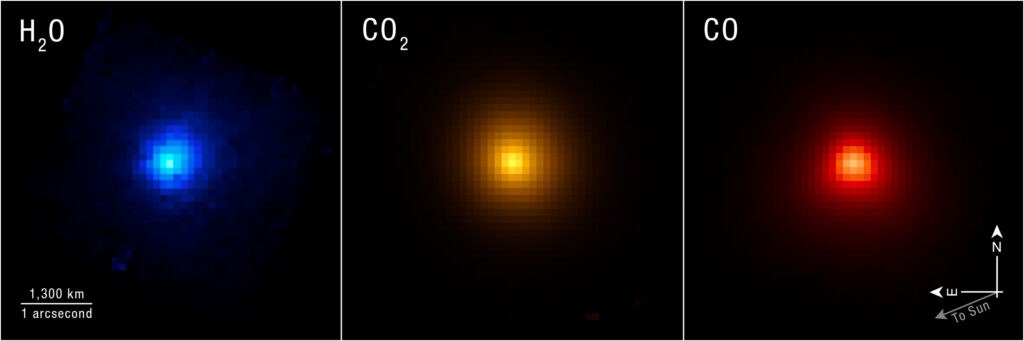
Every comet is a cold storage unit. The ice it carries froze where its parent star was forming, and as long as it never warms up, it keeps a chemical record of that place. Comets from our own Solar System describe one cloud of gas, 4.5 billion years ago. The interstellar comet 3I/ATLAS came from somewhere else entirely, and a new measurement of heavy methane in its coma suggests that somewhere was colder and harsher than the nursery that built the Sun.
The result, published in Nature Astronomy on 23 October 2026, comes from a team led by Nathan Roth, with Martin Cordiner and Stefanie Milam of NASA’s Goddard Space Flight Center among the co-authors. They pointed the James Webb Space Telescope (JWST) and its Near-Infrared Spectrograph at the comet on 22 and 23 December 2025, when it was 2.4 astronomical units from the Sun, or about 2.4 times Earth’s distance. In the glow of its coma, the cloud of gas streaming off the nucleus, they found CH3D: methane in which one of the four hydrogen atoms has been replaced by deuterium. It is the first deuterated organic molecule detected in an object from another star system. The analysis first appeared as a preprint in March and has now passed peer review.
Deuterium is hydrogen with an extra neutron, and it works as a thermometer for ice. In very cold gas, a chain of reactions that begins with the H3+ ion meeting deuterium-bearing hydrogen gas hands deuterium on to other molecules. Warmth runs the process in reverse. Ice that forms in the cold and stays cold keeps the extra deuterium, while ice that is later heated loses it. So the deuterium to hydrogen ratio, written D/H, records both where an ice formed and how gently it was treated afterwards.
The figure for 3I/ATLAS is large. Its methane has a D/H ratio of 3.18 per cent, give or take 0.30, meaning roughly three in every 100 hydrogen atoms in that methane are deuterium. That is about 13 times the value the European Space Agency’s Rosetta probe found in comet 67P/Churyumov-Gerasimenko, the only other comet where heavy methane has been detected. It is also higher than any methane measured anywhere in the Solar System. For scale, ocean water on Earth sits at about 0.016 per cent.
It fits a pattern. In June, Cordiner’s team reported in Nature that the comet’s water has a D/H ratio of 0.98 per cent, more than ten times that of known Solar System comets. Its carbon also holds unusually little carbon-13, an isotope that builds up as generations of stars enrich a galaxy. On that basis the researchers estimated that the comet formed 10 to 12 billion years ago, long before the Sun. The methane is about three times more deuterated again than the water, the same ordering seen in 67P.
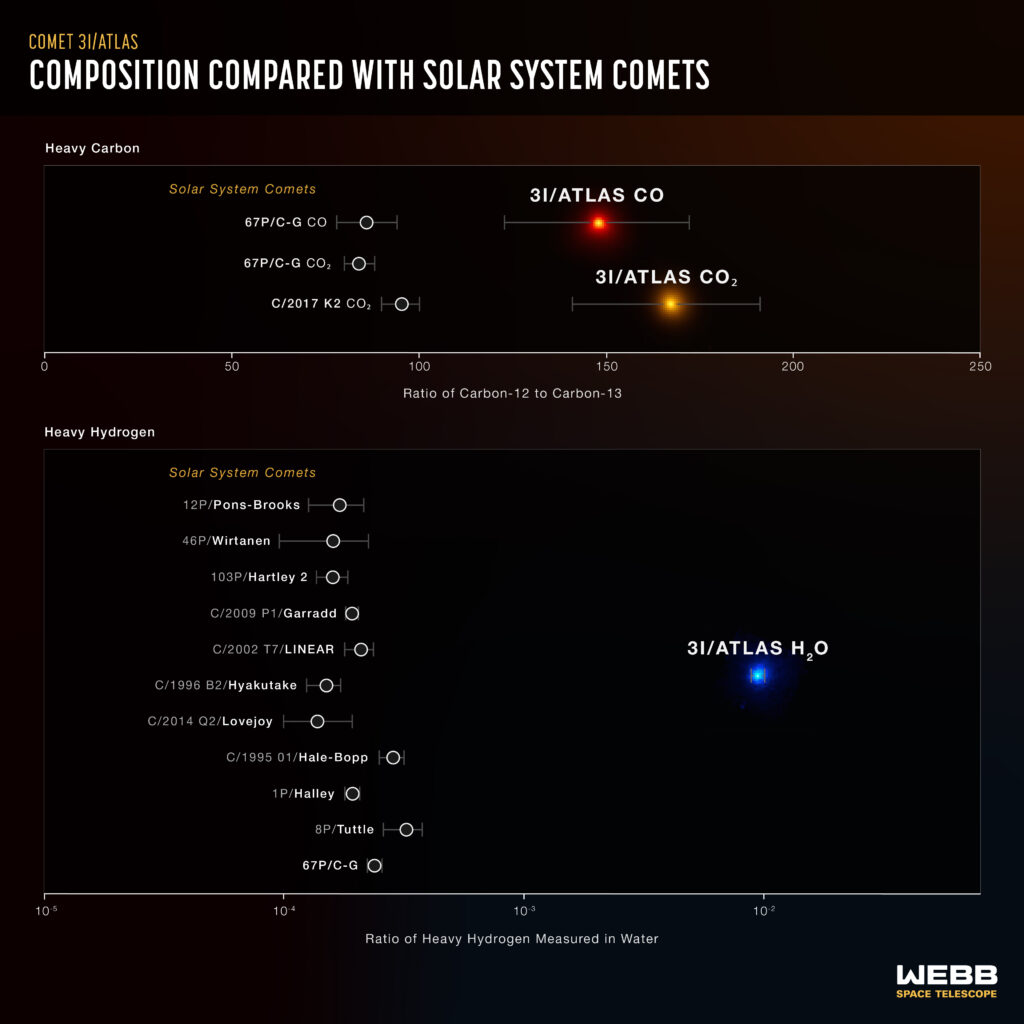
What makes the methane result useful is how far it overshoots. Models of chemistry inside planet-forming discs, the flattened clouds of gas and dust around young stars, produce methane D/H ratios of only a few tenths of a per cent. The authors argue that 3I/ATLAS must therefore have inherited its ice from the cold cloud that came before its star, and kept it through the formation of its home system and billions of years adrift. Its methane looks less like ordinary comet ice and more like the deuterium-rich methanol and formaldehyde that radio astronomers find around stars still being born.
The team’s explanation for the extreme value is a birthplace poor in heavy elements and bathed in cosmic rays. Cosmic rays, high-energy particles largely accelerated by exploding stars, boost production of the ions that carry deuterium into molecules. A shortage of carbon monoxide, which would normally destroy those ions, lets them survive longer. Both conditions suit a young galaxy busy forming massive stars, which sits comfortably with the age suggested by the carbon.
That explanation is still a hypothesis, and the authors say so. No one has yet modelled ice chemistry under low metallicity and strong cosmic rays, and current models do not produce methane D/H above 1 per cent at all. Heavy methane has never been measured directly outside the Solar System, so the comparisons rest on related molecules used as stand-ins. The measurement itself is delicate: the CH3D lines sit among methane lines up to 100 times brighter, and the exact value shifts slightly with how the spectrum’s baseline is fitted. The trend among comets, meanwhile, rests on just two objects.
None of this will be easy to repeat. 3I/ATLAS is on its way out of the Solar System and will not return, and the next interstellar visitor may be too faint or too fast for Webb to study this closely. For now, the best sample of ancient ice from another part of the Milky Way is a faint spectral signature, recorded over two December days, of methane that may have frozen before the Sun existed.
