

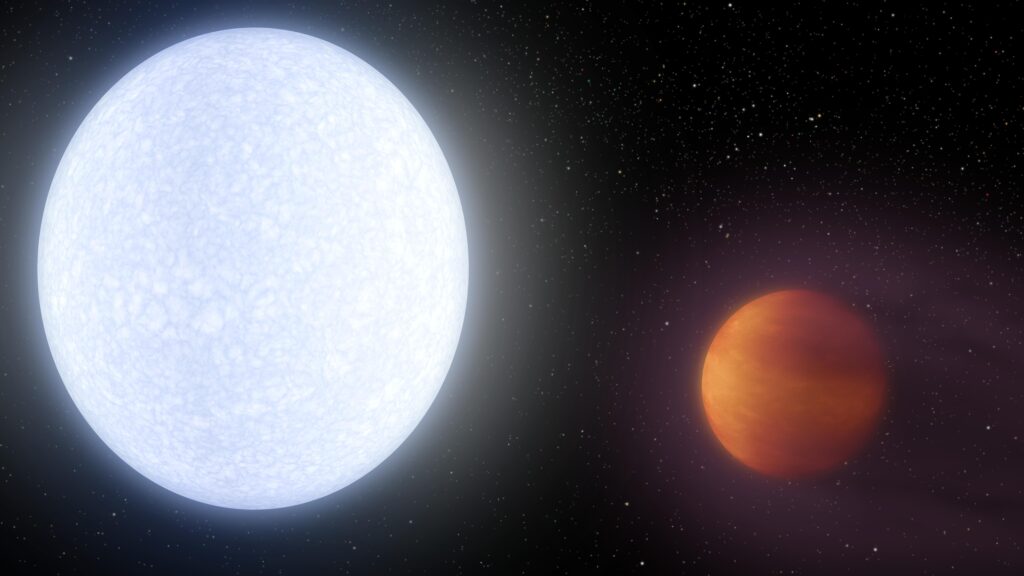
Every giant planet in the Solar System wraps itself in a magnetic field, and spacecraft have flown straight through all four. Around other stars the picture is far emptier: nobody has yet measured a planet’s magnetic field by reading it directly in the planet’s own light. A team led from the Université de Toulouse now reports a faint hint of a KELT-9b magnetic field, picked up in the atmosphere of one of the hottest planets known. The signal is tantalising. It also vanished when the astronomers looked again.
The work, led by Alexis Lavail of the Institut de Recherche en Astrophysique et Planétologie (IRAP), was published as a letter in Astronomy & Astrophysics on 27 October 2026, after appearing as a preprint earlier in the month. The target is extreme even by the standards of hot Jupiters. KELT-9b has nearly three times the mass of Jupiter, circles its star every 1.48 days and has an equilibrium temperature of about 4,050 K. Its host, KELT-9, is a hot, fast-spinning star of roughly 9,500 K, about 675 light-years from Earth.
Their method rests on the Zeeman effect, the way a magnetic field splits atomic spectral lines and leaves the light slightly circularly polarised. The team used SPIRou, a near-infrared spectropolarimeter (an instrument that records both a spectrum and its polarisation) on the Canada-France-Hawaii Telescope. As KELT-9b crossed the face of its star, a sliver of starlight filtered through the planet’s atmosphere on its way to the telescope. To pull a planetary signal out of that sliver, the researchers stacked 1,398 atomic lines from 14 atomic species, 959 of them from neutral iron, into a single averaged profile.
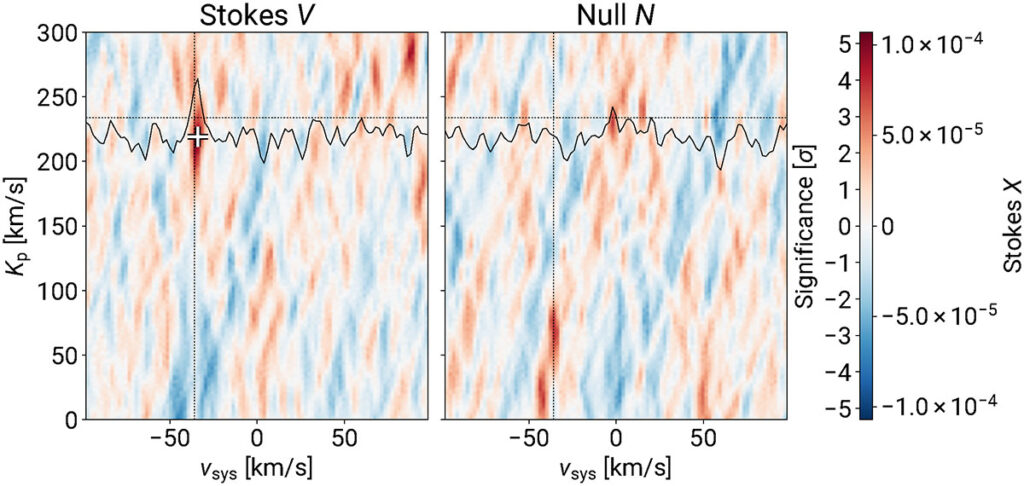
One of three observed transits, on 7 September 2025, produced something. A polarisation signal appeared close to the velocity expected for the planet, with an amplitude of just under one part in 10,000 of the light. The chance of noise producing a peak like it was put at about one in 5,000. A simple model of the atmosphere matched the amplitude with a field of about 2,000 gauss at the equator, inside the 400 to 4,000 gauss range that dynamo theory predicts for this planet. In the paper’s own words, the signal “qualifies as a marginal detection at best”.
Why chase something so faint? Magnetic fields shape how a planet’s atmosphere circulates and how quickly it bleeds away into space, and on ultra-hot Jupiters the effect could be large. Gas this hot is partly ionised, so a magnetic field can act as a brake on the winds that carry heat from the permanent day side to the night side. Earlier this year, a study of seven ultra-hot Jupiters using ESO’s Very Large Telescope found their winds slowed as temperature rose, the pattern magnetic drag predicts. That result was indirect. A Zeeman signal would be the field written into the planet’s own light.
The catch arrived ten months later. Two further transits, on 3 and 6 July 2026, showed nothing at the same position, even though the data were good enough to recover the 2025 signal at four sigma or better (sigma being a measure of how unlikely a result is to be chance). The team also found peaks of similar strength scattered elsewhere in their maps, and the planet’s orbital speed implied by the signal sits below several published values. Either the 2025 peak was noise, or the field genuinely changes from one epoch to the next; the authors stress that the second idea is qualitative for now. If the true field is nearer the lower prediction of 400 gauss, they estimate it would take roughly 15 to 17 transits to reach a three sigma detection.
That is a great deal of telescope time for one planet, and the answer could still come back empty. Even so, the letter sets out a working method, a clear target and a realistic bill. For now, KELT-9b has spoken once, quietly, and then said nothing. The next run of transits will show whether astronomers were hearing the planet or the instrument.
