

The James Webb Space Telescope (JWST) keeps turning up black holes that look far too heavy for a universe that young. Growing such giants in the time available is hard to explain if each one started as the remains of a single ordinary star. A new study argues that the shortcut may have been violence rather than appetite. In the tightly packed star clusters of the early universe, stellar collisions could have been routine, and repeated mergers could have built stars big enough to collapse into black hole seeds.
Led by UCLA doctoral student Claire Williams with astrophysicist Smadar Naoz and nine co-authors in the US, Japan, Italy and Germany, the work was published in The Astrophysical Journal on 26 October 2026 and announced by UCLA the same day. Rather than simulating every star, the team built an analytic framework: a set of equations that tracks how often stars meet at each distance from a cluster’s centre, and what happens when they do. Its starting conditions come from high-resolution cosmological simulations of early galaxies. Its predictions were then checked against Monte Carlo simulations, which follow random encounters star by star.
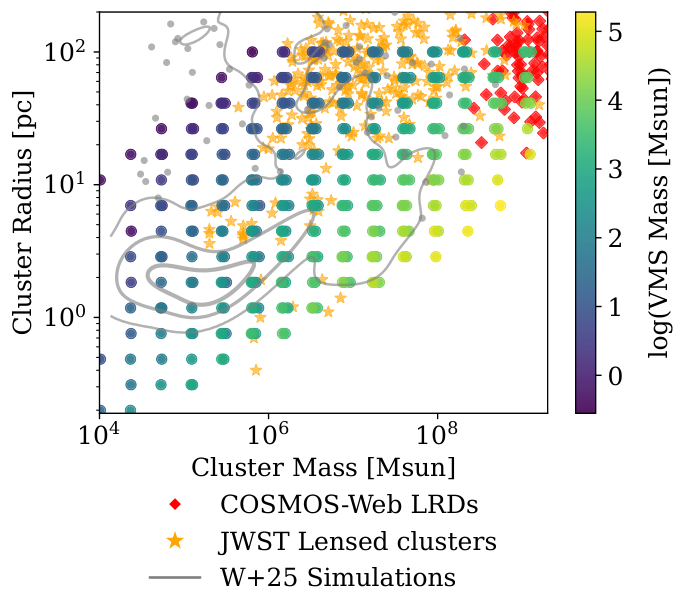
Everything hinges on speed. When two stars meet slowly, they merge into one heavier star; when they meet faster than the escape velocity at a star’s surface, they tear each other apart. In clusters without a central black hole, the model finds that collisions stay gentle throughout, so merger products sink towards the middle and keep growing. The authors explored clusters weighing from 10,000 to a billion times the mass of the Sun, with radii from under a light-year to roughly 330 light-years, seen at redshifts between 5 and 12.
Density is the tipping point. Once the inner part of a cluster packs in more than about 100,000 solar masses per cubic parsec (a cube roughly 3.3 light-years on a side), nearly every low-mass cluster builds a very massive star of more than 200 solar masses. In the densest cases the merged star passes 100,000 solar masses. An object like that could collapse into a black hole, handing the cluster a ready-made seed. “Dense star clusters provide a natural birthplace for massive black-hole seeds in our model,” Williams said.
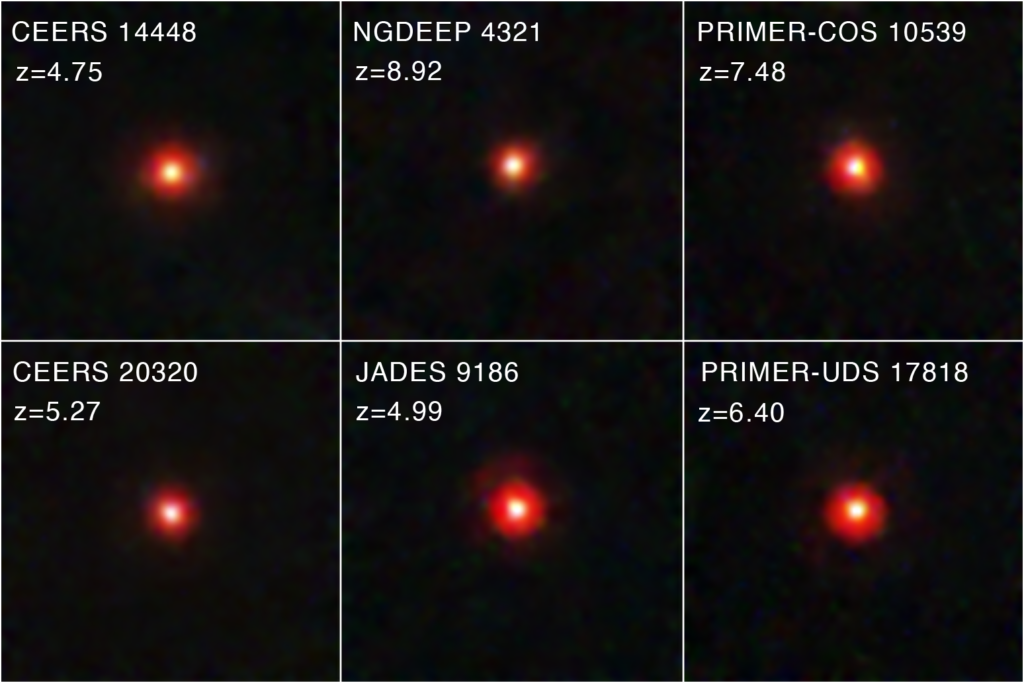
The second half of the paper turns to Little Red Dots, compact red objects that Webb has found in large numbers. According to NASA, they become common about 600 million years after the Big Bang and decline sharply by around 1.5 billion years; spectra suggest many are growing black holes wrapped in gas. The UCLA team offers a way to make that wrapping. Where a massive black hole already sits at a cluster’s heart, its gravity whips nearby stars to high speeds, so collisions near the centre turn destructive. Shattered stars release their gas, and the model shows this can rapidly build an extremely dense cloud around the black hole.
So far the fit with observations is encouraging. The densities measured for Little Red Dots would, on the model’s terms, produce very massive stars of 10,000 to 100,000 solar masses, and several young clusters magnified by gravitational lensing sit where heavy collision rates are expected. The idea also reaches closer to home. Our own galaxy’s central black hole lives inside a dense nuclear star cluster, and the release notes that the model’s black hole case resembles it. Dense clusters may also be what intermediate-mass black holes, rarely seen objects between stellar and supermassive scales, need in order to form.
This is a model of conditions, though, not a recording of a collision. The authors do not simulate gas falling onto the black hole or reproduce the light of Little Red Dots, so the link to those objects rests on consistency rather than proof. Their Monte Carlo checks used 1,000 stars within 1 parsec across 10 parameter sets, far short of a full calculation of every star’s gravity.
The paper also flags that it may overestimate the gas that destructive collisions produce, and that it holds the mix of star masses fixed, which probably misses some runaway growth. If the first clusters were dominated by very heavy, short-lived stars, only 22 model systems form a very massive star at all, the largest just 512 solar masses. Those stars simply die before they can pile up.
Testing the idea will mean finding the wreckage: chemical traces of merged giants, such as the nitrogen enrichment the authors discuss, or a seed caught before it grew. Webb has already supplied the crowded clusters this picture needs. If the model holds, some of the largest black holes in the universe began not with a single dying star but with a traffic jam.
