

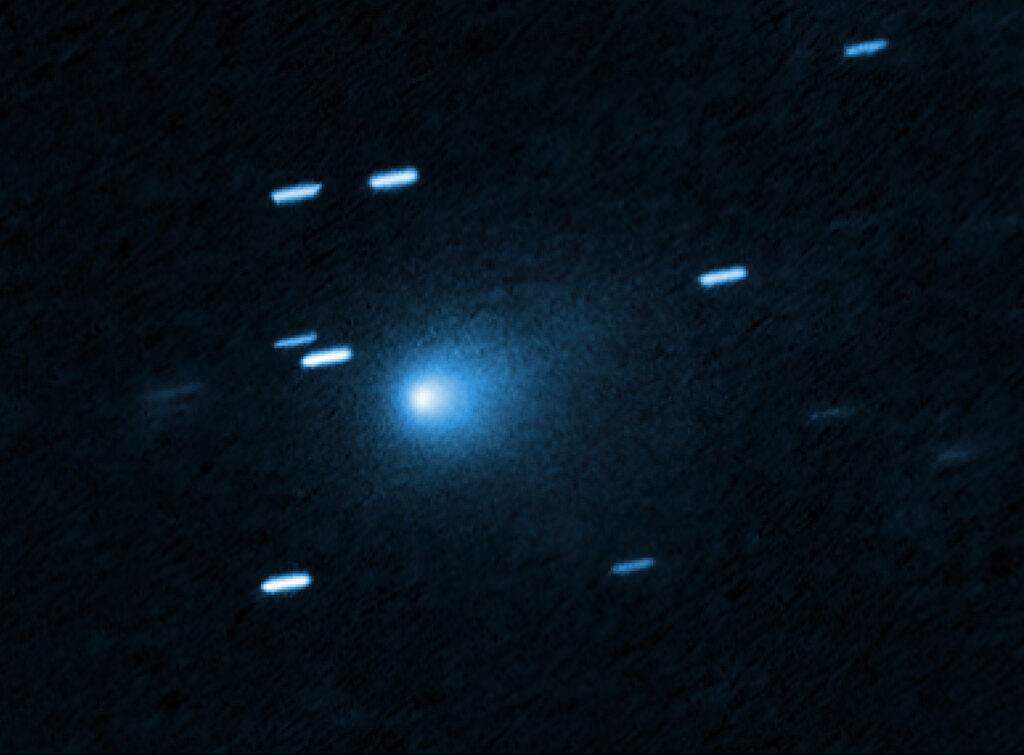
Comets are often called dirty snowballs, yet the snow in most of them is surprisingly clean. When a comet warms and its escaping gas lifts ice grains into the surrounding cloud, those grains usually turn out to be close to pure frozen water. The interstellar comet 3I/ATLAS, a visitor from another star system, breaks that pattern. New observations from the James Webb Space Telescope (JWST) show that it shed dusty ice: tiny clumps with rocky minerals and carbon mixed right through the water.
The study, led by Silvia Protopapa of the Southwest Research Institute (SwRI), was published in The Astrophysical Journal Letters on 26 October 2026. Michael Kelley of the University of Maryland is second author, and Martin Cordiner of NASA’s Goddard Space Flight Center leads the Webb programme that collected the data. The team observed the comet three times with Webb’s Near-Infrared Spectrograph in its prism mode, which spreads light from about 0.6 to 5.3 microns into a low resolution spectrum. The visits fell on 6 August 2025, 22 December 2025 and 1 April 2026, either side of the comet’s closest approach to the Sun on 29 October 2025. 3I/ATLAS is only the third interstellar object ever found.
Water ice leaves three fingerprints in infrared light: dips in brightness near 1.5, 2.0 and 3.0 microns, where its molecules absorb. The 3 micron band is by far the strongest. It shows up even when light crosses only a sliver of ice, while the two shorter bands need a much longer path through ice before they register. In 3I/ATLAS the 3 micron dip is deep, removing about 77 per cent of the reflected light at its centre in August. The 1.5 and 2.0 micron bands, by contrast, are faint or missing. Most icy comets show all three.
To explain the mismatch, the team compared the spectra with models of how light scatters off grains of different sizes and make-up. The best fits favour aggregates from below a micron to about a micron across, built from water ice threaded with a rocky silicate called pyroxene and with carbon. Inside such a grain, light meets only thin films of ice before it reaches dust: enough for the 3 micron band, too little for the weaker pair. In the preferred model for August, water made up about 41 per cent of the volume of the main grain population. For comparison, ice grains from the Solar System comet C/2013 US10 contained at most about 1 per cent dust. “What seems to set them apart is how much dust is mixed into the ice,” Protopapa says.
By April 2026 the comet had changed. It was then 5.65 astronomical units from the Sun, more than five times Earth’s distance, and the data favoured a second population of larger, ice-rich grains, still around a micron across. That spectrum also carries a faint ripple near 3.1 microns that fits crystalline ice, water frozen into an ordered lattice rather than a glassy jumble. Kelley says the team cannot yet tell whether this reflects the Sun heating the grains differently at each visit or fresh material exposed as the surface wore away.
A more telling comparison lies beyond Neptune. Webb surveys of trans-Neptunian objects, the icy bodies of the outer Solar System, include some with a 3 micron band shaped much like that of 3I/ATLAS, especially in classes whose surfaces carry carbon dioxide ice and organic compounds. The likeness is in the water band only. Still, it lets the authors propose that planet-forming discs, the flattened clouds of gas and dust around young stars, produce ice in a range of physical states, from nearly pure to heavily laden with dust. On that view 3I/ATLAS is not a category of its own; it simply sits at the dusty end. If confirmed, the form water ice takes would be set early in a disc and partly survive into the bodies that grow there.
Caution is warranted on several fronts. This is one object. The grain sizes and compositions come from scattering models rather than direct measurement, and two widely used sets of laboratory data on the optics of ice disagree over part of the spectrum. The crystalline ice ripple is weak and appears in the faintest of the three spectra. The December observation was left out of the modelling altogether, because emission from gas, organics and nickel swamped the ice signal. And surfaces beyond Neptune have been battered by radiation and impacts for billions of years, so a matching band shape is not a matching origin; the paper itself says similar spectra do not imply identical parent discs.
Repetition is now the test. Webb will need more Solar System comets and, eventually, another interstellar visitor to show whether 3I/ATLAS is typical or an outlier. On 29 October it will be a year since the comet swung closest to the Sun, and it is now leaving for good.
What it left behind is a short run of spectra with an unexpectedly homely message. Around other stars too, it seems, the snow in dirty snowballs comes in grades.
