

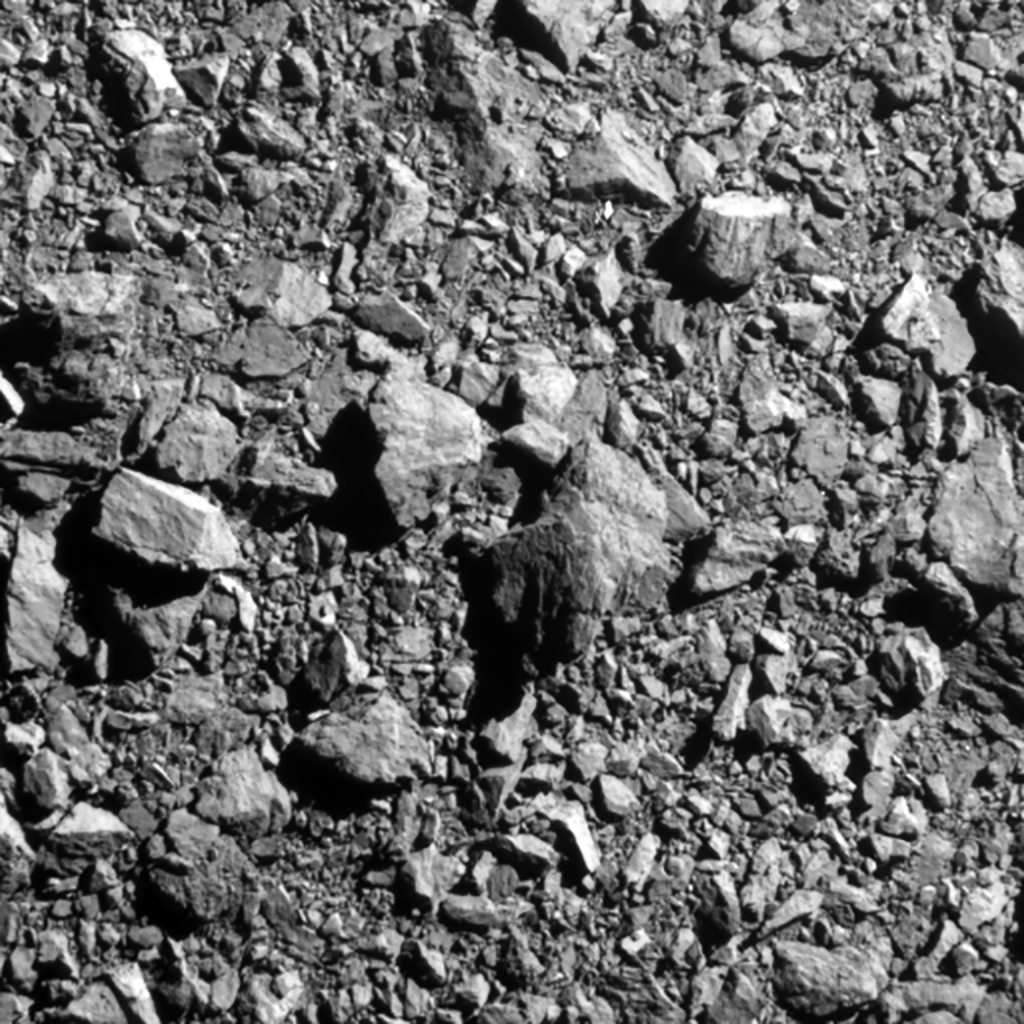
For four years, the best close views of the first deliberate asteroid deflection came from a spacecraft that destroyed itself taking them, and from a small Italian probe that flew past within minutes. Europe’s follow-up mission has now arrived in the neighbourhood. On 27 October 2026, ESA reported that its Hera spacecraft had seen the asteroid Didymos and its small moon Dimorphos as two separate objects for the first time. It is the opening move in what the agency calls a crash site investigation.
The picture was taken on the evening of 18 October with Hera’s Asteroid Framing Camera, a monochrome imager, from 1,280 km away. The pair were then about 197 million km from Earth. Until now Didymos had shown up as a single point of light. In the new frame Dimorphos covers roughly one pixel, but it sits clearly apart from its parent. Two thruster firings a week apart, earlier in October, had slowed Hera to 20 m/s relative to the asteroids so it could close in gradually.
Neither body is large. Didymos is 780 metres across, while Dimorphos measures 151 metres, about the size of the Great Pyramid of Giza, and circles its parent at an average distance of 1.15 km. It moves at roughly 18 cm per second, a fraction of walking pace. On 26 September 2022, NASA’s Double Asteroid Redirection Test (DART) struck it at 6.1 km/s. The impact cut its orbit of 11 hours 55 minutes by around half an hour, against a success threshold of just 73 seconds, according to the mission team at Johns Hopkins APL.
That surplus is the reason Hera exists. A study in Nature measured the change at 33 minutes, against about seven for a simple collision with no extra push. The difference points to debris thrown off the surface acting like rocket exhaust and adding momentum. To turn one successful shove into a dependable planetary defence tool, scientists need the asteroid’s mass, internal structure and composition, and to know whether DART left a crater or reshaped the whole body.
One pixel answers none of those questions. The first detailed images of Dimorphos are due on 25 November 2026, and the closer work will take months. That includes releasing two shoebox-sized CubeSats for a nearer survey and, eventually, a landing. Until then the deflection remains a measurement without a full explanation.
There is a pleasing contrast in the pace of it all. DART did its work in an instant at 6.1 km/s. Explaining why it worked so well falls to a patient spacecraft edging in at 20 metres per second, now looking at two faint dots where there used to be one.
