

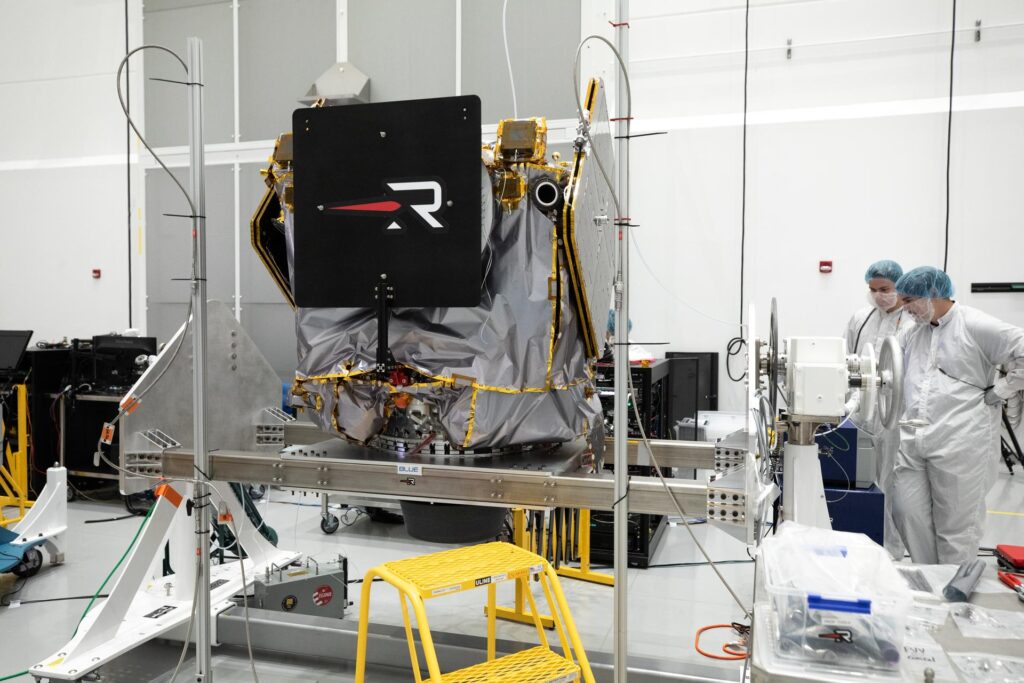
Miss a launch window to Mars and the usual penalty is a 26-month wait on the ground. NASA’s twin ESCAPADE spacecraft took another path: they launched anyway in November 2025, spent a year parked far from home, and are now using a powered ESCAPADE Earth flyby to fling themselves towards the Red Planet. The first of the pair was scheduled to fire its engine at 09:51 GMT on 7 November 2026, with its twin following on 9 November.
According to NASA’s mission blog, each fridge-sized spacecraft passes between about 965 and 1,770 km above the surface. That is higher than most satellites. At closest approach, over southern Australia, each fires its engine for around nine minutes, raising its speed from about 10.1 to 10.8 km/s. NASA says no agency spacecraft has flown a powered flyby like this before. The mission is led by Rob Lillis of the Space Sciences Laboratory at the University of California, Berkeley, and the spacecraft were built by Rocket Lab.
The physics behind it is the Oberth manoeuvre. A rocket burn adds the most energy when a spacecraft is already moving fastest, and a probe swinging past a planet peaks in speed at closest approach. Earth supplies the speed; the engine turns it into a bigger kick than the same burn could manage in deep space. The detour was forced at launch, when Earth and Mars sat on opposite sides of the Sun, so the pair spent the year on a kidney-bean-shaped loiter orbit around Lagrange point 2, a gravitational balance point about 1.5 million km away.
At Mars, Blue and Gold, as Berkeley calls them, will be the first spacecraft to fly in formation around the planet. They will measure how the solar wind, the stream of charged particles from the Sun, interacts with Mars and helps strip away its atmosphere. Watching from two places at once lets scientists separate changes in space from changes in time, something a lone orbiter cannot do. The waiting year was not wasted either: the pair crossed a distant stretch of Earth’s magnetotail, the field swept downwind by the solar wind, that no spacecraft had sampled directly.
None of this pays off quickly. After the burns come trajectory corrections and a cruise of about 10 months, with arrival due on 7 and 9 September 2027. NASA had not reported the outcome of the first burn at the time of writing, and the second still lies ahead. The magnetotail results are also promised rather than published.
If the burns go to plan, a missed launch window becomes a scheduling problem rather than a two-year sentence. The waiting room, it turns out, came with a slingshot.
