

The standard model of cosmology predicts that the space around the Milky Way should be crowded with clumps of dark matter far smaller than any known galaxy. Most of them should contain no stars at all, which makes them awkward to find: a halo of invisible matter with nothing shining inside it gives a telescope nothing to look at. Some of the smallest, though, may have held on to a thin ball of hydrogen. A team using China’s giant FAST radio telescope now reports a dark galaxy candidate of exactly that kind, sitting on its own about 12 million light-years away.
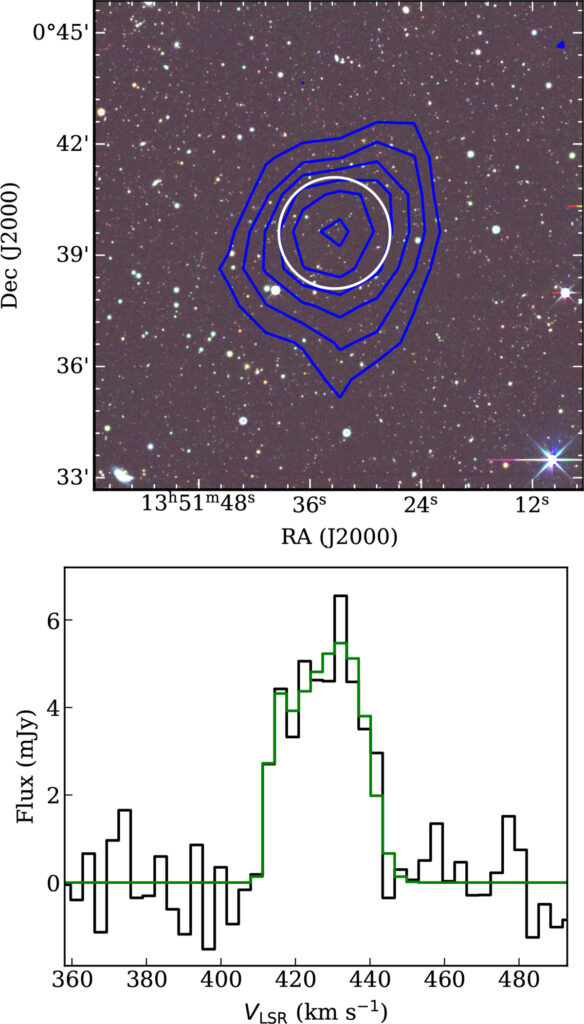
Catalogued as J1351+0039, the object is described in a letter published in Astronomy & Astrophysics on 9 November 2026. Jin-Long Xu of the National Astronomical Observatories of the Chinese Academy of Sciences and Alejandro Benítez-Llambay of the University of Milano-Bicocca led the work. The cloud turned up in a blind survey with the Five-hundred-meter Aperture Spherical radio Telescope (FAST), which listens for the 21 cm radio line given off by neutral hydrogen. Repeat observations in July and August ruled out radio interference. Deep optical images from the DESI Legacy Survey show nothing at the position except unrelated background galaxies.
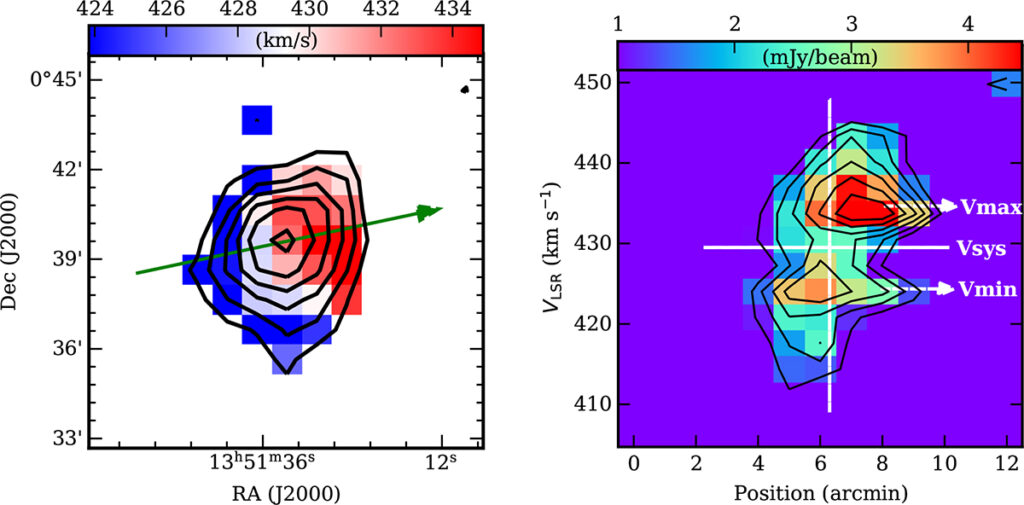
By galactic standards the hydrogen is a trifle, weighing about 450,000 times the mass of the Sun. What matters is how it moves. The cloud rotates at only about 4 km/s, while random motions inside it reach roughly 12 km/s, so it is held up mainly by its own pressure, like a warm bubble, rather than by orbiting in a disc. Balancing that pressure against gravity, the team estimates a total mass of about 130 million Suns within 2.8 kiloparsecs (about 9,000 light-years) of the centre. That is around 200 times the mass of its gas and any stars combined. The optical images cap any stars at roughly 120,000 solar masses.
Theorists have a name for this kind of object: a RELHIC, or reionisation-limited H I cloud, where H I is astronomers’ shorthand for neutral hydrogen. Once the first stars and galaxies switched on, their ultraviolet light flooded the Universe and heated the gas between galaxies. Haloes below a certain mass were too feeble to squeeze that warm gas into a core dense enough to form stars. They kept a puffy, pressure-supported ball of hydrogen and nothing else. The cloud’s gas has a kinetic temperature of about 11,000 K, which fits that picture.
Cloud-9 is the best known earlier candidate. In January this year, Hubble images confirmed that this hydrogen cloud, first found by FAST, contains no stars. Benítez-Llambay, principal investigator on that study, called it “a tale of a failed galaxy”. Cloud-9 sits on the outskirts of the spiral galaxy Messier 94 (M94), where a large neighbour could complicate the story. J1351+0039 has no catalogued galaxy within about three degrees of sky, roughly 200 kiloparsecs at its distance. Explanations that need a neighbour, such as gas torn from a passing galaxy, lose their footing. Its velocity of 429 km/s and symmetric shape also rule out a stray hydrogen cloud inside our own galaxy.
The fit is not perfect, and the authors say so. Models predict that a RELHIC’s hydrogen line should be about 22 km/s wide; this one measures 27.6 km/s, and even weak rotation is unexpected. The cloud spans only about two widths of the FAST beam, so blurring could hide its internal structure. The bigger worry is starlight too faint for DESI to see. Leo T, a dwarf galaxy near the Milky Way, has a similar amount of hydrogen and about 200,000 Suns’ worth of diffuse stars that would sit below these images’ limits. If J1351+0039 hides a population like that, it is a very faint galaxy rather than a failed one.
Settling the question needs deeper imaging, and the team names Hubble and the James Webb Space Telescope (JWST) as the tools for it. The distance is uncertain by about 20 per cent too, which feeds directly into every mass estimate. Both outcomes would be useful. A faint dwarf would extend the census of the smallest galaxies. A confirmed RELHIC far from any large galaxy would be a clean test of how dark matter behaves where nothing else gets in the way.
For now J1351+0039 is a warm ball of hydrogen drifting through intergalactic space. If the theory is right, it has looked much the same since the first starlight closed the door on its chance of becoming a galaxy. Proving that is an unusual job for a telescope: showing, as convincingly as possible, that there is nothing there to see.
