

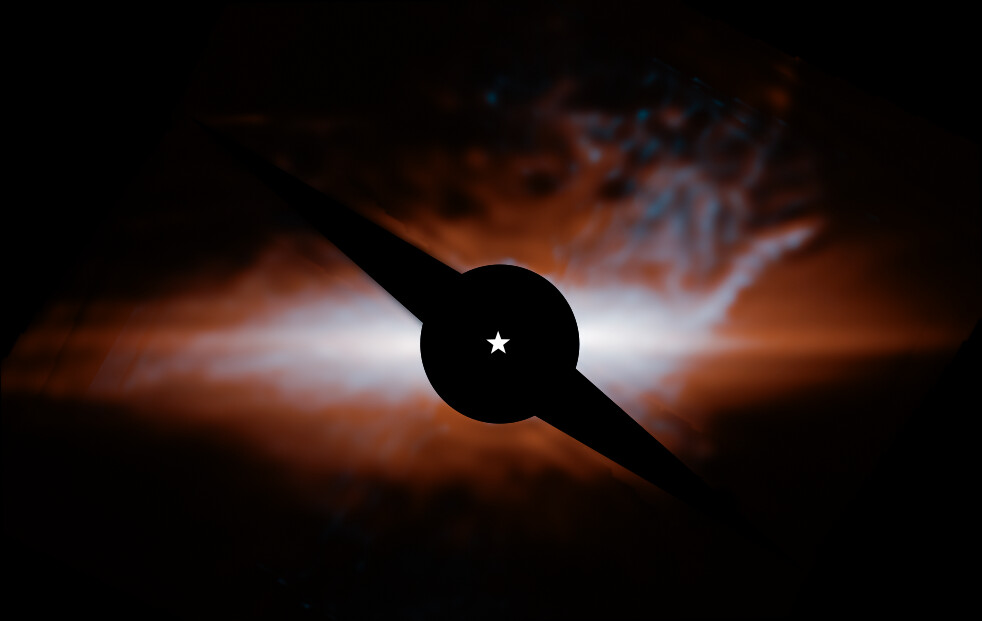
Water is easy to find in a young planetary system. Its history is much harder to read. A new study of Beta Pictoris ice, made with the James Webb Space Telescope (JWST), suggests that the frozen water around this nearby star may have formed in cold interstellar clouds before the star itself existed, and has stayed largely unaltered ever since.
The work, published in Science, analyses near-infrared spectra of the star’s debris disc, a flattened ring of dust and rubble left over from planet building that we happen to see almost edge-on. Beta Pictoris lies about 63 light-years away and is roughly 20 million years old, a toddler next to the 4.5-billion-year-old Solar System. The team, which includes astronomers at the Space Telescope Science Institute, used Webb’s NIRSpec instrument to pick out the absorption features that frozen molecules stamp on starlight scattered by the dust.
Two ices turned up. The water ice is almost entirely amorphous, meaning its molecules are jumbled rather than locked into a crystal lattice; less than 7% of it is crystalline, according to the data and summary the authors released with the paper. Carbon dioxide ice is there too, in two isotopic forms, mixed into the water at roughly one part in 10. That jumbled structure is the clue. Ice that is warmed reorganises into crystals, so disordered ice implies material that formed and stayed very cold, conditions the authors link to the interstellar medium, the thin gas and dust between stars.
Another young system makes a telling comparison. In 2025 Webb confirmed crystalline water ice around HD 181327, a Sun-like star about 155 light-years away and about 23 million years old. Two discs of similar age appear to hold ice with very different thermal histories.
The catch is that an interstellar origin is an inference from the ice’s structure, not a measurement of its age. The authors also argue that frequent collisions between icy bodies are needed to explain why the ice is spread so evenly across the disc; that too is a model rather than a direct observation. A follow-up Webb programme led by Christine Chen of Johns Hopkins University will take sharper spectra across the disc, aiming to settle where the ices came from and how they have been processed.
If the reading holds, some of the water around Beta Pictoris is on loan from the galaxy. It was carried into a new planetary system and is still frozen in the shape it took between the stars.
