

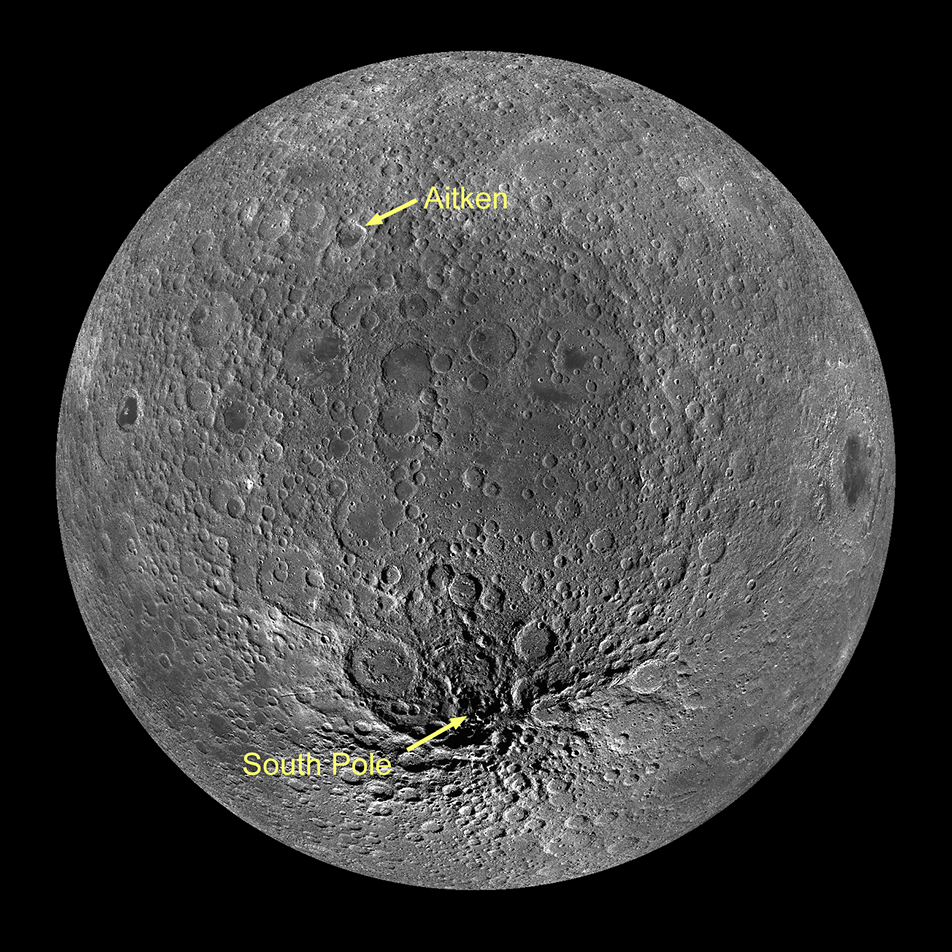
On the far side of the Moon lies the oldest and largest impact scar it carries. The South Pole-Aitken basin measures roughly 2,050 by 2,400 kilometres and drops about 12 kilometres deep. Working out when it formed, and what it dug up, matters well beyond lunar geology. A new analysis of soil returned by China’s Chang’e-6 mission now gives the most detailed account yet of how the basin changed after the blow, and it takes a side in a running argument about its age.
The study, led by Yuqi Qian and Guochun Zhao at the University of Hong Kong, was published in Science Advances on 18 November 2026. It combines three kinds of evidence. Grains from the Chang’e-6 samples, the first material ever brought back from the far side, were analysed in the laboratory. Spectra recorded on the surface by the Chang’e-4 rover Yutu-2 and the Chang’e-6 lander were added, along with orbital maps and computer models of how crater debris spreads. Collaborators included Brown University, the University of Münster and the European Space Agency, according to the university’s release.
Neither landing site, however, sits on rock the basin itself produced. Chang’e-4 touched down in Von Kármán crater, and Chang’e-6 on a lava plain inside the Apollo basin, a later crater nested within the larger one. Both sites are blanketed in debris thrown in by younger impacts. The team’s models show that the rover is driving across about 4.6 metres of material flung out by Finsen, a crater 73 kilometres wide that formed around 3.1 billion years ago. At the Chang’e-6 site, roughly 15 centimetres of debris came from a crater called Chaffee S, making up 16 to 18 per cent of the soil by volume.
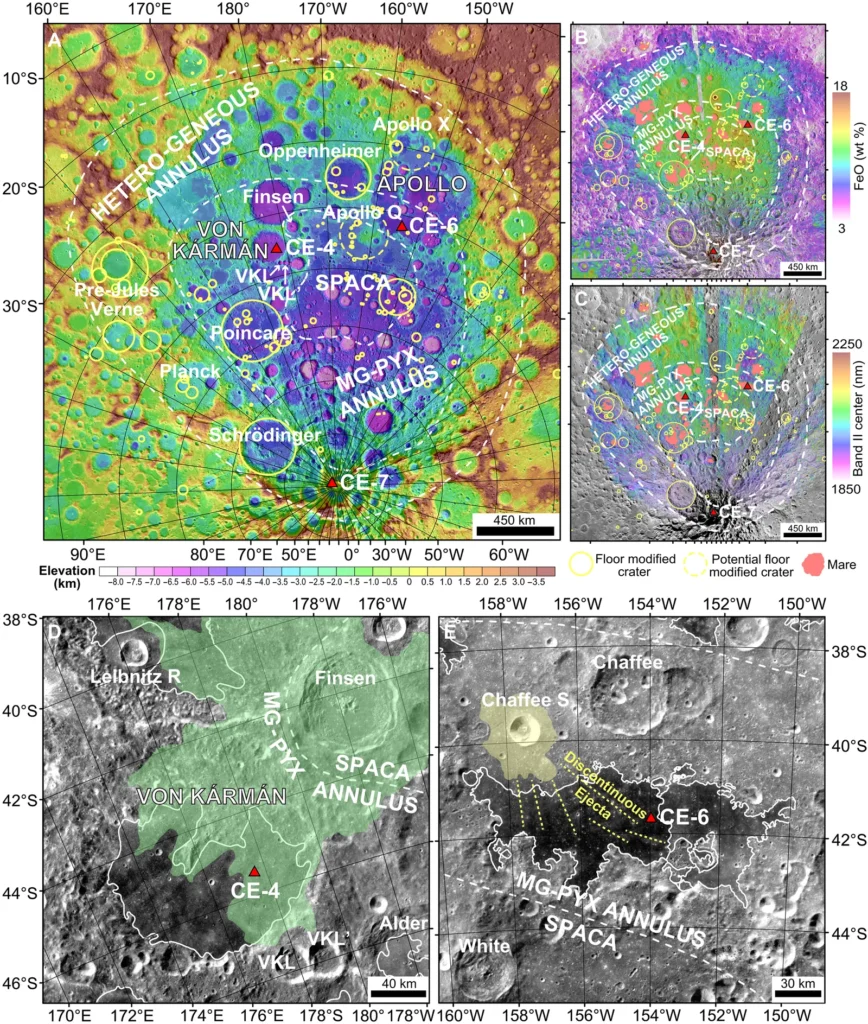
That borrowed material comes in two flavours. Geochemists track it with a value called Mg#, the share of magnesium among the magnesium and iron atoms in a mineral. Across nearly 42,000 pyroxene grains from Chang’e-6, the values cluster in two peaks. One, near 62, matches the local lava. The other, near 84, belongs to an added rock called norite. The rover spectra show that the Finsen debris is only moderately rich in magnesium, much like the central peaks of large craters across the basin floor, while Chaffee S delivers something richer still.
The authors read these as two separate origins. The moderate rocks, they argue, crystallised from the vast pool of melt the original impact left behind, a sheet hundreds of kilometres across that cooled and separated into layers. The richer rocks look like the products of magma that pushed into the crust from below, part of a family geologists call the Mg-suite. The Apollo impact later excavated them onto its western peak ring, where Chaffee S picked them up and scattered them towards the lander.
Ages from earlier sample studies then fall into a sequence. The team places the basin’s formation at about 4.34 billion years ago, the Apollo impact at about 4.2 billion and the Orientale impact at about 3.87 billion. That last figure had previously been read as the age of the Apollo basin itself; the new modelling attributes it instead to debris from Orientale. The stakes are larger than a date. The giant impact may have stirred the lunar mantle enough to push heat-producing elements towards the near side, which could help explain why the two hemispheres look so different. Its age is also an anchor for the lunar cratering clock, the scale planetary scientists use to date surfaces elsewhere.
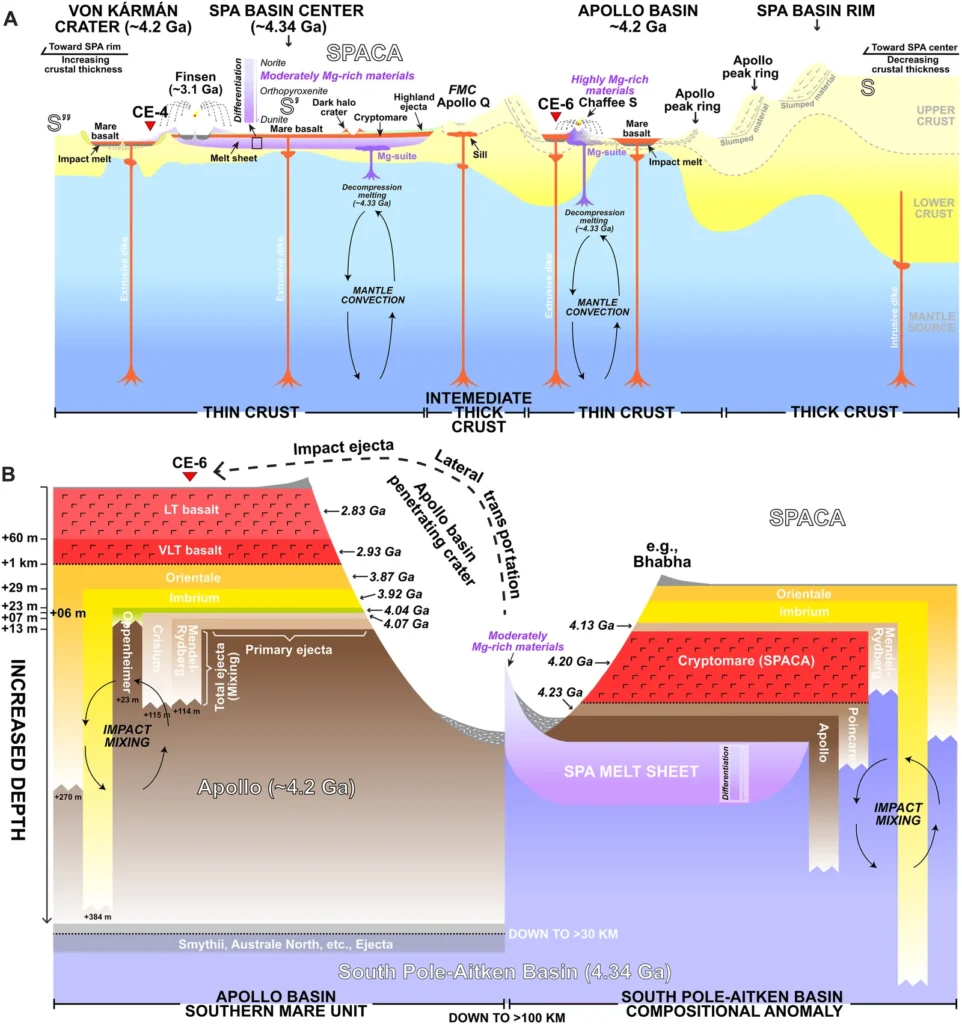
The catch is that 4.34 billion years is an inference rather than a fresh measurement. The study argues that the basin must predate rocks reset by the Apollo impact at around 4.25 billion years, and it points to Mg-suite fragments dated to 4.34 billion years and one impact melt rock dated to 4.33 billion, with an uncertainty of 65 million years. A 2025 study of Chang’e-6 norites reached a different answer, dating the basin to 4.25 billion years. The authors also concede that two landing sites may not represent a basin this size, and that comparing grains, rover readings and orbital maps means mixing very different scales.
More ground truth is on the way. Chang’e-7 and Artemis IV are headed for the basin’s rim near the lunar south pole, and the proposed Endurance rover would drive across its interior. Until then, the largest crater on the Moon is being read through about a gram of returned soil, most of it carried in by craters that formed billions of years after the blow.
